
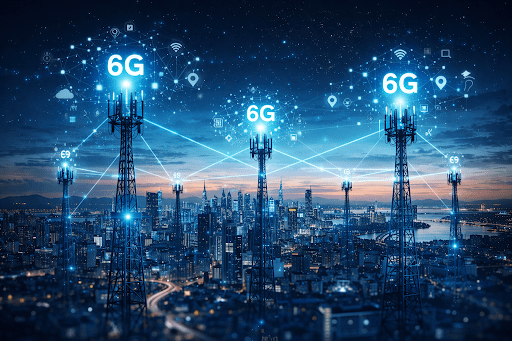
New Delhi, India—2026: The best tech giants, governments, and research organizations are putting all efforts into coming up with the next generation of wireless communication commonly referred to as 6G technology. Being the next generation of 5G technology, 6G promises to bring unparalleled speeds, insanely low latencies, and connectivity that may change the world in industries, economies, and day-to-day life. Although 5G networks have been developing widely in most regions, scientists across the world are already striving to come up with the 6G generation, which is expected to be commercially launched around the year 2030. Limited experiments and theoretical studies indicate that 6G networks can be 100 times faster than the existing 5G technology and can transmit vast amounts of data and intelligent systems. The experts in the industry think that the evolution of 6G would be very instrumental in the future in maintaining emerging technologies like artificial intelligence, smart cities, immersive virtual worlds, autonomous transportation, and advanced healthcare systems.
Worldwide Partnerships that are Powering 6G
A wide group of technology companies, universities, and government agencies are leading the development of 6G technology. The United States, China, Japan, South Korea, and Finland, among other countries, are also spending much on research projects aimed at next-generation connectivity. Samsung, Nokia, Huawei, and Ericsson are technology corporations that are currently venturing into new network designs, improved spectrum management, and novel hardware platforms that will be needed to support 6G technology infrastructure. The international collaboration is also being enabled via agencies like the International Telecommunication Union that assists in coordinating international telecommunication standards as well as future network development.
The main technologies that drive the 6G era.
It is anticipated that 6G technology will have a number of advanced innovations that are way ahead of existing mobile networks.
Terahertz Spectrum Communication.
The use of terahertz (THz) frequency bands is one of the most significant innovations under consideration in 6G networks. These ultrahigh frequencies have the potential of providing blazingly fast wireless data communications, thus allowing networks to handle data rates of up to 1 terabit per second.
Intelligent Networks of Artificial Intelligence.
It is anticipated that the 6G networks to be developed in the future will contain elaborate artificial intelligence systems that will be able to self-manage network traffic, link optimal connectivity, and enhance security. The AI-based networks will enable the systems to have a way of self-correcting themselves and stay at high performance despite the high usage.
Holographic Communication and Immersive Media.
The new possibilities of digital communication that 6G can create include holographic video calls in real-time and holographic immersive experiences that are entirely real due to the technologies of virtual reality and augmented reality. These innovations would revolutionize industries in remote education, entertainment, healthcare, and business collaboration.
The Revolutionizing Industries with High-level Connections.
The influence of the 6G technology will be felt in various industries, and this will allow innovation and efficiency to be unlocked.
Smart Cities and Infrastructure
Smart Cities and Infrastructure Smart cities include information and communications technologies (ICTs) that are integrated into their environment. <|human|>Smart Cities and Infrastructure Smart cities consist of information and communications technologies (ICTs) that become part of the environment of the city. Smart technologies are now being implemented in cities around the globe to enhance transportation, energy management, and the safety of the people. 6G networks have the potential to ensure that thousands of connected sensors and devices work in tandem in an urban setting.
Autonomous Transportation
One of the exceptional low-latency features of 6G is the need to communicate between vehicles, the infrastructure, and the cloud-based system at a very high speed to enhance the safety and efficiency of autonomous transportation systems.
Healthcare and Remote Medicine.
Telemedicine, remote robotic surgeries, and real-time patient monitoring systems are the areas of healthcare that might be transformed significantly by the 6G technology. Such technologies may enhance quality healthcare access, especially in remote and rural areas.
Problems with 6G Technology Development.
Although the 6G networks have potential, a number of technical and regulatory challenges exist. Researchers are faced with challenges in the area of energy consumption, proliferation of the signals at very high frequency, and the cost of constructing new infrastructure. Also, governments and international bodies should work together to assign spectrum and come up with international standards to allow interoperability among the networks. Cybersecurity will be a significant issue too since the networks are increasingly becoming complex and interrelated. There will be a need to have strong security frameworks to prevent the security of critical data and digital infrastructure.
The Future of 6G Connections.
Even though 6G technology is in its research and development stage, it is improving at a very fast rate. Analysts believe the preliminary full-scale trial and pilot programs will occur later this decade with commercial implementation occurring around 2030. The 6G technology has the potential to transform the world into a place where every corner is connected, and with the possibility of revolutionizing communication across the world, 6G technology may be adopted to allow innovations that seemed to be impossible before. With ongoing collaborations between governments, technology firms, and study institutes, the world is on the path of approaching the 6G age, which is the one that is likely to transform communication, technology, and the world economy.
Frequently Asked Questions (FAQ)
What is 6G technology?
The sixth generation of the wireless communication technology that is likely to replace the 5G technology is known as “6G technology,” which promises to provide much higher speeds, reduced latency, and great connectivity options.
What is the expected time of 6G networks?
The majority of analysts believe that the 6G networks might start to be commercially available in the year 2030.
What are the leaders in 6G research?
Other countries such as the United States, China, Japan, and South Korea are the leading countries in 6G research and development.
What is the expected speed of 6G in relation to 5G?
The 6G networks will be approximately 100 times faster than the 5G technology and may have a speed of up to one terabit per second.
Which industries will 6G technology be useful in?
The healthcare, transport, education, entertainment, and smart city infrastructure industries are likely to be greatly improved with the help of 6G connectivity.