
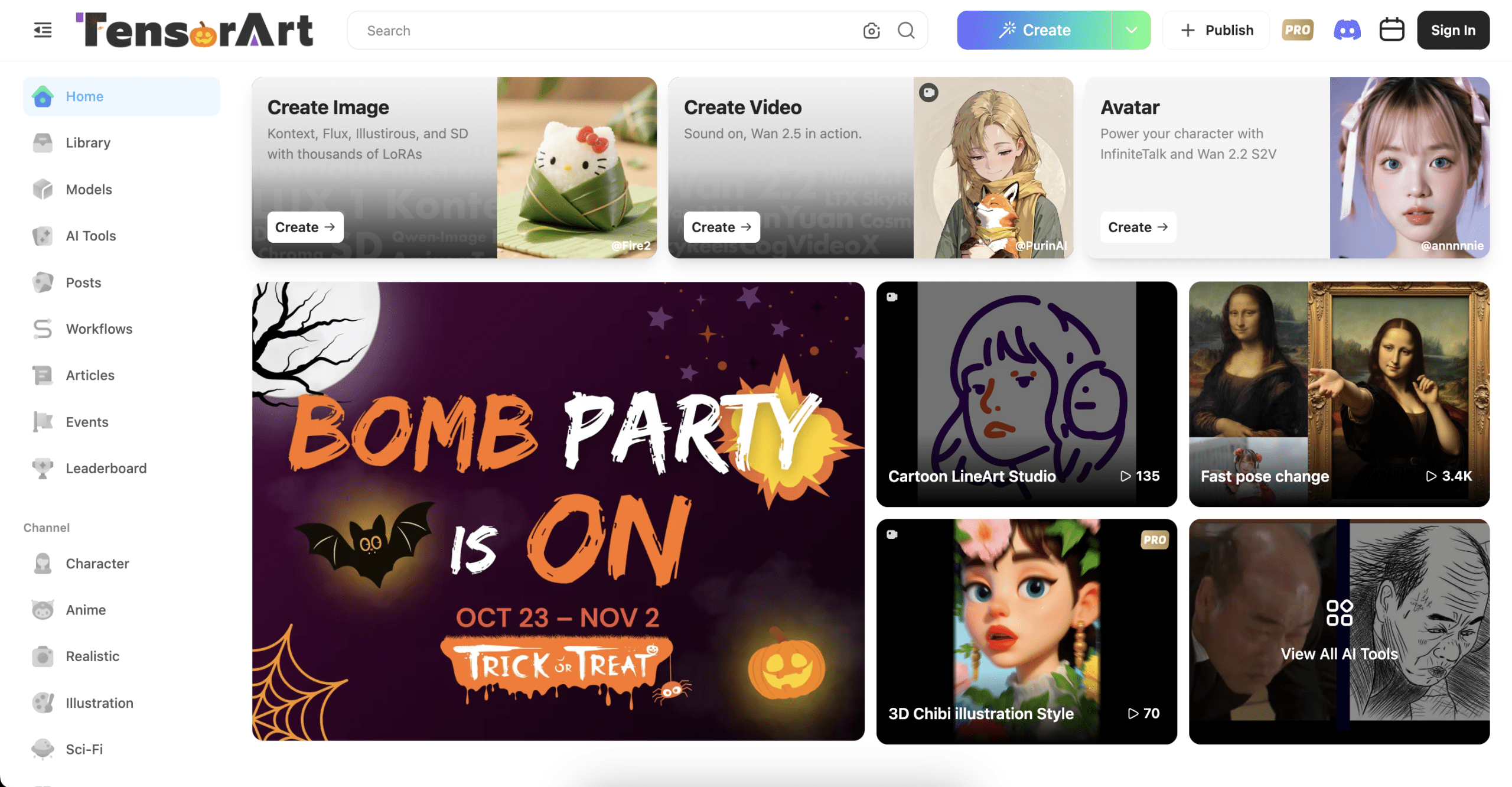
Excerpt: Tensor.Art unifies creator tools and developer workflows with SD/SDXL/FLUX support, LoRA, and model hosting, as well as image refinement, early video pipelines, and TAMS APIs that precisely meter costs by resolution, steps, and model coefficients for predictable scale-up.
What is Tensor.Art
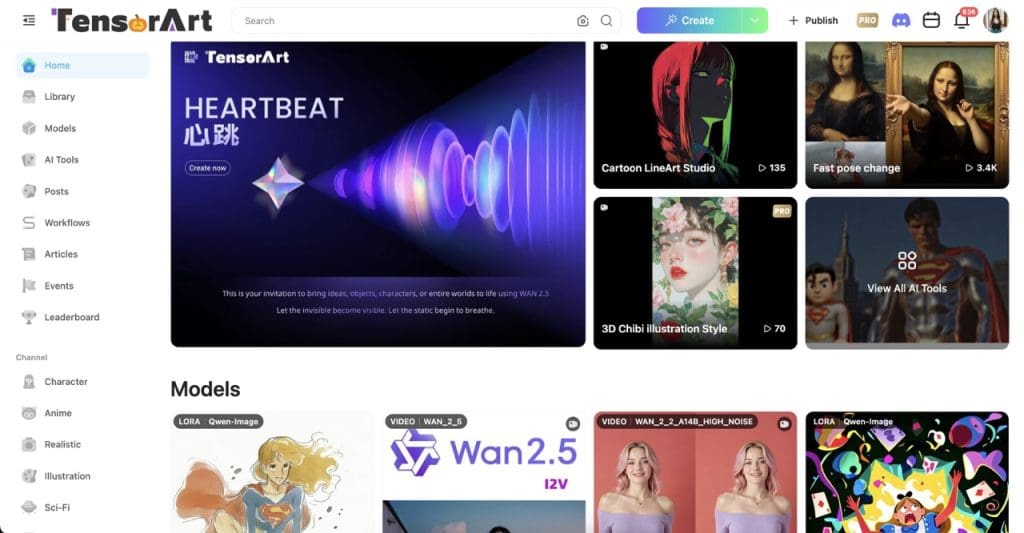
Tensor.Art is an AI image generation and model hosting platform built around the Stable Diffusion ecosystem, enabling text-to-image, image-to-image, and style-consistent creation with LoRA and community-shared models at its core. Reviews consistently highlight image upscaling, denoising, and marketplace features that let creators share or monetize models and outputs within a vibrant community.
What’s new in 2025
Tensor.Art’s TAMS introduces cloud inference with SD WebUI‑like and ComfyUI‑like APIs so teams can build complex pipelines without managing local GPUs or infrastructure. Official docs also detail coefficients and pricing behavior for SD, SDXL, and FLUX, plus named video diffusion options such as HunyuanVideo, CogVideoX, and LTX‑Video, including model‑specific fast‑mode discounts.
Core features for creators
- Text‑to‑image and image‑to‑image generation using SD/SDXL and community models for styles from photorealistic to anime and abstract.
- Image refinement via upscaling and denoising to reach production‑quality fidelity for social, ads, and brand assets.
- Model hosting and marketplace support for Checkpoints and LoRA to share, remix, and monetize within an active community.
- Advanced workflows with ComfyUI‑style pipelines through the cloud, aligning with professional node‑based control without local setup.
Developer workflows and credit control
TAMS exposes SD WebUI‑like and ComfyUI‑like APIs, enabling orchestration of multi‑stage pipelines (generation, upscaling, detail passes, and video) via deterministic credit rules rather than opaque GPU minutes. Credit pricing follows published formulas that scale with width, height, steps, image count, and a model factor where SD/SDXL are one and FLUX is documented at 2, allowing precise budget planning across workloads.
How the credit math works
Docs specify that diffusion stage cost grows with steps and image count, plus a model factor, while refiners and upscalers add resolution‑based terms for transparent accounting across the pipeline. In formula terms, a core component follows MODEL_FACTOR×COUNT×(⌈STEPS/5⌉/5)MODEL_FACTOR×COUNT×(⌈STEPS/5⌉/5), with video pricing keyed to frame count, model coefficients, and any applicable fast‑mode discounts per model.
Pricing and plans
Third-party reviews mention a free daily credit allowance and available Pro subscriptions. The standard entry tiers start at about $9.90 per month, and there are flexible credit packs for heavier use. However, specific bundles can change over time and by region. Developer documentation states a baseline of $0.003 per credit for TAMS, allowing teams to estimate image and video costs based on parameters before deciding to scale.
Mobile apps and on‑the‑go creation
Tensor.Art offers an iOS app and an Android presence, extending browsing, generation, and community access beyond desktop to support quick iterations and inspiration. Mobile availability complements the web experience, which remains the most feature‑complete environment for advanced workflows and bulk production.
Why creators pick Tensor.Art
- Rapid ideation with SD/SDXL, LoRA, and community prompts accelerates learning curves and shortens creative cycles for social‑ready media.
- Built‑in refinement tools reduce dependency on external editors for upscaling and cleaning, improving consistency and speed.
- Marketplace dynamics reward quality models and settings, increasing discoverability and potential monetization for creators.
Why developers adopt TAMS
- API-first design, similar to SD WebUI and ComfyUI, streamlines integration and reduces DevOps friction.
- Transparent credits and model coefficient tables enable predictable cost control across image and video pipelines at scale.
- Rapid access to modern models—including FLUX and documented video options—without GPU provisioning or version churn locally.
Midjourney vs Tensor.Art
| Dimension | Midjourney | Tensor.Art |
|---|---|---|
| Access model | Web app and Discord interface for prompting and generation | Browser UI plus documented SD WebUI‑like and ComfyUI‑like APIs for orchestration |
| Model ecosystem | Proprietary model family curated for aesthetics and ease of use | Open SD/SDXL/FLUX ecosystem with LoRA/Checkpoint hosting and community remixing |
| Developer focus | No credit‑formula style cost controls publicly documented for pipelines | Explicit credit math, model coefficients, and video model docs for planning |
| Learning path | Strong outcomes with an opinionated workflow and community showcases | Inspectable prompts/settings, model hosting, and API workflows for iterative learning |
Use cases
- Social and ad creatives that need fast concepting, style control, and high‑quality upscales without round‑tripping through multiple tools.
- Brand‑consistent portraits or product visuals guided by LoRA and ControlNet‑style assets for pose and composition control.
- Automated pipelines for bulk generation, refinement, and video clips driven by TAMS APIs and predictable credit budgeting.
Getting started
Create a free account to receive daily credits, explore trending prompts, and duplicate working settings as a starting point for your own style. Teams can request TAMS credentials, select SD/SDXL/FLUX or a supported video model, and estimate per‑job costs using the published formulas before moving workloads into production.
FAQs
Q: Does Tensor.Art support SDXL, LoRA, and ControlNet‑style guidance?
A: Yes, SDXL and LoRA are core to the platform with model hosting and community sharing, and workflows align with ControlNet‑style structure control for consistent outputs.
Q: Can Tensor.Art do video generation?
A: TAMS documents video diffusion using models like HunyuanVideo, CogVideoX, and LTX‑Video, with model‑specific coefficients and fast‑mode discounts.
Q: Is there a free plan?
A: Reviews note free daily credits for casual use, alongside affordable Pro tiers and add‑on credit packs that scale for heavier workloads.
Q: Is there a mobile app?
A: Yes, Tensor.Art is available on iOS, offering on‑the‑go generation and community access, while the web app remains best for advanced workflows.