

Why Temple Homeowners Face Unique HVAC Challenges
In Central Texas, air conditioning isn’t just about comfort—it is a necessity for safety and survival. When the heat spikes, finding reliable HVAC repair services becomes urgent. Whether you own a historic bungalow near Downtown Temple or a newer build in the West Temple growth corridor, your cooling system faces a workload that few other regions in the country can match.
For most of the country, an air conditioner runs seasonally. However, systems in Temple often operate for 8 to 10 months of the year, battling triple-digit heat indices from May through September. This intense, prolonged usage puts accelerated wear and tear on compressors, capacitors, and coils, meaning that units in Bell County often age faster than the national average.
The Repair vs. Replace Dilemma
Because our systems work so hard, local homeowners frequently find themselves at a crossroads: Do you pour money into another repair for an aging unit, or is it time to invest in a modern, energy-efficient system?
Making the wrong choice can be costly. Repairing a dying unit can result in a “money pit” scenario, while replacing a unit too early can be an unnecessary expense. To make the best financial decision, you must evaluate three critical factors:
- SEER Ratings: Understanding how older technology (SEER 10-13) compares to the efficiency of new SEER2 standards.
- Cost Thresholds: Knowing the mathematical “tipping point” where a repair bill exceeds the value of the unit.
- Long-Term Efficiency: recognizing that rising temperatures and population growth in Temple are driving up energy demands, making efficiency more important than ever.
As demand for both emergency repairs and AC replacement Temple TX continues to rise alongside our local population, understanding the lifecycle of your HVAC system is the best way to protect your home and your wallet. In this guide, Lynx HVAC Repair Temple will help you navigate the numbers so you can make a confident decision.
Evaluating Your Current System: Age, Performance, and SEER Rating
Determining whether to repair or replace starts with a hard look at what you currently have installed. In the mild climates of the Pacific Northwest, an air conditioner might last 20 years. But here in Temple, TX, where summer temperatures frequently soar above 100°F, the life expectancy of an HVAC unit is significantly shorter—typically 10 to 15 years.
If your system is approaching that decade mark, it’s time to evaluate its performance against modern standards.
The “Temple Timeline”: Age Matters
Think of your air conditioner like a car. A 12-year-old car with 200,000 miles is different from a 12-year-old car with 50,000 miles. Because Temple HVAC systems run for thousands of hours annually to combat our long cooling season, a 12-year-old unit here has seen “heavy mileage.”
- 0–10 Years: Usually requires only routine maintenance and minor repairs (capacitors, contactors).
- 10–15 Years: Major components (compressor, coils) begin to fail; efficiency drops significantly.
- 15+ Years: You are likely on “borrowed time,” with a high risk of catastrophic failure during a heatwave.
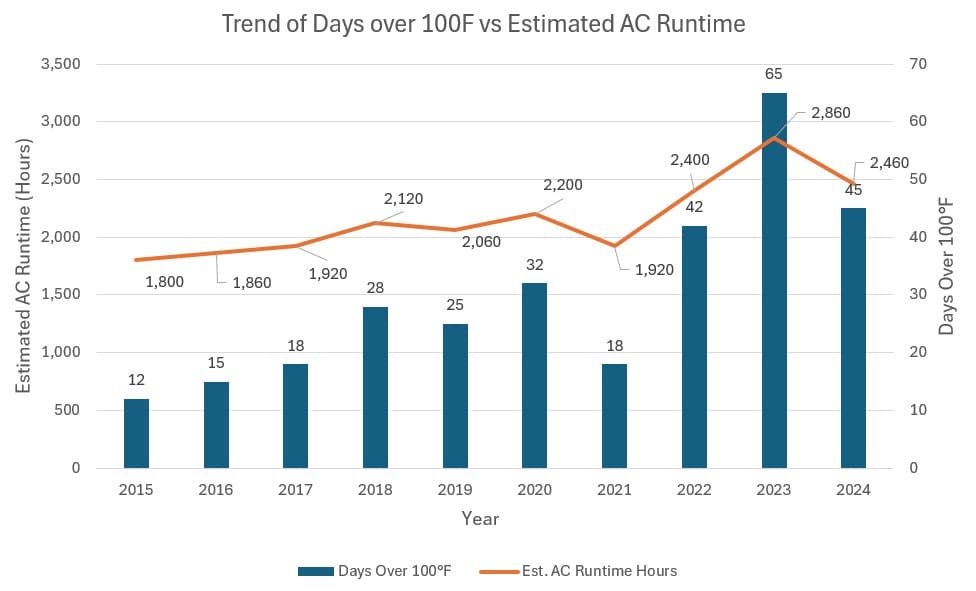
Figure 1: The Heat Stress Effect: A ten-year analysis showing how rising days over 100°F in Central Texas have drastically increased the annual runtime—and wear and tear—on residential AC systems.
Decoding the SEER Rating
The most critical metric for evaluating your system is its SEER (Seasonal Energy Efficiency Ratio) rating. This number measures how efficiently your unit converts electricity into cooling power—higher numbers mean lower bills.
- SEER 8–10 (The Dinosaurs): Common in units installed before 2006. These are energy guzzlers. Replacing one of these can lower your cooling costs by up to 50%.
- SEER 13–14 (Standard): The standard for the last decade. Reliable, but far less efficient than today’s technology.
- SEER2 14.3+ (The New Standard): As of 2023, the DOE introduced SEER2, a more rigorous testing standard. Modern systems installed by Lynx HVAC Repair Temple—including those from innovative manufacturers like First Co.—meet these higher benchmarks, offering superior humidity control—a must for the muggy days we get in the Garden District.
Lynx Insight: If you don’t know your SEER rating, look for the yellow “EnergyGuide” sticker on the side of your outdoor condenser unit. If the sticker is faded or missing, the unit is likely old enough to warrant an upgrade discussion.
Silent (and Noisy) Signs of Decline
Age and SEER rating are on paper, but your daily experience matters too. Watch for these physical signs that your system is losing the battle against the Texas heat:
• Rising Energy Bills: If your usage hasn’t changed but your bill has jumped 20% over last summer, your system is working harder to do the same job.
• Humidity Issues: A healthy AC doesn’t just cool; it dehumidifies. If your home feels “clammy” or sticky even when the thermostat reads 72°F, the compressor is losing efficiency.
• Weak Airflow: If the air coming out of your vents feels like a gentle breath rather than a strong breeze, it could indicate a failing blower motor or clogged coils.
• Strange Noises: Grinding, squealing, or banging sounds are often the “death rattle” of a compressor or fan motor—issues we also see frequently during furnace repair season in the winter.
The Repair-Cost Threshold: When Fixing Your AC No Longer Makes Financial Sense
Every homeowner in Temple dreads that moment: the technician hands you an invoice, and the total makes you wince. Is it worth spending $800 today to fix a system that might break again next month?
At Lynx HVAC Repair Temple, we use a simple financial guideline to help our customers navigate this choice without emotion getting in the way. We call it the 50% Rule
The 50% Rule
The logic is straightforward: If the cost of the repair equals 50% or more of the value of a new system (or the current value of your existing unit), you should replace it.
Why? Because putting significant money into an aging machine is like putting a brand-new engine into a car with a rusted-out frame. You are fixing one part, but the rest of the system is still tired, worn, and inefficient.
Breaking Down the Costs: Minor vs. Major
Not all breakdowns are created equal. Here is how we categorize repairs when advising clients in neighborhoods like Canyon Creek or Midway:
- The “Go-Ahead” Repairs ($150 – $450):
- Issues: Failed capacitors, contactors, blown fuses, or minor sensor issues.
- Verdict: If your system is under 12 years old, these are standard maintenance costs. Fix it and keep going.
- The “Danger Zone” Repairs ($1,200 – $2,500+):
- Issues: Failed compressor, leaking evaporator coil, or a bad blower motor on an out-of-warranty unit.
- Verdict: This is where you need to pause. Spending $2,000 on a 12-year-old system is risky. If you proceed, you still have a 12-year-old unit that could fail again next week.
The “Hidden” Costs of Old Systems
The invoice isn’t the only cost. Old systems in the Temple, TX heat act as a silent drain on your bank account.
- Energy Inefficiency: A 15-year-old unit (SEER 10) costs roughly 40% more to operate than a modern SEER2 unit. That difference often amounts to $50–$100 per month during a Texas summer.
- R-22 Refrigerant: If your older unit has a refrigerant leak and uses the phased-out R-22 (“Freon”), the cost to refill it is astronomical due to environmental regulations. Investing in R-22 is rarely a wise financial move.
Comparison: Repair vs. Replace
Let’s look at a real-world scenario for a homeowner with a 12-year-old system facing a compressor failure.
| Factor | Option A: Repair the Old Unit | Option B: AC Replacement |
| Upfront Cost | $2,200 (Compressor Replacement) | $6,000 – $9,000 (New System Est.) |
| Warranty | 1 Year (Part only) | 10 Years (Parts & Major Components) |
| Monthly Energy Bill | Remains High ($350+) | Drops significantly ($200 – $250) |
| Reliability | Low (Other parts may fail soon) | High (Peace of mind) |
| 3-Year Outcome | High risk of spending more money. | System pays for part of itself in savings. |
Lynx Recommendation: If you are facing a major repair bill on a system that struggles to cool your home during the August heat, AC replacement Temple TX is almost always the smarter financial path. The monthly energy savings alone often offset a portion of the monthly payment for a new system.
Conclusion: How to Make the Right Call for Your Temple Home
Deciding between another repair and a full replacement is never easy, but in Temple, TX, timing is everything. The worst time to make this decision is when your AC dies on a Friday afternoon in August with heat index values hitting 105°F.
At Lynx HVAC Repair Temple, we advocate for proactive care. If your system is showing its age, don’t wait for a total breakdown.
- Choose Repair if your unit is under 10 years old, under warranty, and the fix is minor.
- Choose Replacement if your unit is over 12 years old, inefficient, and facing a costly repair.
Whether you need a quick diagnostic to get a few more years out of your current unit or a free estimate on a high-efficiency upgrade, our team is here to give you honest, no-pressure advice.
Ready to Restore Your Comfort?
Stop worrying about whether your AC will make it through the summer.
Contact Lynx HVAC Repair Temple Today
- Call us for Fast HVAC Repair: We diagnose issues quickly to get your home cool again.
- Ask for a Free Replacement Estimate: Let us show you how much you can save with a new high-efficiency system.
Lynx HVAC Repair Temple
254-500-3188
2807 Blue Meadow Dr., Temple, TX 76502
