
The global appetite for premium coffee is evolving. While the café experience remains vital, the convenience of single-serve options—specifically coffee capsules and drip bags—has created a lucrative revenue stream for roasters. However, as order volumes swell from hundreds to thousands, the romantic notion of “hand-crafted” packaging quickly becomes a logistical bottleneck.
For emerging roasters and beverage entrepreneurs, the transition from manual labor to automated precision is not just an operational upgrade; it is a prerequisite for survival in a competitive market.
The Equipment Landscape for Emerging Roasters
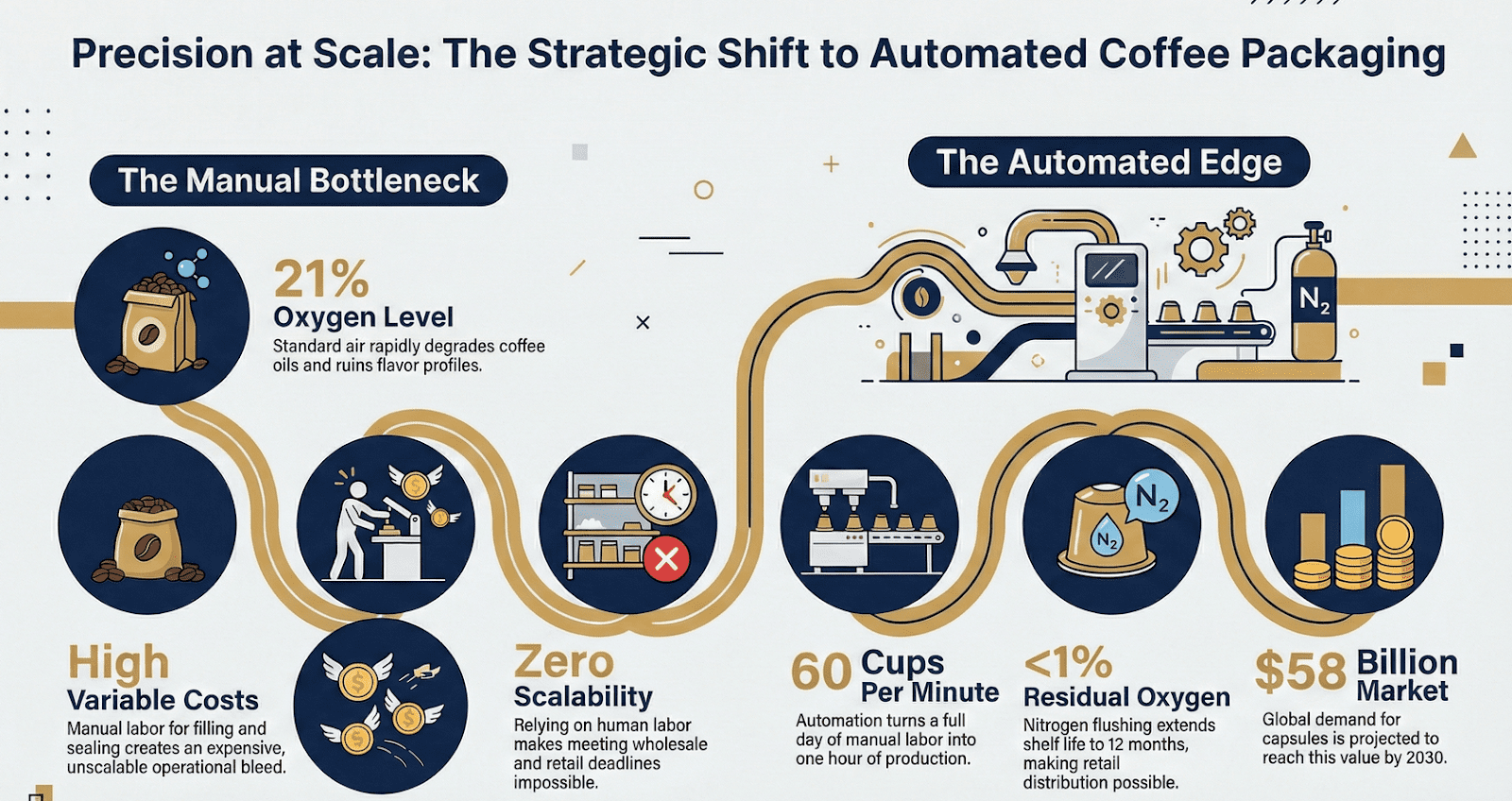
Scaling a coffee business requires a hard look at your supply chain capabilities. As demand for single-serve capsules surges, roasters are quickly realizing that manual filling allows for no scalability. It becomes impossible to meet wholesale deadlines relying solely on human labor.
To meet this volume, forward-thinking brands are partnering with specialized equipment manufacturers early in their growth phase. Industry leaders like SANEU have developed compact, high-efficiency sealing machines specifically designed to bridge the gap between startup operations and industrial-scale production. By integrating reliable automation hardware, roasters can stabilize their output and shift their focus from packaging logistics back to sourcing and roasting.
The Hidden Costs of Manual Production
Many founders initially resist automation due to the upfront capital investment, failing to account for the operational bleed caused by manual processes.
- Labor Inefficiency: Paying staff to manually fill, weigh, and seal pods is one of the highest variable costs in production.
- Inconsistent Dosage: Human error leads to overfilling (wasting expensive coffee grounds) or underfilling (leading to poor extraction and customer complaints).
- Seal Integrity: Manual heat sealers often result in micro-leaks. A compromised seal allows oxygen entry, ruining the crema and flavor profile before the customer even brews the cup.
Why Nitrogen Flushing is Non-Negotiable
In the B2B coffee sector, shelf life is currency. If a roaster wants to sell to supermarkets or hotels, the product must remain fresh for 6–12 months. This is where manual packaging fails completely.
Automation introduces Nitrogen Flushing, a technology that displaces oxygen inside the capsule immediately before sealing.
- Oxidation Control: Standard air contains roughly 21% oxygen, which rapidly degrades coffee oils.
- The 1% Standard: Professional automated lines can reduce residual oxygen levels to below 1%.
Without this technology, high-quality beans will taste flat and stale within weeks, damaging the brand’s reputation permanently.
Calculating the ROI of Automation
When evaluating the move to an in-house automated line, the alternative is usually Co-packing (outsourcing). While co-packers offer convenience, they demand high Minimum Order Quantities (MOQs) that can choke a small business’s cash flow.
Investing in in-house automation offers a different financial trajectory:
- Cost Per Unit: Drastically reduced as labor costs plummet.
- Flexibility: The ability to run small batches of limited-edition roasts without MOQ penalties.
- Speed: Modern entry-level machines can achieve outputs of 50–60 cups per minute, turning a day’s worth of manual labor into a one-hour task.
Future-Proofing Your Brand
The trajectory of the coffee industry favors those who optimize for efficiency without sacrificing quality. The shift toward automation is supported by clear market signals.
According to comprehensive market analysis by Grand View Research, the global coffee pods and capsules market is projected to exceed $58 billion by 2030. This growth trajectory suggests that roasters who invest in efficient production capabilities now will be best positioned to capture this expanding market share.
Key Takeaways
| Area | Key Takeaway | Impact/Data |
| Scalability | Manual filling creates severe growth bottlenecks | Zero scalability relying on labor |
| Quality | Nitrogen flushing is non-negotiable for retail | Residual oxygen reduced to <1% |
| Efficiency | Automation turns daily labor into hourly tasks | Speed increases to 50–60 cups/min |
| Economics | In-house automation eliminates Co-packer MOQs | Avoids cash flow choke from high MOQs |
| Market | Early efficiency adoption captures rising demand | Market reaching $58 Billion by 2030 |
Conclusion
Ultimately, the transition from a local roastery to a regional powerhouse is paved with operational efficiency. By automating the packaging process, business owners reclaim their most valuable asset: time. Whether it is preserving the delicate notes of a single-origin roast through nitrogen flushing or meeting a sudden spike in distributor demand, the right machinery transforms production from a liability into a competitive advantage.
