
Seeing past the hype cycle: reading Rolex today
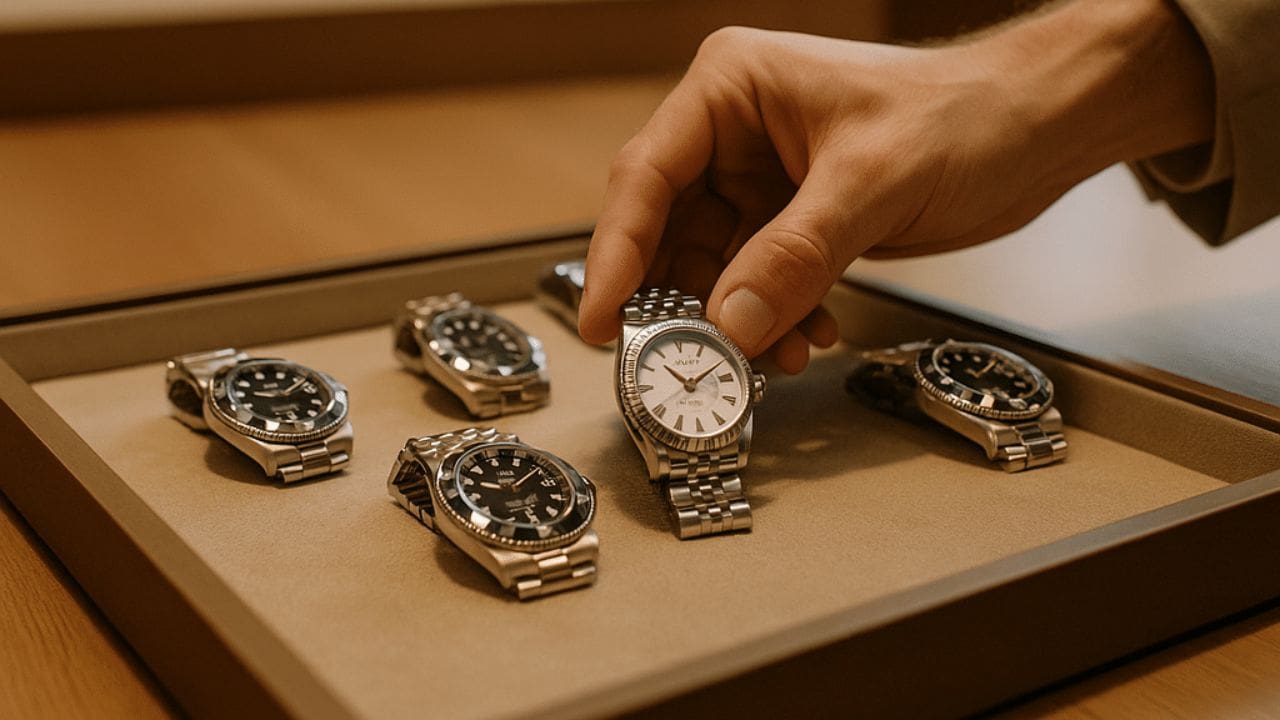
Walk into an authorized dealer and you feel it immediately. Lists run long, allocations run short, and shoppers quote reference numbers before they say the model. Pre-owned prices mirror that tension. Steel sports pieces set the tempo because people grab them for daily wear; Datejusts keep the market grounded because they quietly fit office routines. Over the past five years, many buyers reframed Rolex from playful gadget to “wearable savings account.” Behavior explains it: a watch that survives a hundred commutes and still looks sharp gets recommended, and prices trail those endorsements. Since 2023, the brand’s Certified Pre-Owned rollout through retailers has supported clean, documented examples—a floor under quality, not a promise of flips. Before you browse listings, ask an AD for timing on the exact reference you want and cap your pre-owned ceiling using that signal.
Three acts, one lesson: velocity changed more than direction
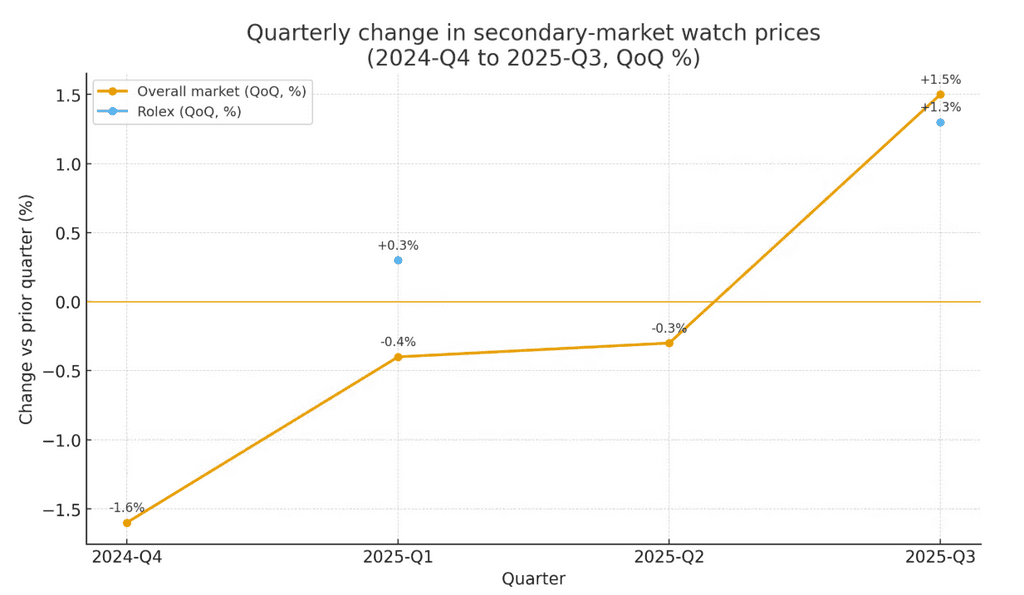
Frame 2020–2025 in three acts. First came the sprint: 2020 to early 2022 paired scarce AD supply with stay-at-home cash and social heat. Second came the reset: mid-2022 re-priced expectations as rates rose and speculative demand thinned. Third, the slower burn: through 2023 and into 2025, the broader pre-owned market cooled, but declines eased to their gentlest pace since the correction, with early-2025 used Rolex levels edging up quarter-to-quarter on liquid references tracked by brand indices. Across the window, versatile case diameter and conservative dials—Datejust 36/41, Submariner, steel GMT-Master II—retained value more consistently, while fashion-driven variants swung harder.
Quiet winners and the anatomy of “hold”
Many headlines missed the boring winners.

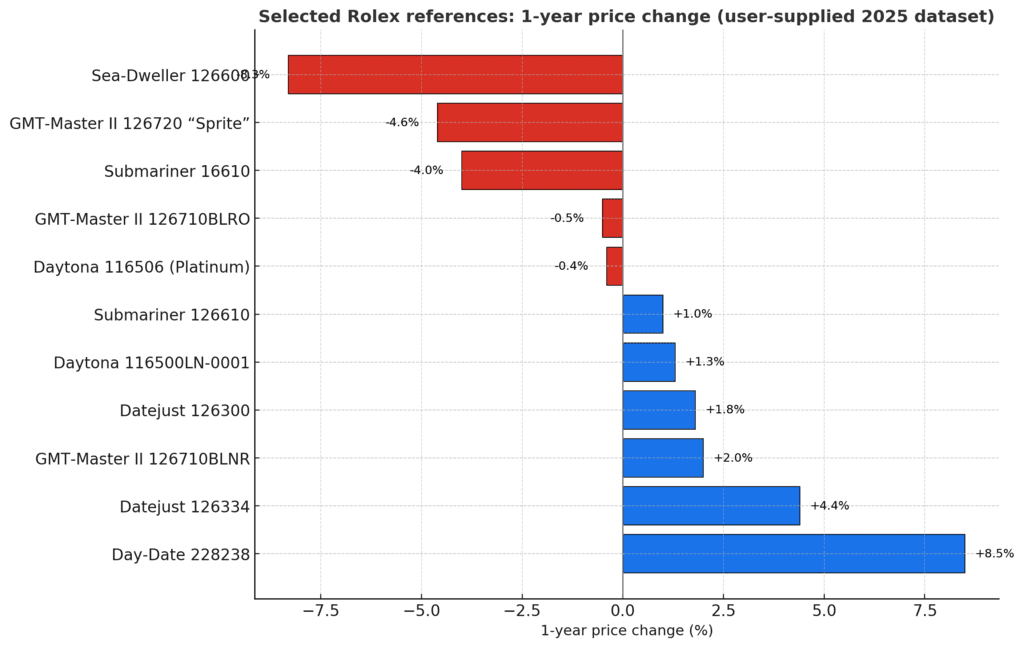
The Datejust 126334 sits near 13,267 with a 1-year move of 4.4%—steady demand, not fireworks. The yellow-gold Day-Date 228238 shows an 8.5% 1-year lift, a reminder that evergreen design in precious metal can carry its lane when volumes thin. By contrast, the Sea-Dweller 126600 posts −8.3%, and the GMT-Master II “Sprite” 126720 shows −4.6% over one year—novelty and narrower buyer pools don’t equal deep liquidity. Platinum Daytona 116506 trades at a very high absolute level around 86,733 and barely moved (−0.4%); steel 116500 variants live in the mid-20s and react visibly to condition and completeness. The through-line is ergonomic as much as economic: wearable lug-to-lug, balanced case diameter, and broad wrist circumference fit usually bring more bids. If you want a higher chance of a quick sale later, prioritize classic dials and comfortable proportions over nicknames.
Four levers that really move resale
- Supply you can’t see still sets the rules. Allocations trickle—especially in steel sports—nudging real buyers into pre-owned, where sharp cases resist lowball offers.
- Story scales beyond algorithms. Slow-evolving designs and incremental movement updates keep a five-year-old Sub looking correct with a suit or a hoodie, which lowers hesitation at checkout.
- Spotlight without the billboard. Ambassadors help, but organic sightings—airports, podiums, films—cement desirability for longer than a campaign cycle.
- Sellability beats theory. Condition, completeness (box, papers, spare links), and service history decide numbers; original parts on a crisp case outpace a tired “full set.” Score your target on these four levers before writing the offer; the number will defend itself.
Part of our perspective is grounded in a German-language article. If you want the underlying dataset and argument, see the original (German) analysis on Rolex prices and secondary-market retention: Rolex-Zweitmarkt-Preise 2020–2025: Welche Modelle hielten den Wert am besten?. Cross-check the model list and production status against your watch before trusting any price gap.
Macro friction without melodrama
Rates, tariffs, and headlines change the speed of sales more than the destination. Higher policy rates in 2023–2024 made cash feel expensive and cooled time-arbitrage flips. Import rules and duties influenced cross-border spreads, especially in Europe, where margin-scheme VAT on used goods can compress the dealer-to-private delta. Even so, early-2025 sorting felt binary: some references fell and kept sliding; others dipped, flattened, and found a realistic base. Build offers from comps in the last 60–90 days and state that window explicitly in your message.
Positioning for 2025: where value actually lasted
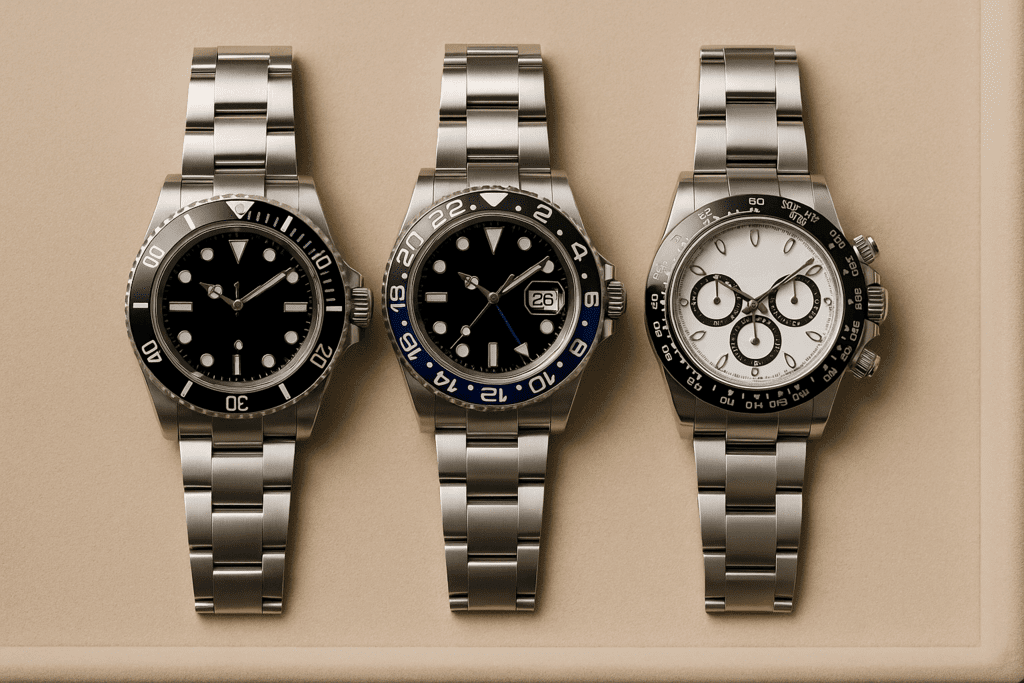
- Seeking long-run liquidity? Submariner, GMT-Master II, and Daytona remain the “always-wanted” trio. Favor original geometry over “full set but over-polished,” and check end-link fit.
- Prefer low-drama stability? Explorer I/II and Datejust 36/41 trade in narrower ranges and suit a wider band of wrist circumference.
- Chasing the pop? Bright-dial Oyster Perpetuals surged in 2021–2022 and retraced in 2023–2024; buy to keep, not to flip.
- Precious-metal temptation? White-gold sports models age gracefully and often carry smaller premiums than yellow-gold; budget for service and accept desk-diving swirls.
- When to act? Gifting seasons tighten spreads; mid-cycle months often reward documented offers on well-photographed listings. Before you bid, write a target range and a walk-away number to avoid chasing.
Rolex 2020–2025 secondary-market timeline
| Phase | Period | Rolex trend | Notable triggers |
|---|---|---|---|
| Acceleration | 2020–Q1 2022 | Rapid appreciation | Lockdowns, stimulus, scarce AD supply |
| Correction | Q2–Q4 2022 | Fast repricing | Rate hikes, risk reset |
| Stabilization | 2023 | Sideways to gentle drift | More supply, selective demand |
| Shallow declines, then firming | 2024–H1 2025 | Slower dips; Rolex inches up | Policy headlines; resilient core-model demand |
SOURCE: WatchCharts Rolex Market Index (2025)
Use the timeline to match comparables by phase; comp a 2021-era spike against 2021 transactions, not 2024 lows.
Value retention tiers by model family (2020–2025)
| Tier | Examples | Why they held up |
|---|---|---|
| Higher retention | Submariner, Daytona, GMT-Master II (steel) | Deep global demand, long waitlists, broad collector base |
| Solid and steady | Explorer I/II, Datejust 36/41 | Versatile sizing, timeless design, abundant but absorbed by end-users |
| More volatile | Oyster Perpetual bright dials, Yacht-Master II | Fashion-driven spikes, narrower buyer pool, sharper cycle moves |
SOURCE: WatchCharts Rolex Market Index (2025)
If your target sits in the volatile tier, extend your holding period or lower your opening bid to respect variance.
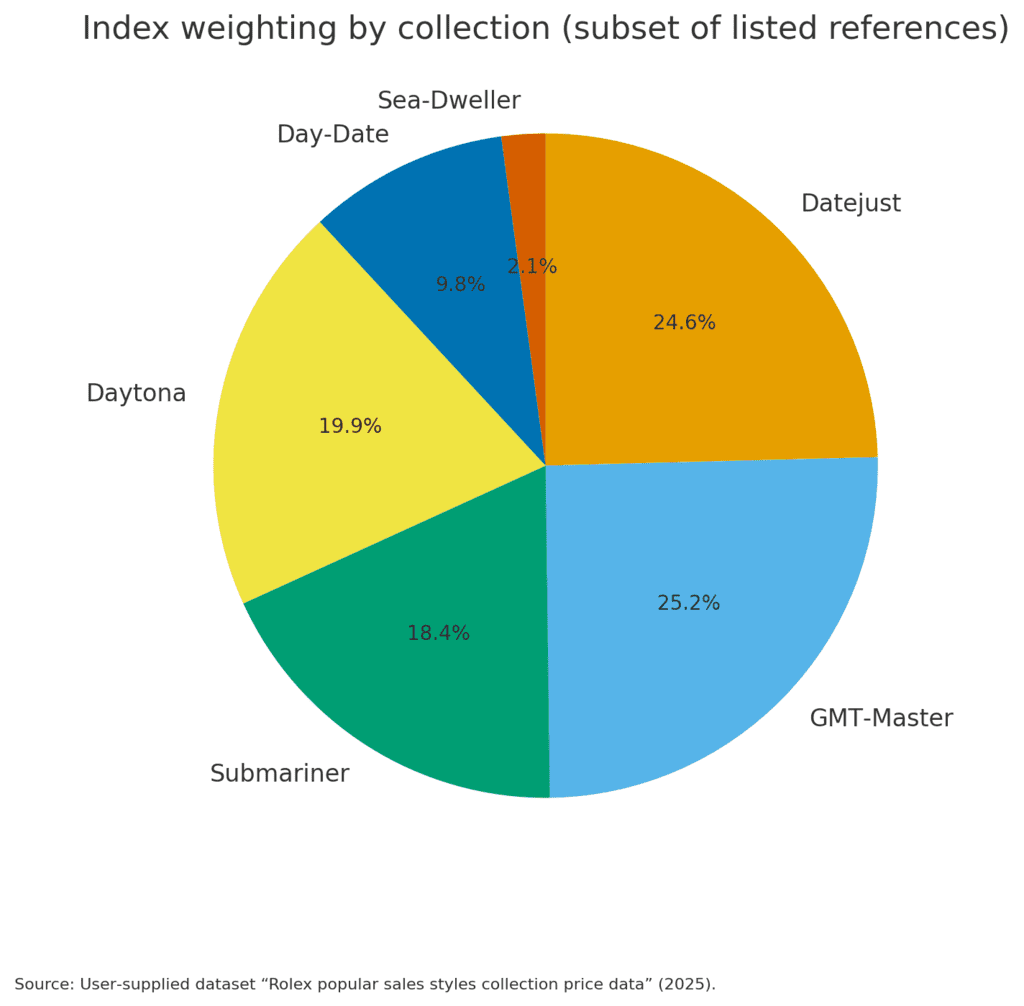
Selected Rolex references: market level and 1-year change
| Watch | Collection | Market Price | 1Y % CHG | Index Weighting | Production Status |
|---|---|---|---|---|---|
| Rolex 126334 | Datejust | 13,267 | 4.4% | 8.2% | In Production |
| Rolex Batgirl 126710BLNR | GMT-Master | 16,311 | 2.0% | 5.3% | In Production |
| Rolex Pepsi 126710BLRO | GMT-Master | 19,496 | -0.5% | 5.0% | In Production |
| Rolex 126300 | Datejust | 9,439 | 1.8% | 4.6% | In Production |
| Rolex 116500LN-0001 | Daytona | 27,900 | 1.3% | 4.5% | |
| Rolex 116506-0001 | Daytona | 86,733 | -0.4% | 4.4% | |
| Rolex 228235 | Day-Date | 48,555 | 5.2% | 4.2% | In Production |
| Rolex 126610 | Submariner | 12,994 | 1.0% | 4.0% | In Production |
| Rolex 116500LN-0002 | Daytona | 24,416 | -1.2% | 3.8% | |
| Rolex Starbucks 126610LV | Submariner | 14,104 | -2.0% | 3.6% | In Production |
| Rolex Root Beer 126711CHNR | GMT-Master | 18,116 | 0.2% | 3.6% | In Production |
| Rolex 126234 | Datejust | 11,693 | 4.1% | 3.6% | In Production |
| Rolex 228238 | Day-Date | 45,062 | 8.5% | 3.5% | In Production |
| Rolex Hulk 116610LV | Submariner | 17,675 | -2.2% | 3.2% | |
| Rolex Sprite 126720 | GMT-Master | 16,361 | -4.6% | 3.1% | In Production |
| Rolex 126333 | Datejust | 14,603 | 3.7% | 3.0% | In Production |
| Rolex 116520-0015 | Daytona | 19,477 | -0.4% | 2.8% | |
| Rolex 16610 | Submariner | 8,540 | -4.0% | 2.7% | |
| Rolex 16233 | Datejust | 6,585 | 2.4% | 2.6% | |
| Rolex 16710 | GMT-Master | 11,824 | -3.4% | 2.5% | |
| Rolex 116710 | GMT-Master | 11,434 | -0.8% | 2.4% | |
| Rolex 126613LB | Submariner | 16,445 | 1.8% | 2.3% | In Production |
| Rolex 126715 | GMT-Master | 35,646 | 0.7% | 2.3% | In Production |
| Rolex 116610 | Submariner | 10,516 | -4.2% | 2.3% | |
| Rolex 124060 | Submariner | 11,589 | 0.4% | 2.3% | In Production |
| Rolex 126331 | Datejust | 15,905 | 4.3% | 2.2% | In Production |
| Rolex 116520-0016 | Daytona | 20,121 | -0.8% | 2.2% | |
| Rolex 126600 | Sea-Dweller | 11,416 | -8.3% | 2.1% | In Production |
| Rolex 126500LN-0001 | Daytona | 31,725 | -0.8% | 1.9% | In Production |
| Rolex 18238 | Day-Date | 20,061 | 7.5% | 1.9% |
SOURCE: User-supplied dataset “Rolex popular sales styles collection price data” (2025)
Use these levels as orientation, not quotes; adjust for condition, completeness, and recent service.
How to buy smart in 2025—without turning it into a spreadsheet
Start with the wrist, not the webpage. Test the watch under daylight and office light; some sunburst dials and ceramic inserts read differently by setting. Price the watch, not the listing: compare recent verified sales, then zoom in on lug symmetry and chamfers to spot over-polish. On ceramic-bezel models, check the insert around 12 and 6 for chips—replacements change the math.
Ask for bracelet-stretch photos and clasp codes. Confirm service history and whether parts are original. Use wrist circumference and lug-to-lug to sanity-check comfort; a case that wears right gets worn more, which supports value. Negotiate with facts, be courteous, and write an offer a seller can accept without losing face. Keep a one-minute checklist on your phone so each inspection ends with a clear yes, no, or price-change.
FAQ
Q: Which Rolex models held value best from 2020 to 2025?
A: Steel sports references—Submariner, Daytona, GMT-Master II—kept the strongest liquidity, while Explorer and Datejust families delivered steadier, lower-volatility holds. Wearability and broad buyer pools were decisive.
Q: Did the market stabilize in 2024–2025?
A: Declines slowed meaningfully versus 2022–2023, and early-2025 data shows modest quarter-to-quarter firmness in used Rolex. It looked less like a snapback and more like a base forming.
Q: Is now a reasonable time to buy pre-owned?
A: For long-term wearers, yes—if you prioritize condition, documentation, and realistic comps. The easy flips of 2021–2022 are gone; buy pieces you would gladly keep.
Q: What single factor most affects resale?
A: Sellability. Broad demand plus everyday wearability beats artificial scarcity. Clean condition with history in order tends to sell close to ask.
Q: Should I prefer full “box and papers” over better condition?
A: If you must choose, pick better condition. Papers help, but soft lugs, replaced inserts, or mismatched hands usually cost more at resale than missing ephemera.
Author Bio
Alex Chen is a watch-market analyst and former boutique buyer with a focus on European and U.S. resale dynamics. He blends index research with hands-on condition checks to help collectors make confident, wear-first decisions. Visit o fakes for more insights.