
Introduction
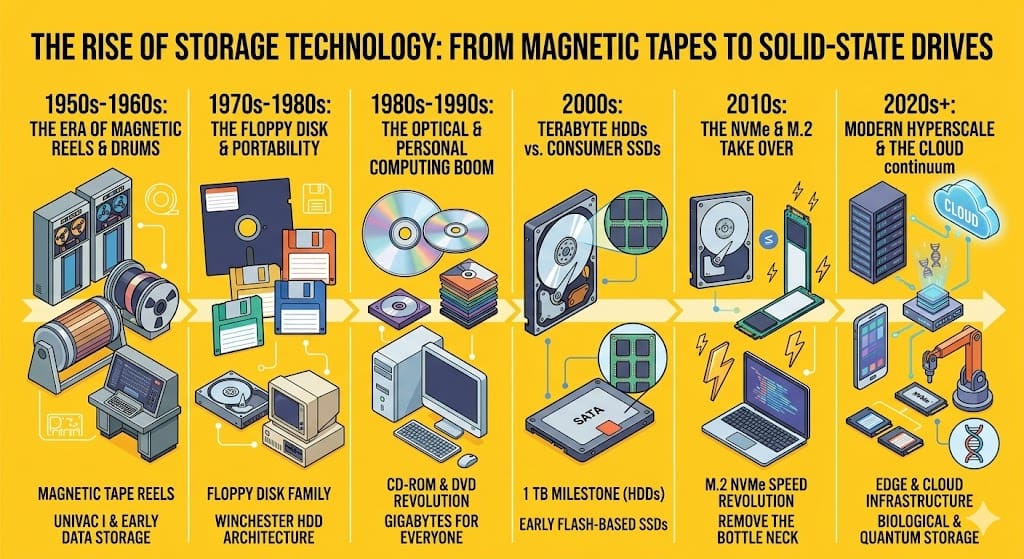
In the span of a single human lifetime, we have transitioned from storing data on paper punch cards to holding terabytes of information in the palm of our hand. This incredible rise of storage technology has not just been about making things smaller; it has been about fundamentally changing how we interact with the digital world. Every high-definition movie you stream, every AI model that processes your voice, and every photo saved to your cloud account relies on a complex lineage of hardware engineering.
To understand where we are going, we must look back at the history of computer storage a journey defined by the quest for greater density and lower latency. In the beginning, engineers battled with massive mechanical reels and fragile magnetic drums. Today, we utilize non-volatile memory (NVM) that operates at the speed of light. This article explores the triumphant evolution of these systems and how the rise of storage technology continues to redefine the limits of human knowledge.
A. 1951 – 1956: The Era of Magnetic Reels and Drums
The early 1950s represented the “industrial age” of data. Before this, memory was volatile and incredibly limited. The first major shift in the rise of storage technology occurred when engineers discovered that iron oxide could be used to record binary patterns.
UNIVAC I and the Introduction of Magnetic Tape
In 1951, the UNIVAC I (Universal Automatic Computer I) introduced the world to magnetic tape as a primary storage medium. Unlike the punch cards that preceded it, UNISERVO tape was made of a thin metal strip coated with magnetic material. While it was a massive step forward, it was a linear medium. If a user needed data at the end of the reel, the machine had to physically wind through hundreds of feet of tape to reach it. This highlighted the early struggles with latency and sequential access.
The IBM 305 RAMAC: The World’s First Hard Disk Drive
In 1956, the trajectory of storage changed forever with the release of the IBM 305 RAMAC. This machine answered the question: how much storage did the first computer have? The answer was a staggering, yet humble, 5 MB. The RAMAC (Random Access Method of Accounting and Control) was the size of two large refrigerators and weighed over a ton. It utilized 50 large magnetic platters that spun at high speeds, with moving read/write heads that could jump to any point on the disk. This was the birth of “random access,” and it laid the foundation for every hard drive that followed.
B. 1970 – 1985: The Rise of Storage Technology and Portability
As computers moved from massive industrial rooms into office spaces, the demand for portable and efficient storage skyrocketed. This era focused on miniaturization and standardization.
The Floppy Disk: Bringing Data to the Personal Computer
The 1970s saw the birth of the floppy disk, a revolutionary invention by IBM. Originally 8 inches wide and holding a mere 80 KB, the floppy disk evolved into the 5.25-inch and eventually the iconic 3.5-inch format. These disks were inexpensive and allowed individuals to carry their operating systems and files from one machine to another. It was the first time that the rise of storage technology truly reached the hands of the average consumer.
Winchester Drives: Sealing the Future of Hard Disks
While floppies handled portability, internal storage needed to become more reliable. In 1973, IBM introduced the “Winchester” drive (the IBM 3340). This design featured a sealed internal environment and a low-mass head that “flew” just above the magnetic surface. By sealing the drive, engineers eliminated the risk of dust and debris, which allowed for much higher data density and faster spin speeds. This architecture became the standard blueprint for all modern magnetic storage milestones.
C. 1985 – 1995: The Optical Revolution and the CD-ROM Boom
In the mid-1980s, the rise of storage technology took a detour into the world of light. For the first time, lasers replaced physical magnetic heads for consumer-grade data retrieval.
CD-ROMs and DVDs: Digitizing Knowledge and Media
Adapting the technology used for music, the CD-ROM was introduced to the computing world in 1985. A single disc could hold 650 MB of data, which was nearly 450 times the capacity of a standard floppy disk. This massive increase in volume allowed for the digitization of encyclopedias, high-resolution photographs, and complex software suites. By the mid-90s, the DVD followed, utilizing shorter-wavelength lasers to pack even more data into the same physical footprint.
Why Optical Storage Changed Software Distribution
Before the CD-ROM, installing a complex program required swapping dozens of floppy disks. The optical revolution made software installation seamless and allowed for the birth of multimedia computing. It provided a reliable, long-term backup medium that was resistant to the magnetic interference that plagued older tapes. However, despite their capacity, optical drives suffered from slow seek times compared to hard drives, meaning they remained a secondary storage tier.
D. 1995 – 2005: The Birth of Flash Memory and USB Storage
The true turning point in the rise of storage technology came with the elimination of moving parts. This decade saw the transition from mechanical systems to solid-state logic.
NAND Flash: Eliminating Moving Parts in Storage
The development of flash memory based on NAND gates changed everything. Unlike traditional RAM, which loses data when power is cut, flash memory is non-volatile. By using floating-gate transistors to trap electrons, data could be stored indefinitely without any mechanical wear. This development of flash memory led to the creation of the first commercial solid-state drives (SSDs). Without read/write heads or spinning platters, these devices were immune to physical shocks and offered near-instantaneous data access.
The Death of the Floppy: How USB Thumb Drives Took Over
In the late 1990s and early 2000s, the USB flash drive emerged. Small enough to fit on a keychain yet holding more data than hundreds of floppies, it quickly became the preferred way to move data. The convenience of “Plug and Play” technology, combined with the ruggedness of flash memory, effectively killed the floppy disk and the Zip drive. It was a powerful demonstration of how the rise of storage technology prioritizes convenience and speed.
E. 2005 – 2018: The SSD Takeover and the Terabyte Milestone
As we entered the 2010s, the bottleneck in computer performance was no longer the processor, but the mechanical hard drive. The industry responded by making solid-state technology the new standard.
SSD vs. HDD: The Speed Revolution for Consumers
The SSD vs HDD history is a story of performance versus price. For decades, HDDs were the kings of capacity, reaching the 1 TB milestone in 2007. However, they were limited by mechanical physics—heads could only move so fast. SSDs, by contrast, offered incredible IOPS (Input/Output Operations Per Second), drastically reducing boot times and software loading. As manufacturing costs dropped, SSDs moved from high-end enterprise servers into every consumer laptop.
SATA vs. NVMe: Removing the Architecture Bottleneck
Early SSDs were held back by the SATA interface, which was originally designed for slow, spinning disks. To truly unlock the potential of the rise of storage technology, a new protocol was needed. The introduction of NVMe (Non-Volatile Memory Express) and the M.2 form factor allowed storage to communicate directly with the CPU via the PCIe bus. This removed the “bottleneck,” allowing modern drives to achieve speeds of 7,000 MB/s or more, compared to the 550 MB/s limit of SATA.
F. 2018 – 2026: Hyperscale Cloud and the Future of DNA Storage
We are currently living in an era where data is no longer local—it is omnipresent. The rise of storage technology has moved into massive facilities and the microscopic world of biology.
Object Storage and the Cloud Data Center Infrastructure
The history of data centers shows a shift from individual servers to hyperscale object storage. Companies like Amazon, Google, and Microsoft manage exabytes of data across global networks. This modern storage landscape relies on sophisticated “wear leveling” algorithms to ensure that flash memory lasts for years, even under intense server workloads. We no longer worry about a single drive failing because the data is distributed across thousands of machines simultaneously.
Biological Storage: Encoding Digital Data into DNA Strands
As we look toward 2026 and beyond, we are approaching the limits of silicon. The next frontier in the rise of storage technology is DNA. Researchers have successfully encoded digital files into the A, C, G, and T bases of synthetic DNA. Because DNA is incredibly stable and dense, we could theoretically store all of the world’s current digital data in a few grams of biological material. This represents the ultimate convergence of biology and technology, promising a future where data can survive for thousands of years without degradation or bitrot.
Frequently Asked Questions (FAQs)
1. What was the main reason for the shift from HDD to SSD?
The primary driver was speed and reliability. HDDs use physical spinning disks and moving heads, which are prone to mechanical failure and slow data access. SSDs use NAND flash memory, which has no moving parts, resulting in much lower latency and significantly faster data transfer rates.
2. Is magnetic tape still used today?
Yes. While it isn’t used for personal computing, magnetic tape remains a staple in large-scale data archiving. It is highly cost-effective for long-term storage and provides an “air gap” that protects data from cyberattacks.
3. What is “Bitrot” and how does it affect storage?
Bitrot refers to the slow decay of data over time on storage media. On magnetic drives, it happens due to magnetic field degradation. On SSDs, it occurs when the electrical charge in the flash cells leaks away. Modern systems use error-correction codes (ECC) to combat this.
4. How does NVMe differ from older SSD types?
NVMe is a protocol designed specifically for high-speed flash memory. Unlike older SATA SSDs that use a communication path built for hard drives, NVMe connects directly to the CPU, allowing for much higher bandwidth and lower power consumption.
Conclusion
The rise of storage technology is a testament to human ingenuity and our insatiable desire to record our existence. From the refrigerator-sized RAMAC storing 5 MB to the microscopic DNA strands capable of holding the world’s libraries, we have witnessed a total transformation of the digital landscape. As we look forward, the focus remains on overcoming the physical limits of materials and ensuring that our data remains accessible for future generations. Whether through hyperscale cloud facilities or atomic-scale memory, the evolution of storage is far from over—it is just entering its most exciting chapter.