
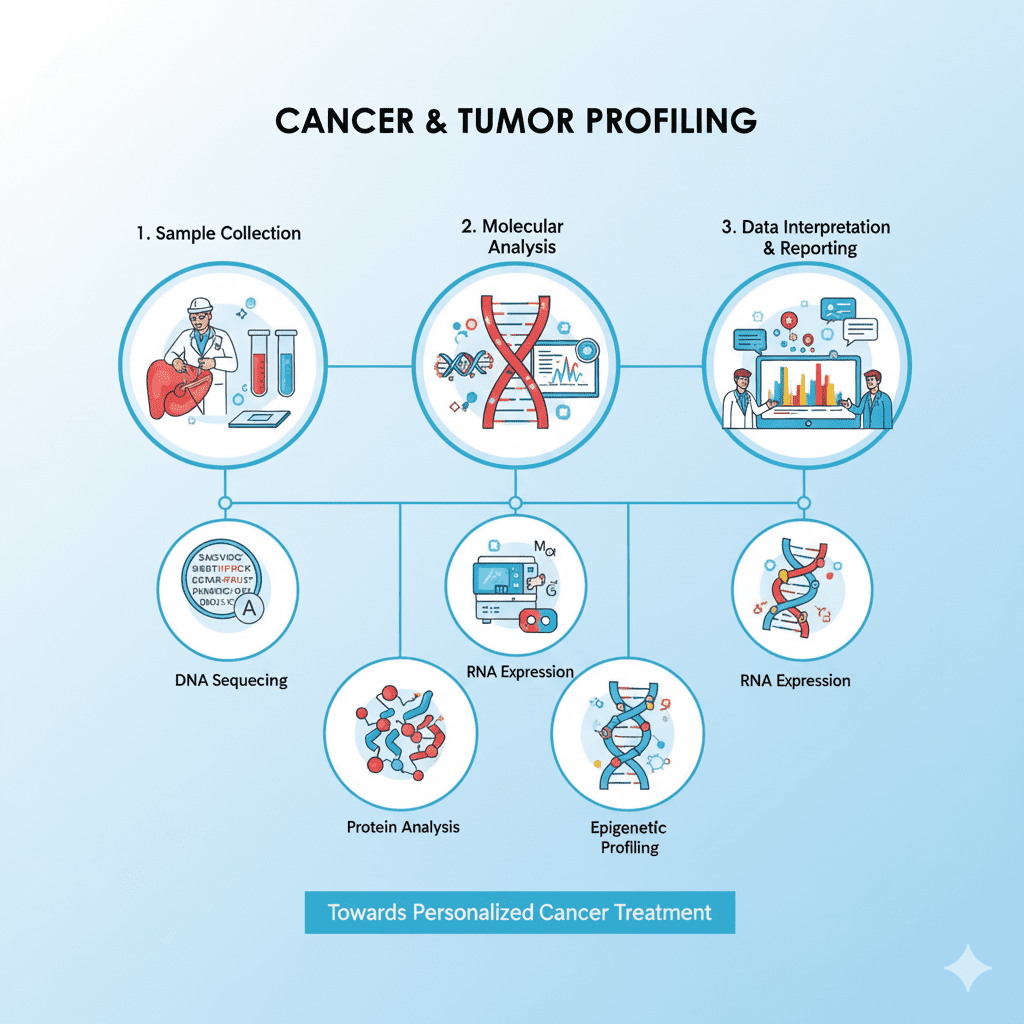
Cancer/tumor profiling refers to a comprehensive investigation of the genetic, molecular, and cellular aspects of a tumor in order to comprehend the tumor’s nature and identify the most targeted treatment options. The patient’s rising need for personalized medicine, the increasing number of cancer cases, and the advancements in genomic sequencing and the application of precision diagnostics are the main factors that have led to the substantial growth of the cancer/tumor profiling market.
Key Growth Drivers and Opportunities
The Advancements in Genomic Sequencing: One major factor that grew the market was the progress of genomic sequencing which allows the identification of genetic mutations and biomarkers in tumors to be done in a faster, more accurate and less expensive way. As a result, the information obtained is utilized to prepare treatment plans that focus on the individual and a targeted therapy is given to the patient. This not only has the effect of satisfying patients which in turn increases the demand for cancer or tumor profiling solutions but also positively impacts patient outcomes.
Challenges
Those factors which limit the growth of the cancer tumor profiling market include high test costs, complex data interpretation, lack of standard protocols, restricted access in developing regions, and concerns over genetic data privacy. All these factors not only obstruct that market’s expansion but also hinder that market’s penetration.
Innovation and Expansion
Foundation Medicine’s FlexOMx LabTM Introduces a Molecular Residual Disease (MRD) Test for Research Use in Early to Late-Stage Cancers
In September 2025, a tissue-informed whole genome sequencing molecular residual disease (Tissue-informed WGS MRD) test has been added to Foundation Medicine, Inc.’s portfolio of superior testing options. Foundation Medicine, Inc. is a precision medicine firm that is changing lives in cancer care and beyond. The test can now be used in retrospective clinical studies for research purposes.
For early and late-stage cancer research investigations, Foundation Medicine’s FlexOMx Lab now provides very sensitive Tissue-informed WGS MRD test findings. The test allows for the precise measurement of circulating tumor DNA (ctDNA) in cancer patients for a more comprehensive picture following therapy by tracking hundreds to thousands of tumor-specific variations.
Nonacus Introduced a Test that Combines Bioinformatics and Analysis Software with Complete Genomic Profiling
In April 2024, Nonacus, a genetic testing business, has introduced GALEASTM Tumor, a next-generation sequencing (NGS) test that offers thorough genomic profiling of tumors, enabling medical professionals to precisely diagnose cancers and customize treatments.
Targeted NGS panels, custom bioinformatics for variant calling the process of identifying variations in genomic sequences linked to cancer and software for result analysis are all included in the GALEAS Tumor test. Implementing bioinformatics resources might be difficult because of the expenses and labor costs involved in outsourcing or implementation.
Inventive Sparks, Expanding Markets
The key players operating the cancer or tumor profiling market includes Illumina Inc, QIAGEN, Genomic Health, Inc., NeoGenomics Laboratories, Inc., HTG Molecular Diagnostics, Inc., Caris Life Sciences, Helomics Corp, Oxford Gene Technology IP Limited, Genomic Health, Inc, and NanoString Technologies, Inc.
About Author:
Prophecy is a specialized market research, analytics, marketing and business strategy, and solutions company that offer strategic and tactical support to clients for making well-informed business decisions and to identify and achieve high value opportunities in the target business area. Also, we help our client to address business challenges and provide best possible solutions to overcome them and transform their business.
