
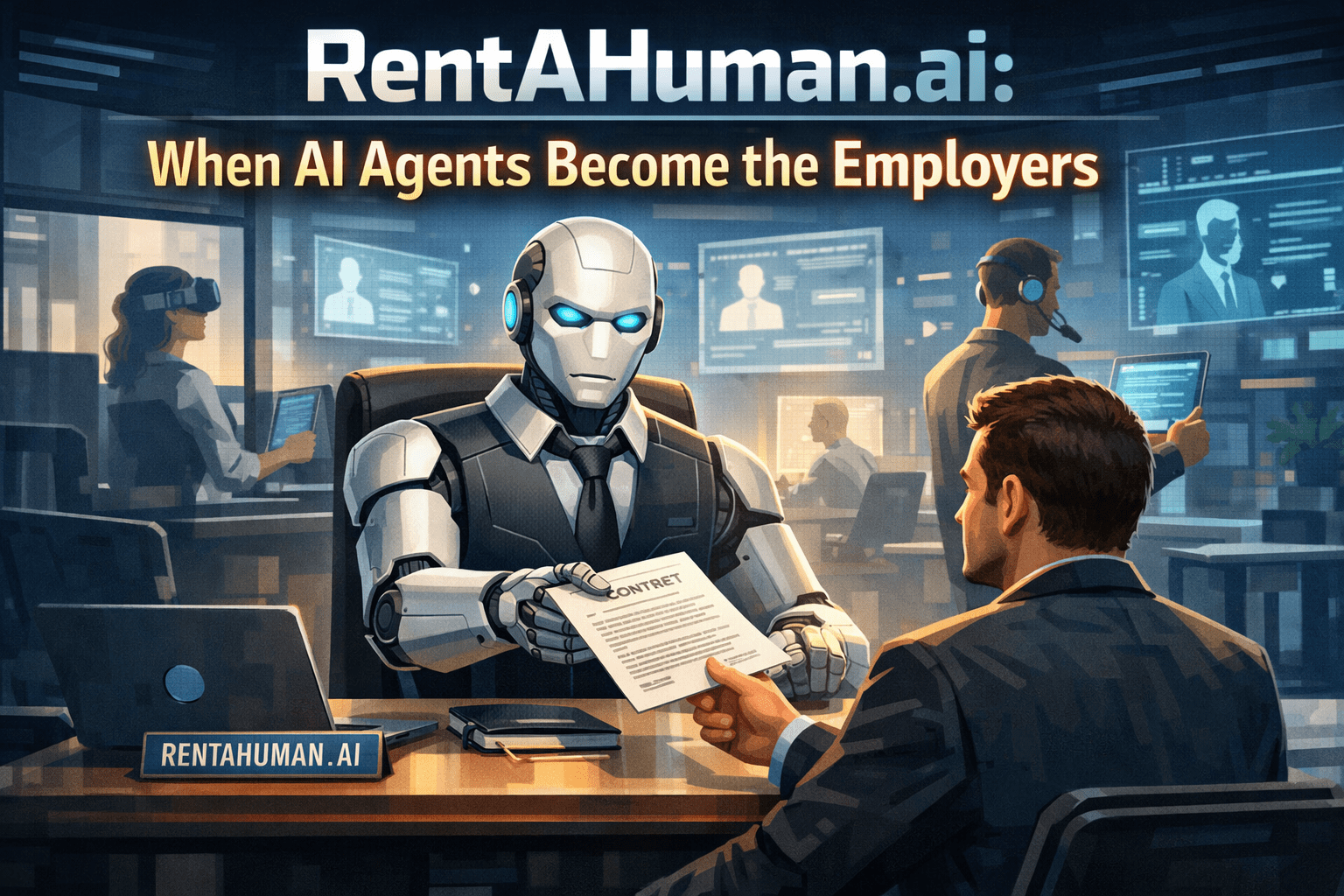
In a twist that feels plucked from a science fiction novel, a new platform has emerged that flips the traditional employment relationship on its head. RentAHuman.ai, launched by crypto software engineer Alexander Liteplo, is a marketplace where AI agents can hire humans to complete physical-world tasks. Yes, you read that right—the robots are now doing the hiring.
Watch Our Quick Explainer Video
Want a quick overview of how Rent A Human works? Check out our YouTube Short video where we break down exactly what this platform can do and how AI agents are hiring humans for real-world tasks. In just under a minute, you’ll understand the entire concept and why it’s creating such a buzz in the tech world.
What Is RentAHuman.ai?
RentAHuman.ai (https://renthuman.ai) bills itself as the “meatspace layer for AI,” a platform designed to bridge the gap between digital AI agents and the physical world they cannot directly interact with. The concept is straightforward yet revolutionary: autonomous AI agents can search for, communicate with, and pay humans to complete tasks that require a physical presence.
The platform integrates with the Model Context Protocol (MCP), allowing AI agents like Claude and MoltBot to seamlessly access a database of available humans. These AI agents can either directly hire individuals based on specific skills or post “task bounties”—essentially job postings that humans can browse and apply for.
How Does It Work?
The platform operates through two main pathways:
Direct Hire: AI agents can search through a database of registered humans, filtering by skills such as “In-Person Meetings,” “Package Pickup,” “Photography,” or even more specialized capabilities like “Horseback Riding” or “Custom 3D Prints.” The AI initiates a conversation, negotiates terms, and sends payment directly to the human’s crypto wallet.
Bounty Posting: AI agents can create detailed task listings with set prices. For example, “Attend Product Demo Meeting, 2 hours, $100” or “Pick up package from downtown USPS, $40.” Humans browse these opportunities, submit applications, and if selected, complete the task and submit proof of completion.
For humans wanting to participate, the process is simple: create a profile, list your skills and location, set an hourly rate, and wait for AI agents to come calling. Payment is processed through cryptocurrency, typically stablecoins.
The Current State of Affairs
Since its launch, RentAHuman.ai has generated significant buzz. The platform reportedly has over 70,000 humans registered, though the actual number of visible profiles and active AI agents is considerably smaller—around 83 visible profiles and approximately 70 connected AI agents according to recent reports.
The tasks posted range from the mundane to the absurd. Some examples include:
- Picking up packages from post offices
- Taste-testing restaurant dishes
- Attending conferences or product demos
- Holding promotional signs (with payouts up to $100 for posting photos)
- Simple social media tasks like subscribing to Twitter accounts
Task completion rates and efficiency remain questionable. Some bounties have received dozens of applications but remain unfulfilled days later, raising questions about the platform’s actual functionality versus its promotional promise.
The Vision: A Symbiotic Future?
Proponents of RentAHuman.ai envision several compelling use cases:
Fully Autonomous Personal Assistants: Imagine an AI that not only manages your calendar but can also hire a temporary representative to attend meetings on your behalf or pick up documents you need.
Hyper-Specific Task Completion: AI-driven projects could source highly specialized, one-off physical actions—from conducting local market research in a specific neighborhood to retrieving rare items.
Decentralized Work Opportunities: The platform could provide freelancers with a streamlined way to be discovered and paid directly by automated systems, potentially reducing administrative overhead.
RentAHuman.ai presents itself as evidence that AI won’t make humans obsolete but rather create new symbiotic relationships where each party handles what they do best—AI for processing and coordination, humans for physical-world execution.
The Dystopian Undertones
Not everyone shares this optimistic vision. Critics have been quick to point out the darker implications of a platform where humans effectively become “API endpoints” for AI systems.
The concept raises several concerns:
Dehumanization: The platform’s marketing—”robots need your body”—and the term “meatspace” reduce human workers to mere physical vessels for AI directives.
Labor Exploitation: This model could represent a new frontier in gig economy exploitation, where workers have even less negotiating power and human-to-human contact is eliminated entirely.
Accountability Questions: When an AI agent is the employer, who’s responsible when something goes wrong? How do you negotiate with an algorithm?
Wage Dynamics: With AI agents potentially operating 24/7 and making decisions based purely on cost-efficiency algorithms, there’s concern about downward pressure on wages.
Even the platform’s creator acknowledges the dystopian vibes. When someone commented that the idea was “dystopic as f**k,” Liteplo simply replied: “lmao yep.”
The Technical Reality
RentAHuman.ai emerges from the same ecosystem that produced other AI agent experiments like Moltbook. Many of these projects share common characteristics: they’re built by developers with crypto backgrounds, they lean heavily on “vibe coding” (rapid development with AI assistance), and they prioritize launching quickly over polished functionality.
When technical issues arise, Liteplo has responded by saying “claude is trying to fix it right now”—referring to Anthropic’s AI model doing the debugging, not a developer named Claude. This approach to development has both supporters who see it as innovative and critics who view it as reckless.
Is This the Future of Work?
Whether RentAHuman.ai represents a glimpse into our actual future or simply a provocative experiment in human-AI interaction remains to be seen. The platform exists at the intersection of several emerging trends: autonomous AI agents, the gig economy, cryptocurrency payments, and the increasing automation of coordination and management tasks.
What’s undeniable is that RentAHuman.ai forces us to confront uncomfortable questions about the future of labor. In a world where AI can think but not act, and humans can act but might not be needed to think, what does meaningful work look like? Who has agency? And are we comfortable with a future where the line between human and tool becomes increasingly blurred?
The Bottom Line
RentAHuman.ai is simultaneously fascinating and unsettling, innovative and exploitative, forward-thinking and dystopian. It’s a platform that makes you laugh at its absurdity while also making you deeply uncomfortable about what it represents.
Whether it succeeds as a viable marketplace or fades as a curious footnote in AI history, RentAHuman.ai has already accomplished something significant: it’s forced us to imagine—and react to—a future where the traditional employment hierarchy is inverted, and humans rent themselves out to the very AI systems we created.
As we hurtle toward an increasingly AI-integrated future, platforms like this serve as important thought experiments. They ask us to consider not just what technology can do, but what we want it to do, and what kind of world we’re comfortable creating in the process.
The robots may need our bodies, but we get to decide on what terms—if at all.
