
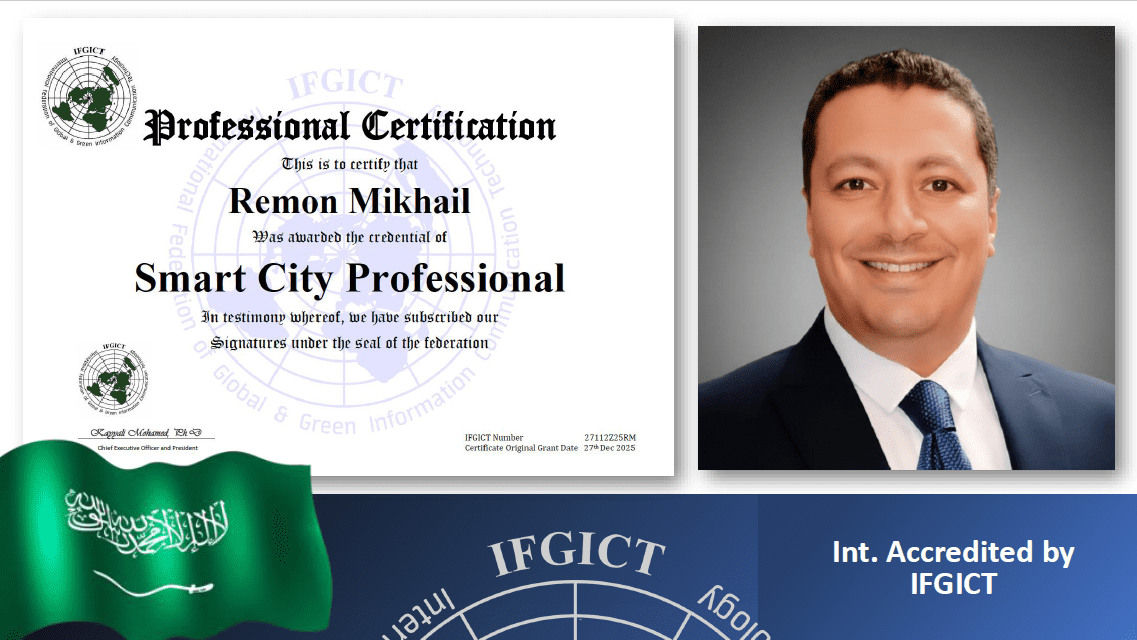
The landscape of modern urban development is undergoing a radical shift, particularly within the rapidly expanding metropolises of the Middle East. At the heart of this transformation are visionaries who possess the technical prowess and strategic foresight to integrate complex digital systems into the physical world. Remon Mikhail, a distinguished engineer recognized for his contributions to large-scale infrastructure, has recently achieved a significant milestone in his professional journey. He has been officially awarded the Smart City Professional (SCP) degree by the International Federation of Global & Green ICT (IFGICT). This certification serves as a formal validation of his expertise in deploying intelligent systems that prioritize efficiency, sustainability, and technological resilience.
The achievement of the SCP degree is not merely an academic milestone but a reflection of a career dedicated to the practical implementation of future-ready urban solutions. The International Federation of Global & Green ICT is a world-renowned body that sets the gold standard for ICT professionals who aim to harmonize technological advancement with environmental responsibility. By earning this degree, Remon Mikhail joins an elite group of specialists who are equipped to handle the multifaceted challenges of the 21st-century city. His work across the Middle East has already established him as a leader in the field, and this new accreditation further cements his position as a definitive authority on smart city architecture and intelligent transportation.
The Architect of Intelligent Transportation Systems
Remon Mikhail has built a formidable reputation as an engineer specializing in the implementation of Intelligent Transportation Systems (ITS). These systems represent the central nervous system of a modern city, allowing for the real-time management of traffic flow, public transit efficiency, and overall commuter safety. In the Middle East, where infrastructure projects are characterized by their massive scale and ambitious timelines, the role of an ITS expert is critical. Mikhail has consistently demonstrated an ability to navigate these complexities, ensuring that transportation networks are not just functional but are intelligent enough to adapt to the changing needs of a growing population.
His expertise extends far beyond theoretical design. Mikhail is known for his hands-on approach, leading deployment and integration activities directly on-site. This level of involvement is rare for engineers of his caliber, but it is precisely what allows him to deliver results that meet the highest operational standards. By overseeing the physical installation and digital integration of sensors, communication networks, and management software, he ensures that the theoretical benefits of a smart city are actually realized in the daily lives of citizens. His work helps reduce congestion, lower carbon emissions from idling vehicles, and creates a safer environment for all road users.
Leading Technical Teams and Vendor Management
One of the most challenging aspects of large-scale infrastructure projects is the coordination of diverse stakeholders, ranging from government agencies to international technology vendors. Remon Mikhail has mastered the art of technical management, acting as the bridge between high-level project goals and the granular technical tasks required to achieve them. Managing technical teams and vendors requires a unique blend of leadership and deep subject matter expertise. Mikhail’s ability to guide multidisciplinary teams ensures that every component of a smart city system works in perfect harmony with the others.
In the context of the Middle East’s rapid development, vendor management is particularly vital. Projects often involve a complex web of global suppliers providing specialized hardware and software. Mikhail ensures that these various elements are integrated seamlessly, avoiding the silos that often plague less successful infrastructure projects. His leadership ensures that vendors remain aligned with the specific operational requirements of the project, fostering a culture of accountability and excellence that is necessary for the delivery of reliable and scalable solutions.
The Intersection of Smart Cities and Cyber Security
As cities become more connected, they also become more vulnerable to digital threats. Remon Mikhail recognizes that a smart city is only as strong as its most vulnerable access point. This is why his approach to infrastructure implementation places a heavy emphasis on cybersecurity. In his role overseeing end-to-end implementation, he ensures that every intelligent system—from automated street lighting to advanced traffic controllers—meets rigorous cybersecurity requirements. This proactive stance on security protects critical infrastructure from unauthorized access and ensures the privacy and safety of the city’s residents.
By integrating cybersecurity into the foundational design of smart city systems, Mikhail addresses the risks before they can manifest as operational failures. This focus on “security by design” is a core tenet of the SCP degree from IFGICT. It requires an engineer to think not just about how a system works under normal conditions, but how it will withstand a targeted attack or a system-wide failure. Mikhail’s commitment to this principle ensures that the ICT and transportation solutions he delivers are not only technologically advanced but are also resilient enough to function as the dependable backbone of society.
Delivering Scalable and Future Ready ICT Solutions
The concept of a “future-ready” city is central to Remon Mikhail’s professional philosophy. He understands that the technology implemented today must be capable of evolving to meet the demands of tomorrow. This requires a focus on scalability—the ability of a system to grow and integrate new technologies without needing a complete overhaul. Whether he is working on a new metro line or a centralized city management platform, Mikhail ensures that the ICT infrastructure is built with a modular and open architecture. This foresight allows cities to adopt future innovations, such as autonomous vehicles or advanced AI analytics, with minimal disruption.
His current work involves overseeing end-to-end implementation and coordination, a role that demands a holistic view of the urban ecosystem. By managing the entire lifecycle of a project, from initial deployment to final integration, he ensures that the end product is a cohesive, reliable solution. The SCP degree from IFGICT acknowledges this ability to manage complex, multifaceted systems. It highlights Mikhail’s capacity to deliver projects that are not only successful at the point of launch but remain viable and efficient for decades to come.
A Global Standard for Middle Eastern Infrastructure
The awarding of the IFGICT Smart City Professional SCP degree to Remon Mikhail is a testament to the high standards being set in the Middle East. As the region continues to lead the world in ambitious infrastructure and smart city initiatives, the need for certified professionals who understand the global best practices for Green and Global ICT has never been greater. Mikhail’s work serves as a blueprint for how technical expertise and strategic leadership can come together to solve the most pressing urban challenges of our time.
Through his dedication to implementation excellence, cybersecurity, and future-ready design, Remon Mikhail is doing more than just building infrastructure; he is helping to define the future of urban life. His recognition by the International Federation of Global & Green ICT is a well-deserved accolade for an engineer whose impact is felt across the most important projects in the region. As he continues to oversee the delivery of intelligent transportation and smart city systems, his focus remains clear: creating reliable, scalable, and secure environments that improve the human experience through the power of technology.
Remon Mikhail’s journey as an SCP-certified engineer highlights the importance of continuous professional development in the fast-moving world of ICT. By staying at the forefront of industry standards and maintaining a commitment to on-site implementation, he ensures that the promise of the smart city is fulfilled. His career stands as an inspiration to other engineers in the field, proving that with the right combination of skill, leadership, and a focus on sustainability, it is possible to build the cities of the future today.