

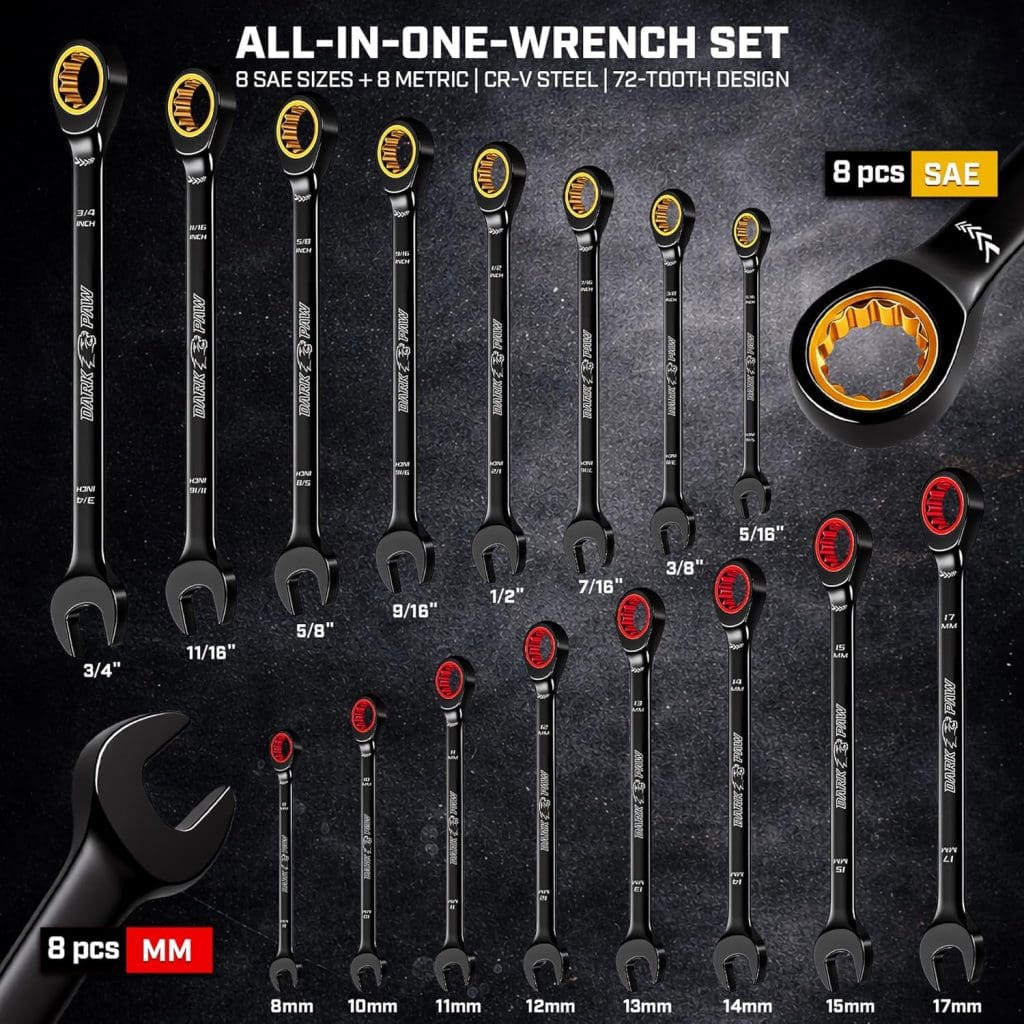
Every mechanic has a moment when a standard wrench just refuses to cooperate. The bolt sits behind an exhaust manifold, wedged between a coolant hose and the firewall, and no amount of repositioning gives you the clearance you need. That frustration is exactly what the 15-piece metric flex head ratcheting combination wrench set was designed to eliminate. By combining a pivoting head, a fine-tooth ratchet mechanism, and a combination open-and-box-end design in a single tool, this style of wrench covers more ground in tight spaces than any fixed-head alternative ever could.
This guide takes a hands-on, research-backed look at what makes a 15-piece metric flex head ratcheting combination wrench set worth owning. We will walk through the engineering behind the design, compare key specifications across price tiers, examine material choices, and explain why this particular piece count and size range hits the sweet spot for automotive, motorcycle, HVAC, and general maintenance work. Whether you are a professional technician who turns wrenches for a living or someone building a solid home garage setup, the information here will help you make a smarter purchase.
What Makes the 15-Piece Metric Set the Sweet Spot?
Wrench sets come in all sorts of configurations — 5-piece starter kits, 12-piece standard sets, and bloated 24-piece collections that sometimes pad the count with odd sizes nobody reaches for. The 15-piece metric set occupies a different position. Typically spanning 8mm through 22mm with no gaps, it covers the complete range of fastener sizes you encounter in everyday mechanical work. That means you get the small 8mm and 9mm wrenches needed for interior trim screws and small clamps, the workhorse 10mm through 17mm range that dominates engine and suspension work, and the larger 18mm through 22mm sizes required for structural bolts, axle nuts, and heavy fittings.
Fewer pieces than fifteen and you start missing sizes you will inevitably need, forcing you to buy individual replacements. More pieces than fifteen in a metric-only set, and you are likely paying for redundant half-millimeter increments that rarely appear on production vehicles. A well-curated 15-piece metric set is the kind of ratcheting combination wrench purchase that eliminates second-guessing. IRONCUBE’s 15-piece metric combination wrench set exemplifies this philosophy, covering 8mm to 22mm with a 12-point box end design that fits both hex and square fasteners.
Understanding the Ratcheting Combination Wrench Design
A wrench in its simplest form is just a lever with a shaped opening. The combination wrench adds two different end designs — an open end for quick positioning on accessible fasteners and a box end for stronger grip on tighter bolts. Adding a ratcheting mechanism to the box end transforms the tool into something far more efficient. Instead of lifting, repositioning, and re-engaging the wrench after each partial turn, the ratchet mechanism lets you cycle back without losing contact with the fastener.
The flex head takes this a step further. By building a pivot joint between the ratcheting head and the handle, the wrench can approach fasteners from a wide range of angles — typically up to 180 degrees of total pivot. If you have ever tried to remove a bolt tucked behind an alternator bracket or loosen a fitting above a transmission housing, you know how valuable that angular flexibility becomes. Understanding how a ratchet wrench works at a mechanical level helps you appreciate the internal gear engineering that makes this combination possible.
The 72-Tooth Ratcheting Standard
Most professional-grade ratcheting combination wrench sets use a 72-tooth internal gear mechanism. This produces a 5-degree swing arc — meaning the handle only needs to move 5 degrees before the ratchet engages the next tooth and starts turning the fastener again. In practical terms, a 5-degree arc lets you work in spaces where you have barely an inch of handle clearance. Higher-end models push to 90 or even 144 teeth, shrinking the arc to 4 degrees or 2.5 degrees respectively. For most mechanics, the 72-tooth design hits the perfect balance between fine engagement and long-term durability of the internal pawl mechanism.
Why the Flex Head Changes Everything
Fixed-head ratcheting wrenches work beautifully on accessible bolts where you can approach from a straight angle. The moment the environment gets cramped, though, the rigid head becomes a liability. The benefit of a flexible head ratchet is that it bends where a fixed head cannot. You gain knuckle clearance, you work around obstructions like hoses and wiring harnesses, and you reach recessed fasteners without disassembling surrounding components first. Many professionals who own both styles report reaching for the flex head version roughly 70 percent of the time, reserving fixed heads only for maximum-torque situations.
For a detailed exploration of practical applications, IRONCUBE has published a guide on flex head ratcheting sets for working in tight spaces that covers real-world scenarios where this design shines.
Material and Build Quality: What Separates Professional from Disposable
The material composition of a ratcheting combination wrench determines everything about its service life. Chrome vanadium steel (Cr-V) has been the gold standard for professional hand tools for decades. This alloy combines approximately 0.8 to 1.1 percent chromium for surface hardness and corrosion resistance with 0.15 to 0.25 percent vanadium for improved grain structure and toughness. The result is a wrench that resists deformation under high torque, maintains tight dimensional tolerances at the fastener contact points, and does not become brittle in cold working conditions.
Surface finishing adds another critical layer of quality. Chrome plating protects against moisture, oil, and corrosive chemicals that are present in every shop environment. A properly plated wrench also wipes clean more easily and resists the pitting that gradually destroys unfinished steel surfaces. IRONCUBE’s chrome vanadium flex head wrench sets feature heat-treated Cr-V steel with a satin chrome finish designed for demanding daily use.
Budget wrenches often use lower-grade carbon steel or skip proper heat treatment to cut costs. The consequences show up quickly — rounding at the box end, a mushy ratchet mechanism that loses its click within months, and surface rust appearing after the first humid season. When a quality ratcheting combination wrench costs only marginally more than a disposable one, investing in better steel pays for itself in the first year of use.
The Ratcheting Combination Wrench in Today’s Hand Tools Market
The ratcheting combination wrench sits at the center of a massive and growing industry. According to a 2025 report from Future Market Insights, the global hand tools market is valued at approximately USD 17.9 billion and is projected to grow at a compound annual growth rate of 5.9 percent, reaching USD 33.6 billion by 2036. Wrenches hold the largest product segment in this market at roughly 33.9 percent of global value — a reflection of how fundamental they remain across automotive, construction, manufacturing, and maintenance sectors.
The rise of DIY culture has played a significant role in this growth. Online tutorials and social media platforms have given millions of people the confidence to tackle repairs that used to require a professional. At the same time, the shift toward online tool purchasing has made it easier for buyers to compare specifications, read reviews, and make informed decisions before committing to a set. The auto care industry alone employs roughly 887,000 technicians in the United States, and the replacement cycle for hand tools in that sector remains constant. All of these factors keep demand strong for quality ratcheting wrench sets at every price tier.
15-Piece Metric Ratcheting Combination Wrench: Key Specs Compared
Choosing the right set means understanding how specifications translate into real-world performance. The following comparison highlights what to look for when evaluating any 15-piece metric ratcheting combination wrench set.
| Specification | Budget Tier ($15–$30) | Mid-Range ($30–$60) | Premium ($150+) |
| Material | Carbon steel / basic alloy | Chrome vanadium steel | Chrome vanadium / S2 alloy |
| Tooth Count | 36–45 teeth | 72 teeth | 90–144 teeth |
| Swing Arc | 8–10° | 5° | 2.5–4° |
| Flex Head Range | ~120° or none | ~180° | 180°+ with locking |
| Finish | Basic paint / raw | Chrome plated satin | Chrome plated mirror |
| Size Range | 8–19mm (gaps) | 8–22mm (complete) | 8–22mm + extras |
| Storage | Loose / basic roll | Canvas pouch / case | Foam tray / organizer |
| Warranty | None / 90 days | 12–24 months | Lifetime |
| Best For | Emergency / backup | Daily professional use | Heavy shop investment |
The mid-range tier delivers the strongest value for most buyers. You get chrome vanadium construction, a 72-tooth mechanism proven over decades of professional use, a complete size range with no frustrating gaps, and functional storage that protects the tools. IRONCUBE positions their ratcheting combination wrench sets squarely in this tier, offering professional-grade materials and manufacturing at an accessible price. Their Amazon storefront makes purchasing straightforward for those who prefer fast shipping.
Where a 15-Piece Metric Ratcheting Combination Wrench Set Proves Its Worth
Automotive Repair and Maintenance
Modern engine compartments are tighter than they have ever been. Turbochargers, emissions equipment, and hybrid battery packs consume space that used to leave generous wrench clearance. A metric flex head ratcheting combination wrench earns its keep most dramatically in automotive work — loosening alternator bolts hidden behind accessory brackets, removing exhaust manifold studs at awkward angles, and reaching brake caliper bolts tucked behind rotor assemblies. The 15-piece metric range covering 8mm through 22mm handles virtually every fastener on European and Asian vehicles, which make up the vast majority of the global fleet.
Motorcycle mechanics find these sets especially valuable because of the compact geometry on bikes. Fasteners sit recessed deep within the frame, surrounded by cooling fins and bodywork. IRONCUBE designs their wrench sets with motorcycle and racing team maintenance as a core use case, reflected in the slim box-end profile and the size range that matches the most common metric fasteners on two-wheelers.
HVAC, Plumbing, and Industrial Work
HVAC technicians routinely work inside air handlers, behind ductwork, and above ceiling tiles. A flex head ratcheting combination wrench that locks at a chosen angle lets you set your approach once and maintain it across multiple fasteners in a row — a significant time-saver when you are on a ladder or reaching overhead. Plumbing work presents identical challenges with fittings buried behind walls and under sinks with minimal clearance.
Industrial maintenance teams benefit from the larger end of the 15-piece range. Factory equipment, conveyors, and production-line machinery often require 19mm through 22mm wrenches for structural fasteners. For jobs that demand even larger sizes, IRONCUBE offers extra-large heavy-duty ratcheting wrenches and a dedicated large heavy-duty ratcheting wrench line that extends coverage beyond what standard sets provide.
Metric vs. SAE: Choosing the Right Measurement System
One of the most common buying mistakes is grabbing the wrong measurement system. Metric wrenches fit fasteners measured in millimeters, which is the standard across European, Japanese, Korean, and Chinese vehicles. SAE (Society of Automotive Engineers) wrenches fit fractional inch fasteners used primarily on American vehicles and older domestic equipment. Using a metric wrench on an SAE bolt — or vice versa — leads to sloppy fit, rounded bolt heads, and skinned knuckles.
If you work on a mix of vehicles, owning both systems is essential. IRONCUBE produces a matching 15-piece SAE combination wrench set that pairs perfectly with the metric version. For quick reference when converting between systems, their printable metric to SAE conversion chart is a practical desk resource that saves time during mixed-fastener jobs.
What to Consider Before Buying a Ratcheting Combination Wrench Set
Ratchet smoothness and backdrag. The ratcheting mechanism should cycle smoothly in the free-spin direction with minimal resistance. Excessive backdrag — the friction you feel when spinning the wrench backward — slows you down and causes hand fatigue during long jobs. Chrome vanadium internals with controlled heat treatment produce the smoothest action.
Flex head quality. The pivot should feel firm but adjustable. A loose pivot undermines the entire purpose of a flex head ratcheting combination wrench because it droops under load and shifts during torque application. Some premium sets include a locking mechanism that holds the head at a selected angle. At minimum, the pivot should hold position under moderate hand pressure.
Storage and organization. A 15-piece set without proper storage becomes a tangled mess in your drawer within days. Look for sets that include a rolling pouch with individual slots, a wax canvas bag, or a molded organizer tray. IRONCUBE includes purpose-built storage with each set — protecting the chrome finish and keeping sizes instantly identifiable.
Brand accountability. Reputable manufacturers back their tools with meaningful warranty coverage. IRONCUBE provides a 24-month warranty on their professional hand tools and offers direct support through their contact page. That kind of accountability separates committed brands from anonymous vendors.
Pricing and Value: Getting the Most from Your Investment
Budget 15-piece metric sets from unknown brands start around $15 to $30, but they frequently suffer from soft steel, rough ratchet action, and finishes that corrode within months. Mid-range sets from established manufacturers like IRONCUBE run approximately $30 to $60 for the same piece count with chrome vanadium steel, 72-tooth mechanisms, and proper storage included. Premium professional sets from tool-truck brands can exceed $200 to $400 for comparable metric coverage.
For buyers who want honest pricing context, IRONCUBE’s flex head wrench pricing guide compares what you get at each tier so there are no surprises. The sweet spot for most users falls in the mid-range, where chrome vanadium construction, functional flex heads, and reliable ratcheting action converge without the premium-brand markup.
Why IRONCUBE Delivers Professional Value at Mid-Range Pricing
IRONCUBE WORKS has manufactured professional-grade hand tools from their Ningbo facility since 2008. What separates them from generic sellers is vertical integration — they control the entire process from raw material sourcing through forging, CNC machining, heat treatment, and final assembly. That level of control eliminates the quality inconsistencies that plague brands sourcing from different factories each quarter.
Their ratcheting combination wrench sets comply with ASME standards for torque requirements, which means each wrench has been tested to handle specified load levels without failure. The 72-tooth mechanism operates with a precise 5-degree arc, and the chrome vanadium steel construction handles daily shop abuse without deformation. You can see IRONCUBE’s tools demonstrated in real working conditions on their YouTube channel, where practical application videos show how the tools perform under actual load.
For buyers looking at the best large ratchet wrench options for heavy-duty applications, IRONCUBE’s lineup extends beyond standard metric sets into specialty sizes that many competitors ignore entirely.
Frequently Asked Questions About the 15pc Metric Ratcheting Combination Wrench
What sizes are included in a 15-piece metric ratcheting combination wrench set?
A standard 15-piece metric ratcheting combination wrench set typically includes 8mm, 9mm, 10mm, 11mm, 12mm, 13mm, 14mm, 15mm, 16mm, 17mm, 18mm, 19mm, 20mm, 21mm, and 22mm. This range covers the fastener sizes found on the vast majority of European, Japanese, and Asian vehicles, as well as most industrial equipment. Having no gaps in the sequence means you will not need to buy additional individual wrenches to complete your set.
Is a 72-tooth ratcheting mechanism good enough for professional work?
Yes. A 72-tooth mechanism produces a 5-degree swing arc, which handles approximately 90 percent of real-world mechanical tasks without issue. Higher tooth counts like 90 or 144 offer finer engagement but increase manufacturing cost and can reduce pawl durability under extreme loads. For most professional mechanics, a 72-tooth ratcheting combination wrench delivers the ideal balance between precision and long-term reliability.
Can I use metric flex head wrenches on SAE fasteners?
This is not recommended. While some metric and SAE sizes are close in measurement (for example, 13mm is approximately 1/2 inch), the fit is never exact. Using a slightly oversized wrench risks rounding off the bolt head, which creates a much bigger problem than the original repair. Owning both metric and SAE ratcheting combination wrench sets is the proper solution for anyone who works on mixed fleets.
How do I maintain a ratcheting combination wrench set?
Wipe each wrench down with a clean cloth after use to remove grease and debris. Apply light machine oil or spray lubricant to the ratcheting mechanism every few months to keep the internal gears operating smoothly. Store the set in its included pouch or organizer to prevent chrome damage from contact with other tools. Avoid using any ratcheting combination wrench as a pry bar or striking it with a hammer, as this damages the ratchet mechanism and can void your warranty.
What is the advantage of a flex head over a fixed head ratcheting wrench?
The flex head pivots up to 180 degrees, allowing you to approach fasteners from multiple angles without switching tools. This is critical in cramped engine bays, inside mechanical enclosures, and anywhere obstructions prevent straight-on access. Fixed heads deliver slightly more torque through their rigid connection, but a quality flex head ratcheting combination wrench handles the vast majority of real-world torque demands while offering far greater versatility in tight spaces.
Why does chrome vanadium steel matter in wrench construction?
Chrome vanadium steel combines hardness, tensile strength, and corrosion resistance in a way that basic carbon steel cannot match. The chromium content hardens the surface and resists rust, while vanadium refines the grain structure and adds toughness to prevent cracking. This means a Cr-V ratcheting combination wrench maintains its dimensional accuracy under repeated stress, resists rounding at fastener contact points, and performs reliably even in cold or humid conditions.
Final Summary
The 15-piece metric flex head ratcheting combination wrench set occupies the sweet spot in any mechanic’s toolkit. Fifteen sizes covering 8mm through 22mm eliminate the gap anxiety that comes with smaller sets, while the flex head and 72-tooth ratcheting mechanism deliver the access and efficiency that modern cramped engine bays demand. Chrome vanadium steel construction ensures durability measured in years rather than months, and proper storage keeps every size organized and ready to grab.
For buyers who want professional-grade engineering without the tool-truck markup, IRONCUBE’s wrench catalog offers a compelling selection of ratcheting combination wrench sets built with vertically integrated quality control, ASME-compliant torque ratings, and a 24-month warranty. Available through their website and on Amazon, these are tools designed to earn a permanent spot in your working toolbox.