
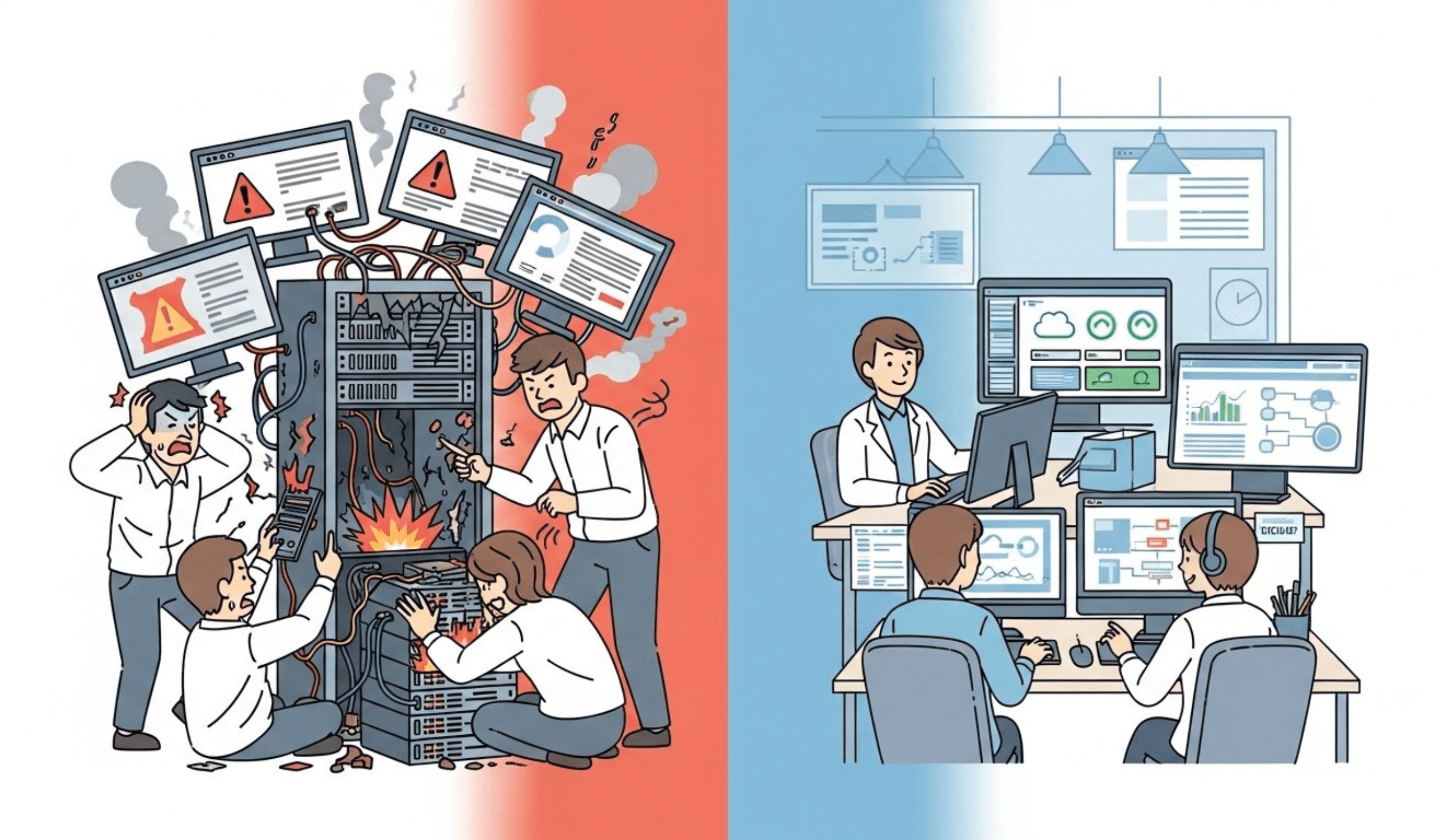
A server crash at 2 PM on a Friday. Email systems offline during your busiest sales period. Ransomware locking your customer database. For California SMBs, these disasters share one thing in common: they could have been prevented.
When technology fails, businesses lose revenue, customers lose patience, and employees lose productivity. The difference between thriving and barely surviving often comes down to one choice: waiting for problems to happen or stopping them before they start.
The True Cost of Downtime for California SMBs
Every minute your systems stay offline costs money you cannot recover. A healthcare practice in Fresno loses patient appointments and billing capability. A Central Valley food processor halts production lines. A retail shop on Shaw Avenue cannot process credit cards or access inventory. Small businesses face substantial losses when critical systems fail.
Direct costs hit immediately. Revenue stops flowing when point-of-sale systems crash or e-commerce sites go dark. Employees remain on payroll but cannot work when they lose access to email, files, and business applications. Recovery expenses pile up through emergency IT service calls billed at premium rates.
Indirect costs hurt just as much over time. Customers who cannot reach you take their business elsewhere. Missed deadlines damage professional relationships that took years to build. Your team spends days recovering lost work and reentering data. California’s competitive business environment means companies facing frequent outages lose ground to competitors whose systems run reliably.
Why Break-Fix IT Support Keeps You in Crisis Mode
The break-fix approach seems simple: call someone when technology breaks, pay to get it fixed, then wait for the next problem. Many California SMBs start here because the monthly cost appears lower than managed services. The reality proves far more expensive.
Break-fix keeps you in constant reaction mode. Problems appear without warning. A failed hard drive destroys weeks of accounting data. Outdated software creates security holes that hackers exploit. Network equipment deteriorates until complete failure stops all operations. By the time you notice something wrong, the damage already exists.
Costs spike unpredictably. One month you pay nothing, the next month brings a substantial emergency server repair. Different technicians respond to each call, requiring time to learn your systems before starting repairs. Hourly billing creates an incentive for longer fixes rather than faster resolutions.
Security vulnerabilities multiply in reactive environments. Without continuous monitoring, malware spreads undetected. Software patches that close security gaps get applied late or not at all. Backup systems fail silently, leaving you unprotected until disaster strikes. Many managed IT support for Woodward Park businesses have shifted away from break-fix precisely because prevention costs far less than recovery.
How Proactive IT Support Prevents Problems Before They Start
Proactive IT management flips the entire equation. Instead of waiting for failures, monitoring systems watch your infrastructure around the clock. Automated alerts notify technicians when hard drives show early signs of failure, when servers run low on storage, or when unusual network activity suggests a security threat. Problems get fixed during business hours before users notice anything wrong.
Preventive maintenance keeps systems healthy. Software updates install on regular schedules. Security patches deploy within days of release rather than months later. Performance tuning prevents slow systems from grinding to a halt. Equipment nearing end-of-life gets replaced on your schedule, not when it fails during your critical season.
Predictable monthly fees replace surprise emergency bills. You know exactly what IT will cost each month, making budgets reliable and eliminating financial shocks. That flat fee covers monitoring, maintenance, security, help desk support, and strategic planning. Many California SMBs discover their total IT spending drops after switching from reactive to proactive support.
Strategic planning aligns technology with business goals. Need to open a second location? Your IT partner already knows your systems and can replicate them efficiently. Planning to hire new employees? Your network and software licenses scale smoothly. Growth becomes an IT strength rather than an IT headache.
Five Proactive Strategies That Reduce Downtime
Continuous System Monitoring forms the foundation of prevention. Monitoring software tracks every server, workstation, and network device in real time. When storage space drops below safe levels, when processors run too hot, or when memory usage spikes abnormally, alerts trigger immediately. Technicians investigate and resolve issues during normal hours rather than at 3 AM during an outage. This visibility catches problems that would otherwise remain hidden until complete failure.
Automated Patch Management closes security gaps before attackers exploit them. New vulnerabilities emerge constantly in operating systems, applications, and network equipment. Proactive IT teams test and deploy patches on regular schedules. Automated systems apply these updates during off-hours to minimize disruption. Manual patching in break-fix environments often falls months behind, leaving systems exposed.
Regular Backup Testing verifies your safety net actually works. Many businesses discover too late that their backups were incomplete or corrupted. Proactive support includes scheduled restoration tests that confirm data can actually be recovered when needed. Backups replicate to offsite locations, protecting against local disasters like fires or floods. You gain confidence knowing your business can survive data loss events.
Network Security Layers defend against ransomware, phishing, and unauthorized access. Firewalls block malicious traffic. Endpoint protection stops malware before it spreads. Email filtering catches phishing attempts before they reach inboxes. Security monitoring detects unusual activity that signals potential breaches. These layers work together to prevent the attacks that cause the longest, most expensive downtime.
Help Desk and User Support keep employees productive when questions arise. Remote support resolves most issues within minutes. Complex problems get escalated to experienced technicians who already know your environment. Some situations require onsite visits, and local technicians respond quickly. Fast, knowledgeable support means minor issues never become major productivity losses.
The ROI of Proactive IT Management
Businesses switching to proactive IT support typically reduce downtime substantially within the first year. That reduction translates directly into saved revenue, recovered productivity, and avoided emergency repair costs. A Fresno accounting firm paying a monthly fee for managed services prevents multiple hours of downtime annually. The prevention saves far more than the service costs when you factor in avoided emergency repairs, improved security, and enhanced productivity.
Predictable IT budgets eliminate financial surprises. Finance teams can plan accurately when monthly costs remain consistent. No more scrambling to cover emergency server replacements or ransomware recovery. That predictability improves cash flow management and removes a major source of business uncertainty.
Employee productivity improves measurably. Workers spend time on their actual jobs instead of waiting for crashed systems to restart or dealing with slow computers and network issues. IT frustrations decrease, morale improves, and output increases. California’s tight labor market makes this productivity gain particularly valuable.
Compliance becomes manageable rather than overwhelming. Healthcare practices meet HIPAA requirements. Retailers maintain PCI standards for credit card processing. Professional services firms comply with California data privacy laws. Proactive support includes the documentation, controls, and monitoring that regulators expect. Avoiding compliance penalties and audit problems protects both finances and reputation.
Conclusion
Technology should drive your business forward, not hold it back with constant emergencies. Proactive IT support transforms technology from a recurring problem into a reliable business foundation. Monitoring prevents failures, maintenance keeps systems healthy, and predictable costs eliminate budget surprises. California SMBs competing in fast-moving markets cannot afford the downtime, uncertainty, and expense of reactive break-fix support. Prevention always costs less than recovery.