
In the world of portable audio, bass has become the defining benchmark of quality. Listeners don’t just want sound they want depth, weight, and physical presence. This is why the search for portable bluetooth speakers with good bass continues to grow across both casual users and serious audio enthusiasts.
Yet, the majority of portable speakers still struggle to deliver bass that is both deep and controlled. Many sound loud, some sound warm, but very few achieve the balance of extension, clarity, and efficiency that defines true low-frequency performance.
The reason is simple: bass is not a feature you can add it is the result of complex acoustic engineering. This article breaks down that complexity, offering a technical, educational perspective on how bass works in portable Bluetooth speakers, why most designs fall short, and how advanced systems like the UB+ dB1 DOUBLEBASS solve these challenges through physics-driven design.
Bass as an Engineering Challenge
At its core, bass reproduction is a problem of energy transfer.
Low-frequency sound waves require a speaker to move large volumes of air. This movement creates pressure variations that propagate through space and are perceived as bass. The lower the frequency, the more demanding this process becomes.
This leads to a fundamental constraint:
Deep bass requires large air displacement, but portable speakers are inherently small.
To overcome this contradiction, designers must focus on efficiency, control, and system integration.
The Role of Air Displacement
Air displacement is the foundation of bass performance. It depends on two key factors:
- The surface area of the moving element
- The distance it can travel (excursion)
In large systems, both can be increased easily. In portable speakers, both are limited, which forces engineers to find alternative solutions.
Without sufficient air displacement, bass becomes:
- Shallow
- Weak
- Lacking physical impact
Internal Pressure and Acoustic Control
Air movement alone is not enough. The system must also control internal pressure.
Inside a speaker enclosure, air behaves like a spring. If not managed properly, it can:
- Resist driver movement
- Create unwanted resonances
- Distort the output signal
Effective bass reproduction requires a design that allows pressure to build, distribute, and release smoothly.
Structural Stability and Energy Efficiency
As a driver moves, it generates reactive forces. If the enclosure is not stable, these forces cause vibration, which leads to:
- Energy loss
- Reduced output
- Audible distortion
A well-designed system minimizes these effects, ensuring that energy is used for sound not wasted as mechanical movement.
Why Conventional Portable Speakers Fall Short
Most portable Bluetooth speakers rely on design principles that prioritize simplicity and cost efficiency over acoustic performance.
Box-Shaped Enclosures
Rectangular enclosures create parallel surfaces, which lead to standing waves. These waves interfere with bass reproduction, causing uneven frequency response.
Outward-Facing Drivers
Traditional drivers push sound directly outward, limiting the system’s ability to build internal pressure. This reduces the effectiveness of low-frequency reproduction.
Limited Radiating Elements
Many speakers use a single passive radiator or small port. These components cannot move enough air to produce deep bass consistently.
DSP-Based Bass Enhancement
Digital signal processing is often used to boost bass artificially. While this can create an initial impression of depth, it often introduces:
- Distortion
- Compression
- Loss of clarity
A Physics-Driven Alternative
To create truly effective portable bluetooth speakers with good bass, engineers must rethink the entire system.
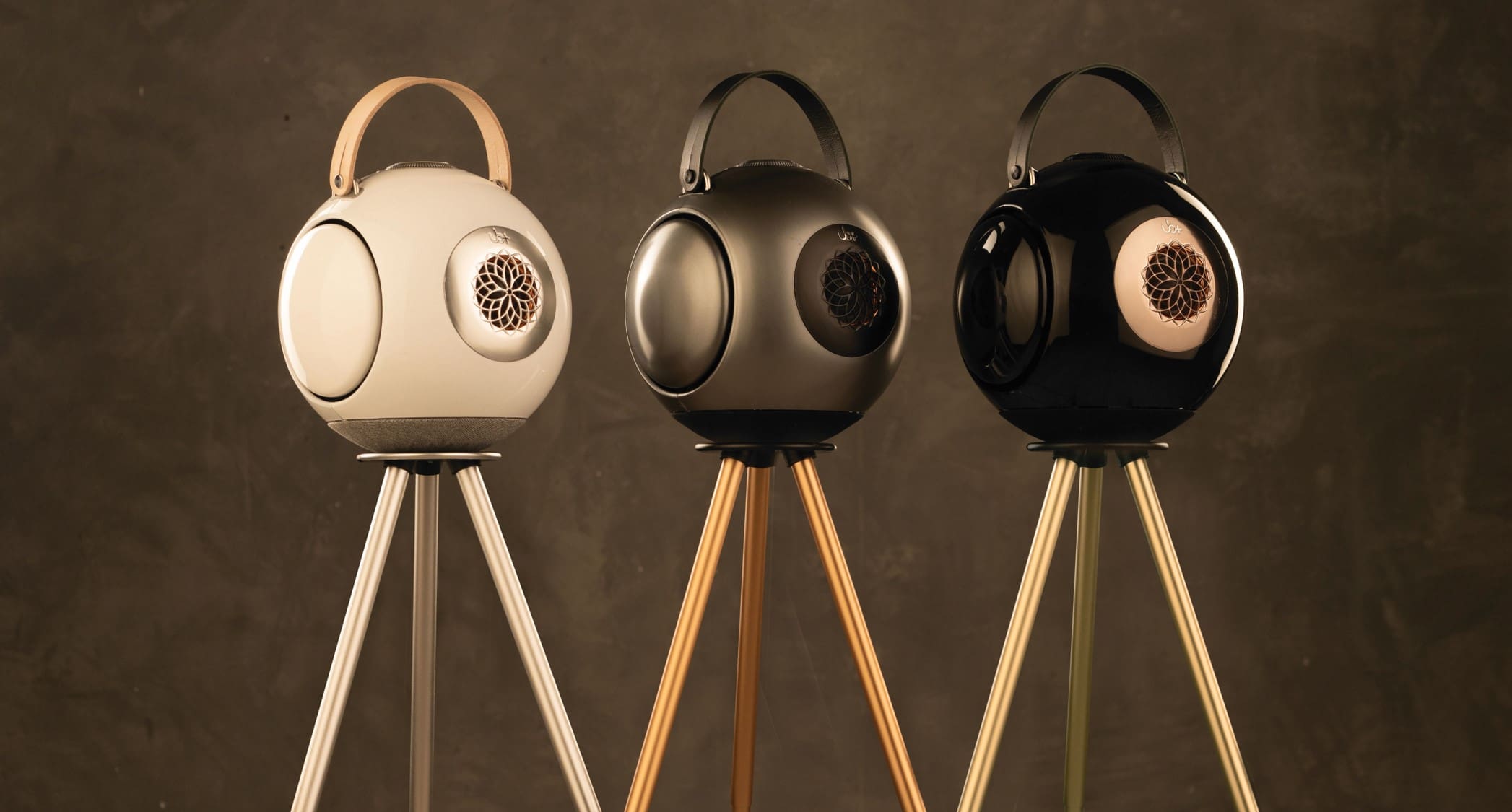
The UB+ dB1 DOUBLEBASS is an example of this approach, combining advanced acoustic principles into a unified design.
Spherical Enclosure: Eliminating Acoustic Interference
One of the most important innovations is the use of a spherical enclosure.
Unlike rectangular shapes, a sphere has no parallel surfaces. This eliminates standing waves and allows for uniform pressure distribution.
The benefits include:
- Cleaner bass response
- Reduced distortion
- Improved consistency
Helmholtz-Inspired Acoustic Behavior
The spherical enclosure functions as a resonant chamber, where internal air oscillates in response to the driver.
This allows the system to:
- Reinforce low frequencies naturally
- Store and release energy efficiently
- Reduce reliance on digital processing
Inward-Firing Driver: A Different Approach to Sound Generation
The dB1 DOUBLEBASS uses an inward-firing mid-bass driver.
Instead of projecting sound outward, the driver:
- Generates controlled internal pressure
- Energizes the enclosure
- Allows sound to be shaped before emission
Technical Features
- High-strength neodymium magnet
- Long-stroke voice coil
- Wide surround for stability
- Aluminum shorting ring for reduced distortion
This configuration enables precise control over air movement.
Dual Symmetrical Passive Radiators
The system uses two passive radiators positioned opposite each other.
These radiators convert internal pressure into sound. Their symmetrical placement creates a self-balancing system, reducing vibration and improving efficiency.
This results in:
- Cleaner bass
- Higher output efficiency
- Better performance at high volumes
Surface Area and Mechanical Amplification
A key innovation is the increased radiating surface area.
The passive radiators provide significantly more surface area than the driver, allowing the system to:
- Move more air
- Reduce strain on the driver
- Maintain linear performance
This concept of mechanical amplification is essential for achieving deep bass in a compact design.
System Integration: A Unified Acoustic Design
The effectiveness of the dB1 DOUBLEBASS comes from how its components work together:
- The driver generates pressure
- The enclosure distributes it evenly
- The radiators convert it into sound
- The symmetrical design stabilizes the system
This integration ensures efficient, controlled bass reproduction.
Comparison with Popular Portable Speakers
| Feature | UB+ dB1 DOUBLEBASS | JBL | Bose | Marshall |
| Enclosure Geometry | Spherical | Rectangular | Rectangular | Rectangular |
| Pressure Distribution | Uniform | Uneven | Uneven | Uneven |
| Driver Orientation | Inward | Outward | Outward | Outward |
| Radiator Configuration | Dual symmetrical | Dual | Single/Port | Dual |
| Surface Area Efficiency | High | Moderate | Moderate | Moderate |
| Vibration Control | Self-balancing | Partial | Partial | Partial |
| Bass Generation | Mechanical | DSP-assisted | DSP-assisted | DSP-assisted |
What Defines Good Bass in Portable Speakers
The phrase portable bluetooth speakers with good bass should be understood through specific performance characteristics.
Depth
The ability to reproduce low frequencies accurately.
Control
Maintaining clarity without distortion.
Balance
Ensuring bass integrates with mids and highs.
Consistency
Delivering stable performance across environments.
Real-World Listening Experience
Engineering decisions directly affect real-world performance.
Indoor Listening
- Even bass distribution
- Reduced resonance issues
- Balanced sound
Outdoor Use
- Maintained bass presence
- Efficient projection
- Consistent output
High Volume Playback
- Stable performance
- Minimal distortion
- Clear sound
Psychoacoustic vs Physical Bass
Many speakers rely on psychoacoustic techniques to simulate bass. While effective in short-term listening, these methods lack the physical foundation required for sustained performance.
True bass is defined by:
- Air movement
- Pressure control
- Mechanical efficiency
The Future of Portable Bass Engineering
The industry is moving toward engineering-first design, focusing on:
- Advanced enclosure geometries
- High-performance driver systems
- Symmetrical radiator configurations
- Reduced reliance on DSP
Engineering Over Marketing
The search for portable bluetooth speakers with good bass is ultimately about understanding how bass is created.
True bass is not achieved through digital tricks or marketing claims. It is the result of:
- Efficient air movement
- Controlled pressure behavior
- Stable mechanical design
- Integrated acoustic systems
The UB+ dB1 DOUBLEBASS demonstrates how these principles can be applied in a portable format, delivering bass that is deep, controlled, and immersive.
In a crowded market, this approach stands out by focusing on what truly matters: physics, engineering, and authentic sound reproduction.
Explore the UB+ dB1 DOUBLEBASS