

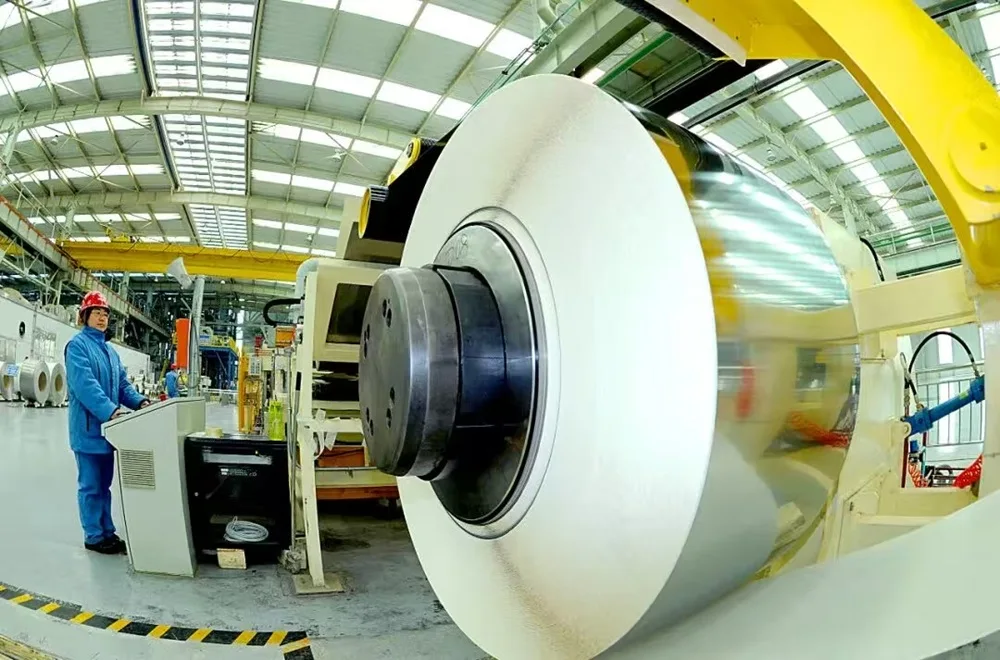
Understanding How Stainless Steel Foil Is Manufactured is a vital asset for engineers, procurement specialists, and industrial designers. In sectors like aerospace, medical technology, and renewable energy, the performance of a component often hinges on the microscopic precision of the foil used.
While it may appear to be a simple thin sheet of metal, the reality is a high-tech, multi-stage metallurgical journey. This process transforms raw, bulky slabs into ultra-thin, high-performance materials through a series of thermal and mechanical refinements.
Phase 1: The Foundation – Material Selection and Casting
Every high-quality foil begins with a precise chemical “recipe.” Manufacturers carefully balance iron, chromium, and nickel to achieve specific traits.
- 301 Stainless Steel Foil: Engineered for high strength and superior spring-back.
- 304 Stainless Steel Foil: The industry standard for versatile corrosion resistance.
Once the alloy is perfected in an electric arc furnace, it is cast into massive slabs. According to the foundational science of what is stainless steel foil, these slabs must be uniform and free of internal impurities to survive the intense thinning processes ahead.
Phase 2: From Slab to Coil – The Hot Rolling Stage
Before it can become “foil,” the steel must first be thinned while hot. The slabs are heated above their recrystallization temperature (typically over $1100$°C) and passed through heavy rollers.
This stage significantly reduces the thickness and breaks down the cast structure of the metal, improving its internal uniformity. However, hot rolling results in a rough “black-skin” surface that is far too coarse for precision applications.
Phase 3: The Precision Stage – Cold Rolling (CRM)
The most critical step in how stainless steel foil is manufactured is cold rolling. Unlike hot rolling, this occurs at room temperature using a 20-high Sendzimir mill.
By applying massive localized pressure, the mill reduces the steel’s thickness from several millimeters down to as little as $0.005$ mm. This process also:
- Work Hardens the Metal: Dramatically increasing tensile strength.
- Refines the Surface: Achieving a smooth, consistent finish.
- Ensures Accuracy: Meeting tolerances as tight as $\pm 1 \mu m$.
For more on these specialized dimensions, see our guide to thin stainless steel foil thickness applications.
Phase 4: Restoring Ductility – The Annealing Cycle
Cold rolling makes the metal strong, but it also makes it brittle. To restore flexibility, the foil undergoes Annealing. The foil is heated in a controlled atmosphere (often 100% Hydrogen for a “Bright Annealed” finish) to allow the crystalline structure to “relax.”
This step is essential because it:
- Relieves Internal Stresses: Preventing the foil from cracking during use.
- Improves Ductility: Allowing the foil to be bent or stamped into complex shapes.
- Determines Surface Quality: A bright annealing line produces a mirror-like BA finish without the need for acid pickling.
Phase 5: Finishing and Custom Slitting
Once the metallurgical properties are locked in, the foil undergoes its final transformation. Large master coils are fed into precision slitting machines. These machines use circular blades to divide the foil into the exact widths required by the customer—from wide rolls for heat exchangers to narrow 301 stainless steel strips for precision springs.
Explore our full product catalog for more information on available widths and stainless steel foil products.
Quality Assurance: The Final Safeguard
No roll leaves the facility without a rigorous inspection. This includes:
- Laser Thickness Gauging: To ensure uniformity across the entire coil.
- Tensile Testing: To confirm the material meets the required strength specifications.
- Surface Roughness (Ra) Checks: Essential for electronics and medical applications.
For advice on keeping your material in peak condition after delivery, review our guide on stainless foil storage and handling.
Summary
The journey of How Stainless Steel Foil Is Manufactured is a testament to modern industrial precision. By balancing the brute force of cold rolling with the delicate chemistry of bright annealing, manufacturers create a material that is as strong as steel but as flexible as paper.
For technical deep-dives or to discuss custom requirements, visit our main website or check out our latest industry insights on the stainless steel foil blog. If you are ready to start a project, please contact us for a consultation.
A Note from Ewan:
I’m the CEO of stainlesssteelfoil.com. With three decades of experience in the Chinese manufacturing sector, I’ve seen these processes evolve into the high-precision arts they are today. My team and I are dedicated to ensuring that every micron of our foil meets the world-class standards your projects deserve. Let’s talk about your next build!