

The global Positron Emission Tomography (PET) market is gaining momentum due to the increasing demand for advanced diagnostic imaging technologies. PET is a powerful imaging technique that helps visualize metabolic processes in the body, aiding in the early detection and management of various diseases, including cancer, cardiovascular conditions, and neurological disorders. The market includes a wide range of PET scanners, radiotracers, and associated services that are instrumental in modern medical diagnostics.
PET scans are particularly valuable in oncology, as they enable precise detection of cancerous tissues and help monitor the effectiveness of treatments. The technology also plays a crucial role in cardiology and neurology by assisting in the diagnosis of heart diseases and neurodegenerative conditions like Alzheimer’s disease.
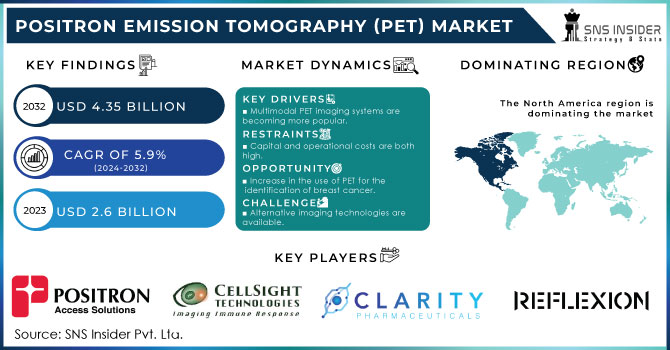
“According to SNS Insider Research, the Positron Emission Tomography (PET) Market size was estimated at USD 2.6 billion in 2023 and is expected to reach USD 4.35 billion by 2032, growing at a compound annual growth rate (CAGR) of 5.9% during the forecast period from 2024 to 2032.”
Download Free Sample Report: https://www.snsinsider.com/sample-request/3443
KEY MARKET SEGMENTATION
By Product
- PET/CT Systems
- Low Slice Scanners
- Medium Slice Scanners
- High Slice Scanners
- PET/MRI Systems
By Application
- Oncology Applications
- Neurological Applications
- Cardiovascular Applications
- Other Applications
By End User
- Hospital & Surgical Centers
- Diagnostic & Imaging Clinics
- Ambulatory Care Centers
- Other End Users
Trends: Several trends are shaping the Positron Emission Tomography (PET) market, including:
- Technological Advancements: Ongoing innovations in PET scanner technology, such as hybrid PET-CT and PET-MRI systems, are enhancing diagnostic accuracy and broadening clinical applications.
- Rising Demand for Personalized Medicine: The growing emphasis on personalized healthcare is driving the demand for PET imaging, as it provides detailed insights into individual patient conditions.
- Increased Use in Oncology: The rising prevalence of cancer worldwide is boosting the adoption of PET imaging for early diagnosis and treatment planning.
- Expansion of Radiopharmaceuticals: Advances in radiotracer development are expanding the range of conditions that can be effectively diagnosed with PET imaging.
- Integration of AI and Machine Learning: The incorporation of artificial intelligence in PET imaging is improving image interpretation, enhancing diagnostic accuracy, and reducing scan times.
Solutions and Services: The PET market offers a variety of solutions and services to meet the needs of healthcare providers and patients. Key products and services include:
- PET Scanners: Advanced imaging systems that provide high-resolution images for diagnosing various diseases.
- Radiopharmaceuticals: Specialized tracers used in PET imaging to detect abnormalities in the body.
- Hybrid Imaging Systems: Combined PET-CT and PET-MRI scanners that offer comprehensive diagnostic information by merging anatomical and functional data.
- Service and Maintenance: Support services ensuring optimal performance of PET imaging systems and compliance with regulatory standards.
- Imaging Software Solutions: Advanced software tools that assist in image reconstruction, analysis, and interpretation.
Industry Analysis: The Positron Emission Tomography (PET) market is experiencing steady growth, driven by advancements in imaging technology, increasing cancer prevalence, and the expanding use of PET in neurology and cardiology. Analysts project a compound annual growth rate (CAGR) of 5.9% over the forecast period. Key sectors such as hospitals, diagnostic centers, and research institutes are leading the adoption of PET imaging, contributing to market expansion.
Applications: PET imaging is essential in various medical fields, including:
- Oncology: PET is widely used for the detection, staging, and monitoring of cancer, as well as evaluating treatment responses.
- Cardiology: PET assists in the diagnosis of heart diseases by assessing myocardial perfusion and viability.
- Neurology: PET imaging helps detect neurodegenerative conditions, including Alzheimer’s disease, by visualizing brain activity and identifying abnormalities.
- Research and Development: PET plays a significant role in clinical research, drug development, and the study of various diseases.
Regional Development: The adoption of PET imaging varies across regions, with North America leading the market due to advanced healthcare infrastructure, high demand for diagnostic imaging, and significant investments in research. Europe follows closely, driven by strong healthcare systems and government support for medical innovation. The Asia-Pacific region is witnessing rapid growth, fueled by increasing healthcare investments, rising cancer rates, and expanding access to diagnostic services. Emerging markets in Latin America and the Middle East are also recognizing the importance of PET imaging as part of their healthcare development strategies.
Conclusion: The Positron Emission Tomography (PET) market is poised for significant growth as advancements in imaging technology, the increasing prevalence of cancer, and the integration of AI continue to drive innovation. With expanding applications in oncology, cardiology, and neurology, the PET market is set to see sustained development, supporting healthcare providers in delivering more accurate diagnoses and personalized treatment plans.
Read More Details @ https://www.snsinsider.com/reports/positron-emission-tomography-market-3443
Contact Us: Akash Anand – Head of Business Development & Strategy
info@snsinsider.com
Phone: +1-415-230-0044 (US) | +91-7798602273 (IND)