
By Investigations Desk
BEAUMOMONT, TEXAS: Newly released documents show that Pakistani-American healthcare entrepreneur Mohammad Tahir Javed and his son, Saad Javed, were at the centre of a multimillion-dollar billing and filing-fraud network built through Winnie
Community Hospital (WCH) and its successor companies under the Riceland Healthcare brand.
Documents released by the U.S. Department of Justice show that the fraud case— United States of America et al. v. Riceland Healthcare System, LLC et al.—was initiated by the U.S. Department of Justice (DOJ) and the State of Texas under the False Claims Act in August 2018.
The case began after whistleblowers (former employees) and federal auditors reported that Mohammad Tahir Javed, his son Saad Javed, and their companies— including Riceland Healthcare and Winnie Community Hospital—had submitted false and inflated Medicare and Medicaid claims, billed for services not rendered, and engaged in kickback schemes to increase government reimbursements. The purpose of the case was to recover fraudulently obtained federal funds and hold the defendants accountable for systematic healthcare billing fraud across their network of hospitals and clinics in Texas.
Winnie Community Hospital (WCH), a small facility in Chambers County, was once hailed by Javed as a model for rural care. Behind the façade, federal suits and tax records describe a business built on systemic deception of state and federal programs. According to U.S. government papers, the hospital and its parent entities filed inaccurate cost reports and billing statements that overstated patient services and reimbursement codes, later funnelled through a network of Riceland-branded affiliates to mask the source of proceeds.
When the hospital collapsed financially and went bankrupt under Tahir Javed’s watch, its assets were quietly absorbed by Riceland Healthcare System LLC and Riceland Medical Centre LLC—both companies controlled by Tahir Javed, who became caretaker Pakistan Prime Minister Anwar-ul-Haq Kakar’s advisor in 2022 but resigned within days after his scandals came to light, shocking Pakistani authorities. Investigators say the transition allowed him to erase WCH’s liabilities while keeping its revenue streams intact—a move currently under scrutiny as potential bankruptcy and wire fraud.
Documents reveal that in United States of America et al. v. Riceland Healthcare System, LLC et al. (2018), prosecutors alleged that Tahir Javed and his Riceland companies knowingly submitted false or inflated claims to Medicare and Medicaid; miscoded or upcoded routine outpatient visits as higher-reimbursed procedures; rendered “worthless or non-existent” services yet billed taxpayers for them; paid and accepted kickbacks for patient referrals in violation of the Anti-Kickback Statute (42 U.S.C. §1320a-7b) and Stark Law (42 U.S.C. §1395nn); and retained overpayments rather than refunding them, breaching the False Claims Act (31 U.S.C. §3729).

Whistleblower materials described internal audits showing that up to half of sampled claims were fraudulent, yet the findings were allegedly suppressed under the direction of Saad Javed, then a Riceland executive overseeing compliance. Although the case was later dropped under mysterious circumstances a few years later, federal authorities kept the investigation open, citing parallel probes into associated COVID-relief fraud that followed. Investigators and legal authorities have raised questions about transparency and whether there was manipulation at play.
DOJ documents identify more than thirty Texas-registered corporations tied to Javed or family members—many sharing offices, accountants, or mailing addresses. These include: Riceland Healthcare System LLC, Riceland Healthcare LP, Riceland Medical Centre LLC, Riceland Holdings LLC, Riceland Senior Living LLC, Starco Impex Inc.,
Royal Smoke LLC, Winnie Community Hospital LLC—the core facility used for false billing and later bankruptcy concealment—Riceland Realty GP LLC, Healthrix Billing LLC, and Mecca Farms Group LLC.
Through these, investigators allege Javed shifted payroll and tax obligations from one entity to another, allowing insolvent firms like WCH to default while new companies continued billing Medicare under fresh taxpayer IDs.
Between 2003 and 2014, the IRS filed at least seven federal tax liens totalling $1.8 million against WCH for unpaid payroll and corporate taxes, alongside a state lien of $11,766. Despite the debts, the Javed network continued political contributions exceeding $2 million, prompting questions about concealed income and violations of 26 U.S.C. §7201 (Tax Evasion).
When Winnie Community Hospital filed for Chapter 11 bankruptcy in 2012 (Case No. 12-46841-dml11), court records show no disclosure of concurrent asset transfers to Riceland entities. Investigators say medical equipment, patient contracts, and receivables were moved off the books to affiliated LLCs before creditors could seize them—acts consistent with fraudulent conveyance under 18 U.S.C. §157. The hospital was discharged in 2014, but its operations continued under the Riceland name, effectively rebranding the same enterprise without its debts. In Labelle v. Winnie Community Hospital LLC (2017), Richard Labelle, a physician assistant, accused the hospital of denying overtime pay in violation of the Fair Labor Standards Act (29 U.S.C.). He alleged WCH “knowingly, deliberately, and voluntarily” paid straight hourly rates regardless of hours worked. While the suit was dismissed, it provided further evidence of a pattern of cost suppression and falsified payroll filings later echoed in Medicare cost-report irregularities.

The same network surfaced again in the Justice Department’s COVID-19 Fraud Enforcement Task Force inquiries. According to federal investigators, Riceland Investment Group LP and Mecca Farms Group LLC—both tied to Javed— participated in a $35 million Paycheck Protection Program (PPP) scheme, submitting more than 80 fraudulent applications with inflated payrolls. The companies obtained roughly $18 million and laundered portions through related Riceland accounts. Documents showed Javed agreed to buy 55 percent of Mecca Farms for $2.465 million but paid only $200,000, using the rest as cover for diverted PPP proceeds— an alleged violation of 18 U.S.C. 1343 (Wire Fraud) and 1956 (Money Laundering). Even outside healthcare billing, Javed’s companies faced compliance issues. In 2017, the U.S. Food and Drug Administration issued a formal warning to Royal Smoke LLC—another Javed entity—for selling tobacco products to minors and misbranding nicotine goods, an offense under the Federal Food, Drug, and Cosmetic Act. The letter warned of “potential criminal prosecution” if violations continued. Public records from Jefferson County Court (Case No. 56447, 1990) show Javed was convicted of “Theft by Receiving,” receiving five years’ probation. He later failed to disclose this conviction when appointed advisor to Pakistan’s interim Prime Minister Anwar-ul-Haq Kakar in 2023; the appointment was rescinded after exposure of the record. In Texas, a separate ethics complaint forced Javed to withdraw from a Fort Bend County Commission race in 2024.
Sources within Riceland confirmed that Saad Javed, Tahir’s son, oversaw billing and compliance operations during key years when fraudulent submissions occurred.
Internal audits cited in the papers claim Saad directed staff to “adjust billing codes to maximize reimbursement” and later signed off on cost reports now under federal review. Emails and meeting minutes show Saad coordinating with his father to move billing under new corporate IDs as federal scrutiny mounted.
A law-enforcement investigator said: “Taken together, the record portrays Winnie Community Hospital not as an isolated rural facility but as the launchpad for a complex billing-fraud apparatus. Its closure through bankruptcy, followed by the rapid rise of Riceland Healthcare, mirrors a deliberate strategy: discard debt-ridden shells, retain assets, and perpetuate the same fraudulent practices under new names. These are legal exposures related to False Claims Act fraud, wire fraud, and money laundering, tax evasion, Kickback and Stark Law violations, criminal fines, and exclusion from federal health programs. These are estimated combined exposures in tens of millions of dollars and potential revocation of Medicare provider status for all Riceland entities.”
Another federal source aware of the matter raised questions about how the Winnie Hospital court case ended so quietly. “The federal and Texas authorities spent a lot of money investigating the case and bringing the charges. There are serious suspicions surrounding what happened behind the scenes and the role of judiciary members, if anything. There are serious background probes active. Investigators are interested in speaking to several current and former state employees. This was one of the most intricate healthcare-billing fraud cases in Southeast Texas history.” A knowledgeable federal source asked: “What were the official reasons for closing or terminating the Winnie Community Hospital–Riceland Healthcare fraud inquiry? Was the 2018 federal False Claims Act case dismissed due to lack of evidence, settlement, or undisclosed negotiations? Did the Department of Justice or the Texas Attorney General’s Office conduct an internal review into the handling of these cases? Were all judges, prosecutors, and defence attorneys in the case vetted for possible financial, political, or personal connections to the defendants or their affiliates? What safeguards exist to detect or prevent improper influence in high value healthcare fraud cases?”
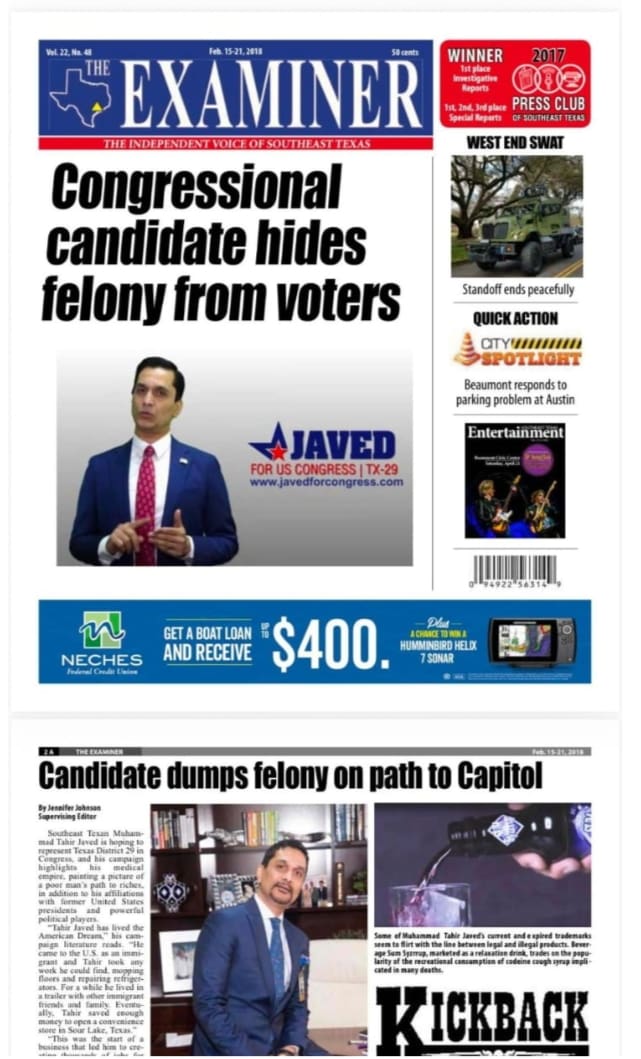
The case United States of America et al. v. Riceland Healthcare System, LLC et al. was filed on August 10, 2018, and “terminated” on March 9, 2023, under a cloud of suspicion. Shortly afterward, Tahir Javed lobbied to become advisor to Pakistan’s caretaker Prime Minister Anwaar-ul-Haq Kakar, specifically on Investment and Diaspora Affairs. He was sacked three weeks later when it emerged that he was convicted in the U.S. state of Texas in 1994 for a felony theft offense—“theft by receiving,” with a deferred imprisonment or probation arrangement of five years. A Pakistani probe committee concluded that he misrepresented his credentials, omitted disclosing his criminal history, and pledged a charitable donation (US$50,000) whose check later bounced.

In 2017, the U.S. Food and Drug Administration issued a formal warning letter to Royal Smoke LLC, owned by Javed, for illegally selling electronic nicotine products to minors, violating the Federal Food, Drug, and Cosmetic Act.
In 2018, the Texas Ethics Commission opened an investigation (Case No. SC-32306211) related to alleged improper campaign contributions or financial irregularities, leading him to withdraw from that race. U.S. federal and state agencies are reported to be investigating him and associates over suspected money laundering, wire fraud, and tax evasion in connection with structures set up to obscure the source of funds for the companies Riceland Investment Group LP (Texas) and Mecca Farms Group LLC—central to suspicious transactions and
ownership changes related to COVID-19 relief fund fraud. The investigation is also tied to broader scrutiny of alleged misuse of COVID-19 relief funds (e.g., PPP loans under the U.S. CARES Act), implicating others in transactions totalling tens of millions of dollars.
In his 2018 campaign, some reports allege that Javed shifted funds between his own companies (e.g., Riceland) and his campaign, used loans to himself, and applied other re-labelling techniques to disguise contributions or financial flows. In 2019, it is alleged that he may have engaged in insurance fraud by scheduling surgeries for family members, billing insurance companies, while publicly participating in social events—raising questions about timing and veracity. He is also linked to a contractual dispute regarding plots in Pakistan via a company, TJ Properties (SMC Private) Limited, with claims that contractual obligations were not fulfilled.