
Receiving a lung cancer diagnosis is overwhelming. Reviewing complex clinical trial data often makes it harder.
You need clear answers about your prognosis. Dense medical jargon and vague statistics only add unnecessary stress.
This article breaks down the exact survival rates and efficacy data for Osimertinib. At Medicine For World, we empower patients by turning complex clinical data into accessible, actionable medical intelligence.
1. Understanding Osimertinib in the Landscape of Lung Cancer Treatment
Osimertinib is a targeted therapy. It is widely sold under the brand name Tagrisso.
It specifically treats non-small cell lung cancer (NSCLC). The cancer must have a specific EGFR mutation to respond.
Doctors classify it as a tyrosine kinase inhibitor (TKI). It works by blocking the signals that tell cancer cells to grow.
For many patients, it is now the standard of care.
2. Osimertinib Survival Rates: Breaking Down the Phase III Data
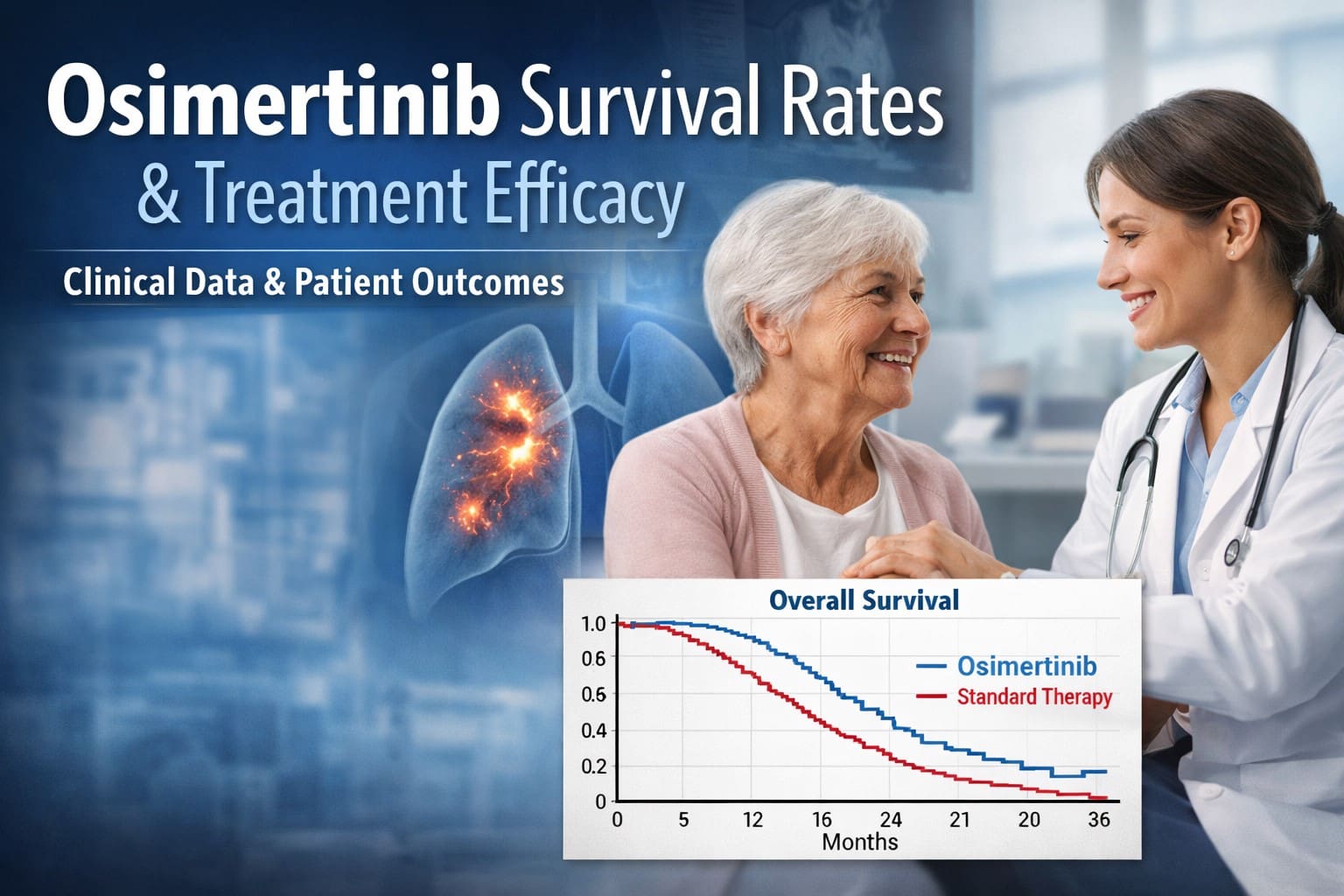
Osimertinib demonstrates a median overall survival of nearly four years for patients with advanced EGFR-mutated NSCLC. Exact survival rates depend heavily on the cancer stage and specific treatment combinations used.
Recent Phase III clinical trials highlight these median overall survival (OS) benchmarks:
- Osimertinib Monotherapy: 38.6 months median overall survival.
- Osimertinib + Chemotherapy: 47.5 months median overall survival.
Progression-free survival (PFS) is also critical. This measures how long a patient lives without the tumor growing.
The FLAURA trial showed a median PFS of 18.9 months for monotherapy. Combining the drug with chemotherapy extends this timeframe significantly.
3. The Frontline vs. Adjuvant Setting: When is Osimertinib Prescribed?
Oncologists prescribe this medication at different stages of the disease. The clinical intent changes based on when you take it.
| Treatment Setting | Cancer Stage | Primary Goal | Key Clinical Trial |
| Adjuvant | Early-stage (Resectable) | Prevent recurrence after surgery. | ADAURA |
| First-Line | Advanced or Metastatic | Halt tumor growth and extend life. | FLAURA / FLAURA2 |
First-Line Therapy for Advanced Stages
Doctors use first-line therapies immediately after an advanced diagnosis. Osimertinib is highly effective here.
It outperforms older, first-generation TKIs. Patients experience longer periods without disease progression.
Adjuvant Therapy for Early-Stage Resectable Tumors
Adjuvant therapy happens after surgical tumor removal. The goal is to keep the patient disease-free.
The ADAURA trial proved its efficacy here. Taking the drug post-surgery significantly reduces the risk of cancer returning.
4. Targeting Brain Metastases: Penetrating the Blood-Brain Barrier
Lung cancer frequently spreads to the brain. This creates central nervous system (CNS) metastases.
Many older drugs cannot cross the blood-brain barrier. This leaves brain tumors unchecked.
Osimertinib was specifically engineered to solve this problem. It effectively penetrates the barrier.
It actively targets the T790M mutation inside the brain. This blocks tumor growth while sparing healthy tissue.
5. Living with Osimertinib: Treatment Duration and Next Steps
Patients take this medication as a daily pill. You continue treatment as long as it controls the cancer.
The median duration of treatment often exceeds two years. This requires managing long-term side effects.
Common side effects include skin rashes and diarrhea. Your oncology team will help you manage these proactively.
Eventually, the cancer may develop resistance. If disease progression occurs, your doctor will order a new biopsy.
This helps them identify new mutations and adjust your treatment plan.
6. Why Trusting Current Data Matters for Your Treatment Plan
Medical oncology evolves rapidly. New clinical trials constantly update our understanding of drug efficacy.
Always discuss recent data with your healthcare provider. Your specific mutation and health history dictate your best options.
At Medicine For World, we remain committed to bringing you the most current, verified data. We want you to feel confident in your treatment decisions.
Frequently Asked Questions (FAQ)
What is the survival rate for osimertinib?
In recent trials, osimertinib combined with chemotherapy demonstrated a median overall survival of 47.5 months for advanced EGFR-mutated NSCLC.
Survival rates vary by individual. They depend heavily on your cancer stage and whether the drug is used as a first-line or adjuvant therapy.
How long can you take osimertinib?
Patients take osimertinib daily for as long as it effectively controls the cancer and side effects remain manageable.
Clinical studies show the median duration of exposure often exceeds 20 to 30 months. Your specific timeline depends on your treatment stage and response.
Is Tagrisso better than chemotherapy?
Yes. For specific EGFR-mutated NSCLC, Tagrisso offers superior progression-free survival and better response rates than traditional chemotherapy alone.
This high efficacy makes it the preferred standard of care. However, doctors sometimes combine it with chemotherapy for even better results.
Does osimertinib cross the blood-brain barrier?
Yes. Osimertinib is specifically designed to penetrate the blood-brain barrier to treat central nervous system metastases.
It shows high efficacy in preventing and shrinking brain tumors. This is a significant advantage over older targeted therapies.
What happens when osimertinib stops working?
If the cancer progresses, oncologists typically perform a new biopsy to identify emerging resistance mutations.
Based on those results, your doctor will recommend next steps. This may include different targeted therapies, clinical trials, or transitioning to new chemotherapy regimens.
