
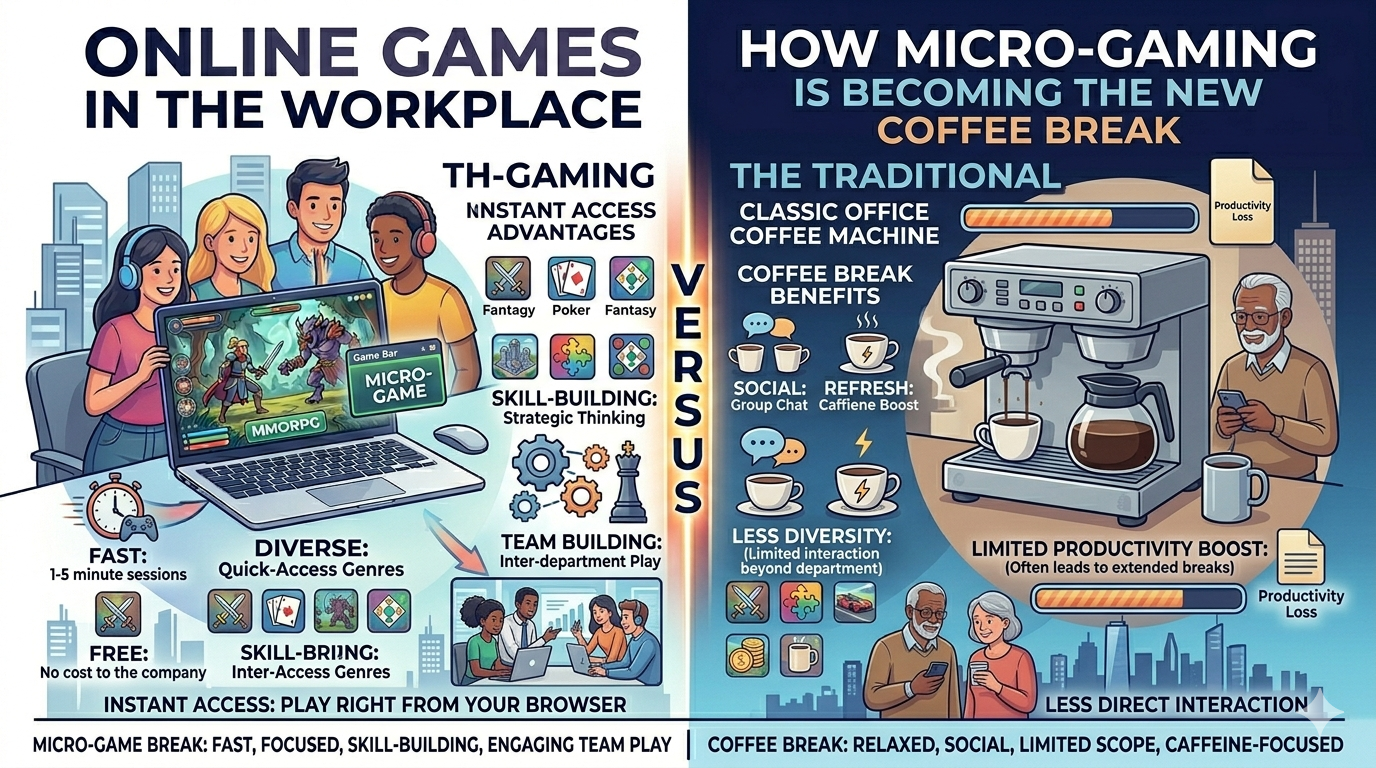
The coffee break is one of the oldest productivity tools in the modern workplace. A few minutes away from the desk, a change of pace, and employees return to work noticeably more focused. The science behind it has always been sound. Short, deliberate pauses reduce mental fatigue, lower stress hormones, and restore the concentration needed for sustained output.
What has changed in 2026 is what those breaks look like. Increasingly, employees are not refilling their mugs or stepping outside for air. They are opening a browser tab and playing a game for five or ten minutes before returning to work. This pattern has a name now: micro-gaming. And it is reshaping how professionals think about rest, recovery, and productivity during the working day.
The Attention Crisis No One Is Talking About
The modern workplace demands more sustained concentration than at any point in history. AI tools have amplified workloads rather than reduced them. Workers handle more tasks, respond to more messages, and switch contexts more frequently than before. Research cited across major business publications in 2026 shows that the average focused work session now lasts just over 13 minutes, down significantly from prior years, while collaboration time and multitasking have both increased sharply.
Against that backdrop, the traditional coffee break has struggled to compete. Checking social media offers stimulation but rarely actual rest. Browsing news adds more information to an already overloaded mind. What the brain needs during a genuine break is a contained, low-stakes activity with a clear objective and a defined end. That description fits a well-designed browser-based online game almost perfectly.
Why Browser Games Work as a Mental Reset
The psychology of micro-gaming rests on a simple principle: the brain recovers better when it is gently engaged rather than completely idle or overstimulated. A five-minute puzzle game, a quick arcade challenge, or a casual strategy round accomplishes something that scrolling through a social feed does not. It provides clear rules, immediate feedback, and a task that has nothing to do with work. That cognitive separation is exactly what the mind needs to reset before returning to deep focus.
Browser-based games are particularly suited to this role because of how accessible they are. There is no installation, no account creation, and no waiting. An employee can open a game, play for a few minutes, and close the tab without any friction or guilt. The barrier to entry is so low that the break takes roughly as long as it needs to and no longer.
This ease of access connects directly to wider conversations happening across the tech and business world. Just as Augmented Reality Services: Transforming Business and Technology in 2026 explores how immersive digital experiences are moving into everyday professional environments, browser gaming represents another front of that same integration. Digital interaction is no longer confined to entertainment. It is becoming woven into how people structure their working hours.
What Kinds of Games Work Best
Not every game is suited to a workplace micro-break. The ideal format shares several characteristics. Sessions should be completable in five to ten minutes. The game should require moderate focus without demanding deep strategic commitment. It should end cleanly, without a cliffhanger or ongoing story that makes it hard to step away.
Puzzle games, casual arcade titles, and quick strategy rounds all fit this description well. They are absorbing enough to genuinely disengage the brain from work tasks, but structured enough that stopping at any point feels natural rather than frustrating. Match-3 games, light physics puzzlers, and quick multiplayer .io games have all become particularly popular in this context.
What employees are not reaching for during a ten-minute break is a complex RPG requiring them to manage inventories and track long-term objectives. The micro-break format rewards simplicity. And the best browser platforms serve that need with thousands of titles instantly playable without any commitment whatsoever.
The Business Case for Letting Employees Play
Progressive employers are beginning to recognise what the productivity research has long indicated: rest is not the opposite of work. It is a component of it. Employees who take meaningful breaks throughout the day maintain higher output and make fewer errors over the course of a shift than those who push through without pausing.
This has implications for how companies think about digital tools and employee wellbeing. The same organisations investing heavily in AI infrastructure to boost operational efficiency, as explored in Designing Enterprise AI Infrastructure with Claude AI: A Practical Blueprint for Scalable Business Intelligence, are also starting to acknowledge that human cognitive limits cannot be optimised away. Supporting recovery during the workday is not a perk. It is a performance investment.
Micro-gaming sits neatly within that framework. It requires no company resource, no IT deployment, and no policy change. Employees can engage with it independently, at a time that suits their focus cycle, and return to work without needing to communicate their break to anyone. It is one of the lowest-friction wellbeing tools available to any working professional right now.
How AI Is Shaping the Next Generation of Micro-Games
The games available for quick browser play are themselves becoming more sophisticated, partly driven by advances in how games are built and designed. The same AI capabilities that are transforming product development across sectors have begun reshaping game creation. As covered in How to Prototype Game Ideas Instantly Using AI Game Makers, the tools available to developers for creating quick, engaging game experiences have never been more accessible or powerful.
That matters for micro-gaming because it means the library of high-quality short-session titles is growing faster than at any previous point. Games that feel polished, rewarding, and well-paced in under ten minutes are becoming easier to produce and discover. The quality ceiling for browser-based casual titles is rising steadily.
The wider impact of generative AI on how businesses operate, as examined in How Generative AI Is Transforming The Modern Business Operations, suggests a future where the tools people use during and around work will continue to blur the lines between professional utility and personal wellbeing. Micro-gaming is part of that broader evolution.
The Takeaway for Modern Professionals
The coffee break has not disappeared. It has simply expanded to include a new kind of activity. For millions of professionals managing high cognitive workloads in 2026, a brief session of browser-based gaming during the working day is not a distraction. It is a strategy. One that requires nothing but a browser tab, a few minutes of time, and the recognition that the brain performs better when it is occasionally allowed to do something that feels nothing like work.