
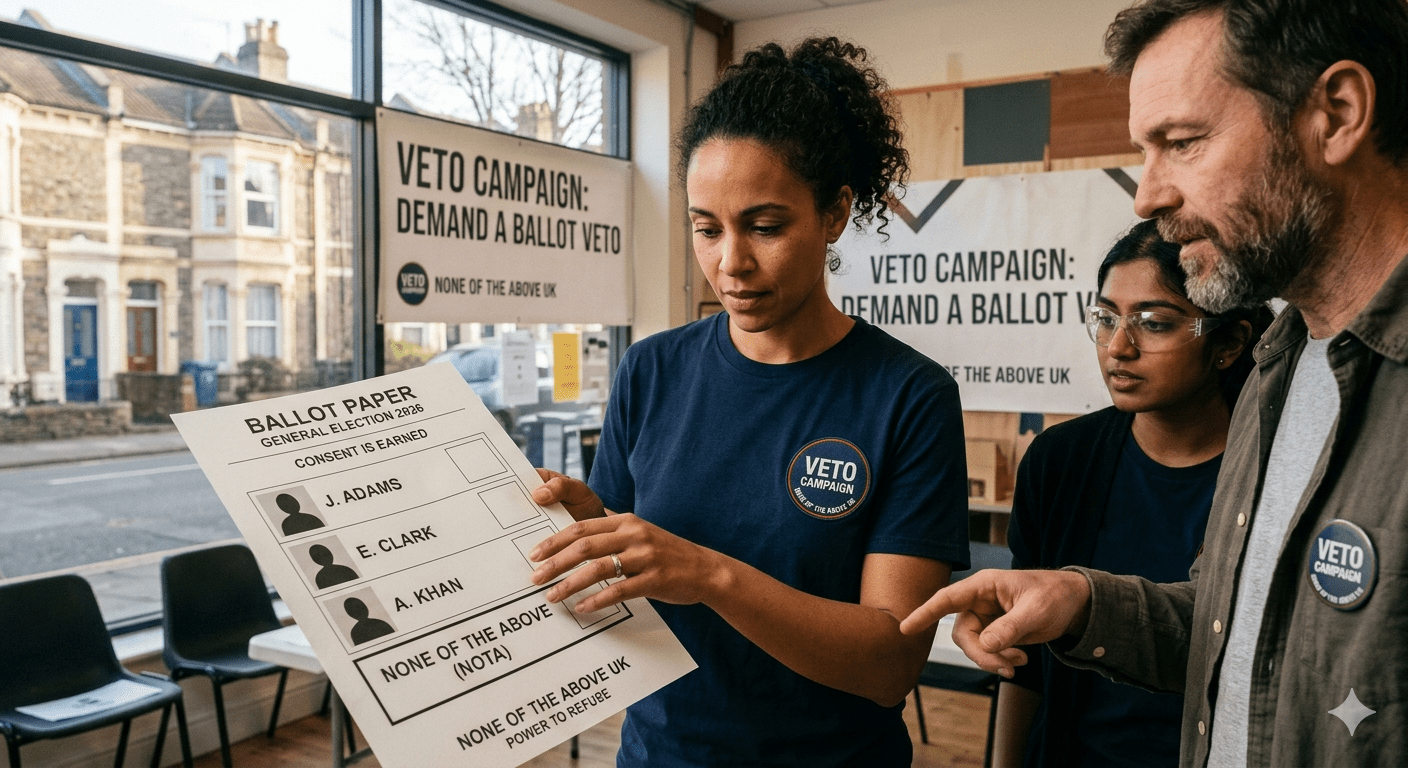
As we navigate the increasingly fragmented political landscape of 2026, a singular question is rising to the forefront of the British democratic debate: Is a vote truly a choice if you cannot say “no” to everyone on the list? The movement for a formal None of the Above (NOTA) UK option has evolved from a fringe protest into a sophisticated demand for systemic reform. In an era where combined support for the traditional “big two” parties has hit historic lows, the ability to formally withhold consent is becoming a mechanical necessity for a healthy democracy.
Currently, UK voters unhappy with their local candidates have two choices: stay home (abstention) or intentionally spoil their ballot. Neither provides a clear, legally recognized mandate for change. A formal None of the Above UK option would change the game, transforming silence into a powerful, quantifiable veto.
The Democratic Deficit: Why Silence is Not Enough
In the UK’s First Past the Post (FPTP) system, a candidate can be elected with a mere plurality of the vote, even if the majority of the electorate is actively dissatisfied.
The Problem with Abstention
Abstention is often misinterpreted by the political establishment as “apathy” rather than “antipathy.” When you don’t show up, you are simply removed from the denominator. A None of the Above UK option forces the system to count your dissatisfaction, making it impossible to ignore the “disengaged” voter.
Spoilage vs. Formal Rejection
Spoiling a ballot is frequently treated as an error or a lack of understanding by returning officers. By contrast, a formal NOTA box on the ballot paper is a positive act of participation. It is the formal declaration that none of the offered platforms meet the minimum threshold of acceptability for the citizen.
The Wise Heading Structure: Implementing NOTA “With Teeth”
For None of the Above UK to be more than a symbolic gesture, it must have formalised consequences. The 2026 reform movement distinguishes between “Faux-NOTA” and “NOTA with Teeth.”
Scenario A: The Protest Vote (Faux-NOTA)
In some jurisdictions, NOTA is counted but has no impact on the outcome—the highest-placing human candidate still wins. While this provides data, it fails to provide a real veto.
Scenario B: The Electoral Veto (NOTA with Teeth)
This is the “wise” approach advocated by modern reformers. If None of the Above UK wins the plurality or majority in a constituency:
The Election is Voided: None of the standing candidates are elected.
New Nominations Required: The previous candidates may be barred from standing in the subsequent by-election.
The “Empty Seat” Protocol: The seat remains vacant for a set period (3–6 months) as a “placeholder of dissatisfaction” until a suitable representative is found.
Just as a healthy democracy requires a clear veto on the ballot a healthy home or business requires precise structural management and proactive protection to ensure that only the best outcomes are built for the future.
International Precedents and the 2026 UK Context
The UK is increasingly an outlier. Countries like India, Greece, and even parts of the US (Nevada) have various forms of NOTA. In the UK, many Students’ Unions already use a similar system called Re-Open Nominations (RON). The logic is simple: if RON wins, the search for a better candidate begins anew.
In 2026, the demand for None of the Above UK is fueled by a multi-party volatility where no single party holds a clear mandate. Providing a “Veto” option would force parties to field higher-quality candidates and more resonant policies to avoid the embarrassment—and the political cost—of losing to a blank box.
