
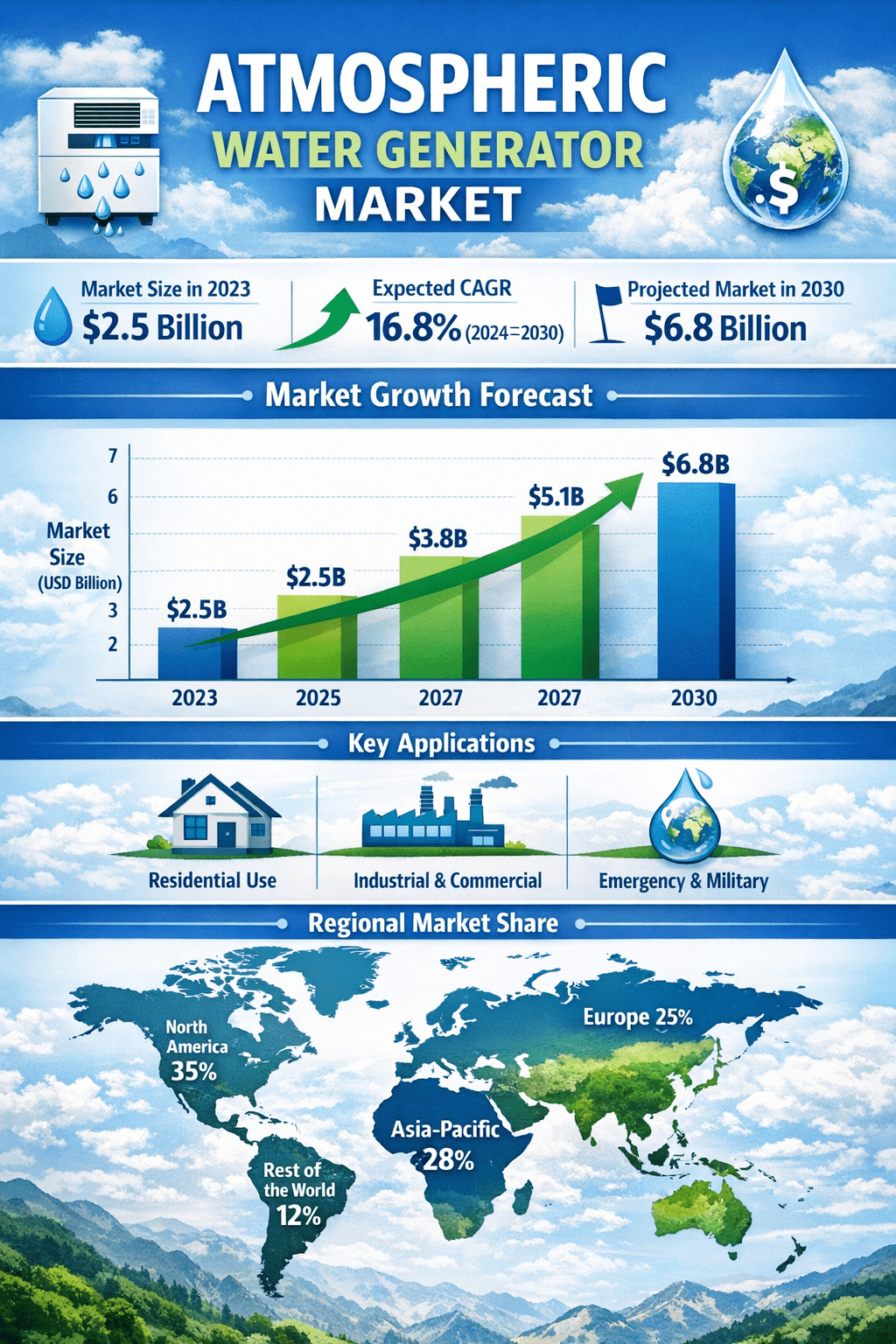
The global atmospheric water generator (AWG) market is gaining strong momentum as governments, enterprises, and research institutions accelerate efforts to secure sustainable and decentralized sources of potable water. Growing water stress, rising sustainability commitments, and advances in atmospheric water harvesting technologies are driving real-world deployments across commercial, institutional, defence, and community settings. Atmospheric Water Generator solutions are increasingly moving beyond pilot projects into visible, operational use cases that demonstrate their role in long-term water resilience strategies.
Recent Industry Developments
A1R Water Brings Atmospheric Water Generation to Professional Sports Infrastructure
In January 2026, A1R Water announced a multi-year partnership with Inter Miami CF, becoming the club’s official water partner. Under the agreement, canned drinking water produced directly from atmospheric moisture will be supplied at Miami Freedom Park. This initiative represents one of the most high-profile commercial deployments of AWG technology, showcasing its use in large public venues while supporting plastic reduction and on-site water sustainability goals.
DARPA Advances Atmospheric Water Harvesting for Defense Applications
In January 2025, GE Vernova’s Advanced Research Center announced the successful independent verification milestone of the U.S. Defense Advanced Research Projects Agency’s AIR2WATER program. The project focuses on extracting potable water from atmospheric humidity using advanced materials and energy-efficient systems. This milestone underscores the strategic importance of AWG technologies for defense, disaster response, and remote operations where traditional water logistics are constrained.
AirJoule Technologies and Arizona State University Collaborate on Low-Humidity Innovation
In April 2025, AirJoule Technologies revealed a collaboration with Arizona State University to advance atmospheric water harvesting research, particularly in low-humidity environments. The partnership aims to optimize AWG system performance through applied research and testing, reinforcing the role of academia–industry collaboration in overcoming technical barriers to wider deployment.
Institutional Adoption Expands in India
In January 2026, ICICI Bank disclosed the installation of atmospheric water generator units across selected facilities as part of its sustainability and corporate social responsibility initiatives. The systems are designed to produce potable water from ambient air, reducing reliance on bottled water and municipal supply while promoting environmentally responsible operations within corporate campuses.
Aeronero Strengthens Asia-Pacific Expansion Strategy
In January 2026, Aeronero Global announced strategic recognition under the NEXTLEAP 2025 program, supporting the establishment of Aeronero Singapore as a regional hub for atmospheric water generation solutions. The move reflects increasing focus on Asia-Pacific markets where water scarcity, urbanization, and sustainability priorities are driving interest in decentralized water technologies.
Market Impact and Future Outlook
Recent developments indicate that atmospheric water generation is transitioning from a niche sustainability concept into a practical infrastructure solution. Key industry insights include:
• High-visibility commercial deployments, such as stadiums and corporate campuses, are improving public awareness and acceptance of water-from-air technologies.
• Government and defense-backed research programs are accelerating innovation in energy efficiency and low-humidity performance.
• Corporate and institutional users are adopting AWG systems to support ESG targets, reduce plastic waste, and enhance water security.
• Academic–industry collaborations are playing a critical role in translating laboratory breakthroughs into deployable systems.
As climate variability and water stress intensify, atmospheric water generators are expected to play an increasingly important role in decentralized water strategies. Organizations that combine technological innovation with scalable deployment models and sustainability alignment are likely to shape the next phase of adoption across commercial, institutional, and public sectors.
About the Author:
HTF Market Intelligence Consulting is uniquely positioned to empower and inspire with research and consulting services to empower businesses with growth strategies, by offering services with extraordinary depth and breadth of thought leadership, research, tools, events, and experience that assist in decision-making.
