
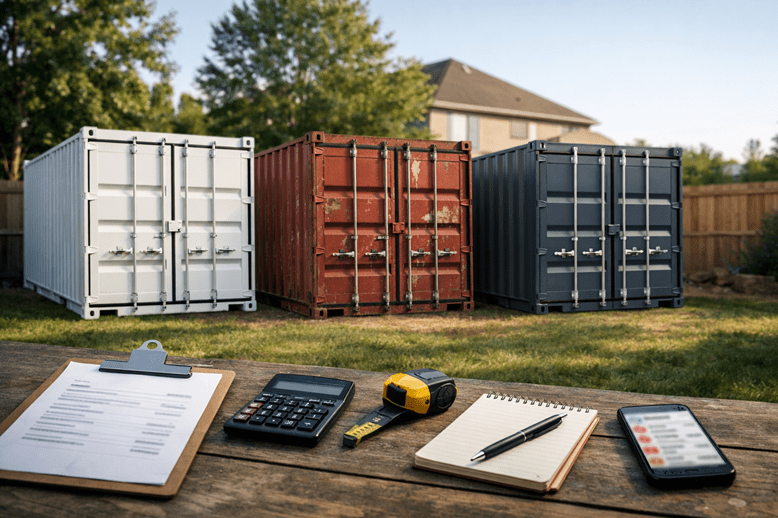
When a friend of mine recently wanted to turn a shipping container into a workshop at the back of his property, he did what most first-time buyers do: He Googled prices, was presented with wildly varying figures and then called me in mild panic. “Why is one $2,800 and another $6,500? They’re the same size.” That is the question at the center of understanding container buying costs, and answering it correctly demands that we walk through what these price differences mean in real-world terms.
This article unpacks an actual buying example between new, used, and refurbished containers, same footprint but with three very different price tags and detailed what each dollar did or didn’t buy.
The Situation: One Buyer, Three Bids and a Decision
My friend was looking for a 20′ container to be located at a residential property permanently. He wasn’t shipping anything internationally. He wanted a dry, weatherproof little building where he could keep tools, along with a workbench and some rudimentary electrical wiring. With that use case in mind, we got quotes on three of them from the other suppliers in that region.
The one-trip (new) container was priced at $6,200. The price for a used cargo-worthy unit was $3,900. A secondhand container, one that was repainted, resealed with new door gaskets, used, at $4,750. All three were 20 feet of standard-issue across the board. Two very different tales behind each price.
Deciphering Container Purchase Cost: What Those Types Really Mean
Brand New or One-Trip Containers: You Pay for Perfection
A one-trip container is made in Asia, filled with product for a single overseas voyage and then sold at the port of destination rather than being carried serving empty to ship back again. The end product is a structurally sound, rust-free container with factory fresh door seals and clean interior floors, no cargo staining or odor.
For my friend’s situation, the price tag was an all-inclusive $6,200. It also extended to the peace of mind offered through no hidden surprises, no soft spots in the floor, no hairline cracks in corner castings, or past exposure to chemical cargo. If you are creating a living space, operating a food-adjacent business or need the container to meet strict client-facing standards, then paying for a one-trip unit is legitimate expense.
What drives prices at this level are primarily the commodity steel market, distance traveled from port of origin and current volume of trade through that port. When shipping volume rises globally, there are fewer one-trip units to be had, and prices rise accordingly.
Cargo-Worthy Containers: The Middle of the Road in Value
What is a cargo-worthy container?
The used $3,900 cargo-worthy unit had made many sailing across the ocean. It was marred by surface rust, dents cluttered its side panels, and the floor looked like it had borne many a load of freight. But it had also undergone a certified inspection that verified the container remained structurally sound and waterproof, fit for international shipping.
For storage purposes in a backyard workshop, cargo-worthy certification is perfectly sufficient. The dents are cosmetic. Arts or Crafts Q: I am considering using some faux stone for a special project, but it has surface rust on the back and oxidation. If I use the piece and prime the back with a rust-inhibiting primer, are there any worries later about premature decay? Perfection wasn’t the demand in my friend’s use case; reliability was.
Selecting the correct container budget at this tier is being honest with yourself about how much cosmetic imperfection you will tolerate and how little you want to spend on minor upkeep. After spending $200 on the ones that need it, and a few coats of paint ($70 in supplies plus some free labor), you really have a 40-foot trailer body for well under $4500.
Refreshed Containers: The Used Option
The refurbished quote at $4,750 was for a used container that had been restored by a supplier. In this case, that meant sandblasting and repainting the exterior, replacing worn door seals and hinges, a full interior rust treatment and resurfacing of the floor. It was, in effect, a used container in a new-container’s clothing.
The scope of refurb work and the supplier’s labour cost is a major factor in what affects container prices in the ‘refurbished’ category. A substantially rehabbed unit, which has undergone structural repairs, received new flooring, and been addressed on the outside, may be close to, or even costlier than, a single-trip container. If you’re in one of those states, a single-trip unit typically doesn’t make sound financial sense.
The used version only made sense in my friend’s case for one simple reason: it came to his house looking sterile and definitely presentable, which was important since the workshop would be visible from the home’s largest living area. Now and then, aesthetics matter in a very real way.
Determining the Appropriate Container Budget for Your Use Case
Understanding the cost of buying containers also means beginning with purpose, not price. While gathering quotes, honestly respond to these questions before you compare quotes:
- Is the container needing structural changes?
- Is it required to be certified?
- Will customers or clients see it?
- How long do you expect to hold onto it?
For simple storage applications without visibility requirements, a used cargo-worthy unit will almost always provide the best value. In general, for customer facing apps like pop-up retail or food service, a one-trip or deep refurbished unit is probably worth the extra few hundred bucks. For conversion to residential or living structures, new is pretty much the only responsible answer.
Always ask for itemized quotes that separate the cost of the container from delivery, any site-preparation needs and any modification work. The container’s asking price is seldom the entire cost of the project.
The Bottom Line
My friend purchased a used cargo-worthy container. He used $200 of exterior paint and another $80 tube of door sealant, and wound up with a weatherproofed, structurally sound space that had cost him barely more than $4,100. The one-trip container would have been $2,100 more for a cosmetic improvement he didn’t want.
That’s the fundamental lesson of choosing the right container budget: match the spec to your application, not some hazy notion of good. All three types of new, used, and refurbished containers—serve legitimate uses; knowing which one serves yours is where smart spending starts.
Frequently Asked Questions
Does a converted container have value beyond used cargo worthy?
It all depends on what refurbishment is covered. A freshly painted container with none of that work may well not justify the premium you’ll pay over a used one. Request a list of refurbishment in detail before you take the price as-is.
What is the most significant thing you need to be aware of, in terms of container buying costs?
The two most important variables in this are grade, and use of the horse. Yeah, size matters, but if there is an equivalent unit (size and structure) that is in good condition, the neglected unit will ALWAYS be inferior in isolation, no matter how low the price.
Am I able to haggle the price of containers with my suppliers?
Yes, and frequently to an even greater extent than buyers might have imagined. Suppliers with high stock levels, aspirations to meet end-of-quarter sales targets and so on, may be willing to haggle on delivery fees or a lower base price. The power: Several competing quotes is leverage with bite.
How can I be sure that a used container is cargo-worthy?
Request the inspection certificate of one good class society or surveyor. It is not enough to be verbally told your container is CW, it must be noted on paperwork.