
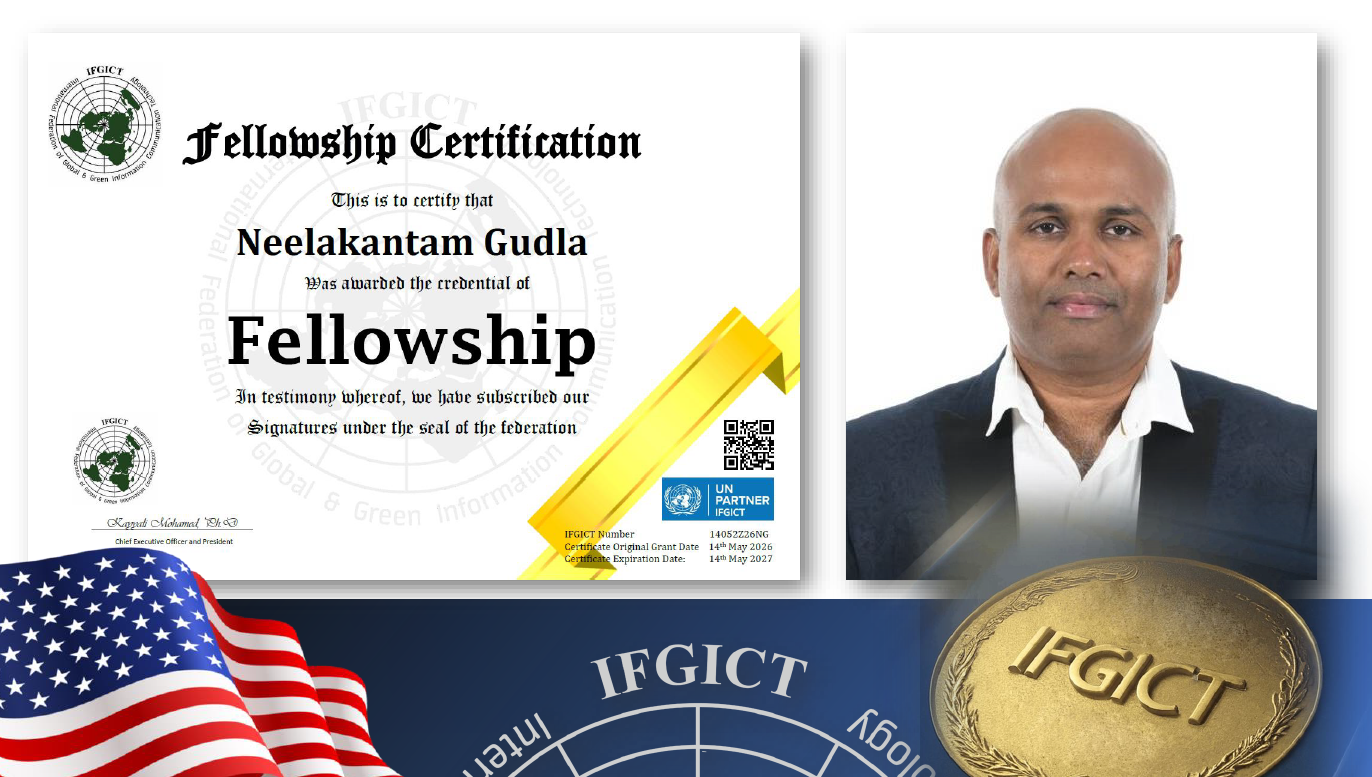
The rapid transformation of telecommunications networks toward cloud-native, software-defined ecosystems has placed immense pressure on the industry to innovate while maintaining absolute security. At the forefront of this shift is Neelakantam Gudla, a distinguished Senior Solution System Architect whose career has been defined by the successful modernization of some of the world’s most critical wireless infrastructures. In recognition of his exceptional contributions to the field of information and communication technology, Gudla has been officially awarded the Fellowship Grade by the International Federation of Global and Green ICT (IFGICT). This prestigious honor is reserved for an elite cadre of professionals who have not only shaped the landscape of modern telecom architecture but have also demonstrated a profound commitment to sustainable, secure, and energy-efficient digital systems.
The IFGICT Fellowship Grade is a hallmark of extraordinary professional accomplishment, celebrating individuals who possess both the technical depth to pioneer new network paradigms and the strategic foresight to implement them at a nationwide scale. By achieving this fellowship, Gudla joins a global community of innovators dedicated to advancing the ethical and sustainable deployment of technologies such as 5G, artificial intelligence, and private network convergence. His work, characterized by a meticulous approach to cloud-native telecom design, serves as a cornerstone for modern digital operators navigating the complexities of multi-vendor environments.
Two Decades of Leadership in Carrier-Grade Modernization
Neelakantam Gudla’s professional trajectory spans over sixteen years of high-impact leadership, during which he has become a primary architect for the evolution of mission-critical systems. His experience is rooted in the high-stakes world of carrier-grade deployments, where he has driven the enterprise-level onboarding of platforms from industry titans like Nokia, Ericsson, and Mavenir. Whether orchestrating large-scale IMS and EPC modernization projects or integrating 5G core functionalities into existing infrastructure, Gudla has consistently proven his ability to enhance performance, automation, and reliability across networks that serve millions of users.
His work with industry giants, including his pivotal contributions at T-Mobile and AT&T, highlights an elite capability to manage the transition from legacy hardware to agile, cloud-native frameworks. In these environments, downtime is not an option. Gudla’s architectural strategies have successfully mitigated risk while enabling the rapid deployment of new services, ensuring that the networks remain resilient, scalable, and fully prepared for the future of hyper-connectivity.
Securing the Next Generation of Telecom Infrastructure
As the telecommunications sector pivots toward open and software-defined architectures, the importance of security has expanded exponentially. Neelakantam Gudla has established himself as a leading cybersecurity strategist within this domain. He has been instrumental in establishing rigorous IMS access security standards and guiding multi-vendor evaluation processes that prioritize both performance and protection. His influence extends to the delicate balance of creating secure cloud adoption strategies for mission-critical systems, ensuring that even as networks become more distributed and open, they remain impervious to emerging digital threats.
Gudla’s commitment to security goes beyond mere compliance. He has consistently championed the adoption of automation frameworks that reduce human error and strengthen the overall security posture of telecom environments. By advancing secure cloud infrastructure engineering and creating robust architectures for private 5G and Non-Terrestrial Network (NTN) convergence, he provides operators with the confidence to transition their critical assets to the cloud without sacrificing the high standards of carrier-grade integrity.
Contributions to Global Scientific Discourse
The influence of Neelakantam Gudla extends well beyond his corporate projects. As a prolific IEEE author, reviewer, and technical committee member, he has contributed extensively to the global scientific body of knowledge. His publications regarding AI-driven wireless systems, cybersecurity architectures, and cloud-native design provide a roadmap for the broader ICT community to follow. By serving as a peer reviewer for high-impact research venues such as IEEE ISEC, WAMS, ICIPTM, and ICISSC, he plays a key role in shaping the evolution of network theory and practice.
His scholarly work reflects a deep interest in the intersection of artificial intelligence and network orchestration, areas that are essential for the sustainability of next-generation infrastructures. Gudla’s focus on energy efficiency in ICT systems—a core tenet of the IFGICT mission—underscores his broader philosophy: that technology should be a driver for both societal progress and environmental preservation. By mentoring colleagues and engaging in international innovation forums, he continues to foster a culture of excellence and sustainability within the engineering profession.
A Legacy of Excellence in ICT
The awarding of the IFGICT Fellowship Grade serves as a formal recognition of the legacy Neelakantam Gudla continues to create. In an industry defined by its constant state of flux, his career has remained a steady example of how deep technical expertise can be channeled into sustainable, secure, and world-class digital solutions. His work not only powers the devices and systems that citizens rely on every day but also sets a standard for how global telecommunications should evolve.
As he continues to lead initiatives in telecom cloud transformation and next-generation architecture, his status as an IFGICT Fellow provides him with a powerful platform to further influence global standards. For the telecommunications industry, Neelakantam Gudla stands as a vanguard of the digital age—a professional who has proven that through architectural discipline and an unwavering commitment to quality, it is possible to build the secure, resilient, and energy-efficient networks that our interconnected world demands.