
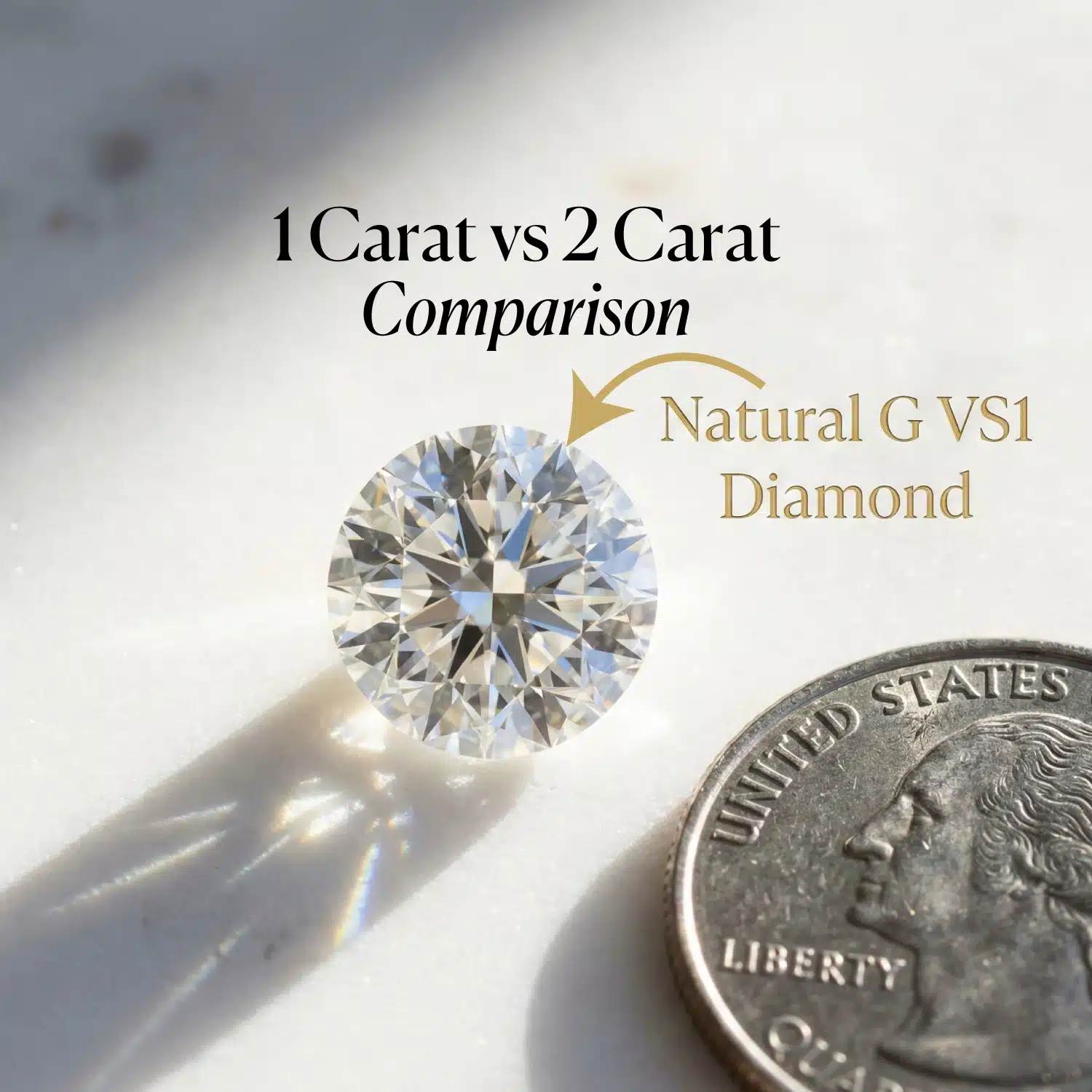
You want a stunning engagement ring. You probably already know that a G color and VS1 clarity diamond is the perfect target. It looks completely flawless to the naked eye.
But pricing scales in a very confusing way. You might look at a 1 carat price tag and assume a 2 carat stone will just double your budget. Then you see the actual retail cost and panic.
We are breaking down the exact math for 2026. Here is what you should pay to get the maximum visual impact without getting ripped off.
➡ Natural G VS1 Diamond Priceatural G VS1 Diamond Price – 1 Carat vs 2 Carat Cost
Why G VS1 is the Ultimate Value Grade
Buying a D color, Flawless diamond is a waste of money. You are paying a massive premium for microscopic perfection. You literally cannot see those traits without a jeweler’s loupe.
A G color diamond faces up completely white. A VS1 clarity grade means the stone is perfectly eye clean.
Choosing a round brilliant G VS1 gives you the exact same visual performance as the most expensive diamonds in the world. You just pay a fraction of the cost.
The 2026 Price Floor: 1 Carat G VS1 Diamonds
A 1 carat stone is the classic standard. Right now, a natural 1 carat G VS1 diamond with an Excellent cut costs between $3,507 and $6,413.
The exact price depends on the retailer and the specific cut quality. Ritani diamond inventory currently holds the market floor. You can easily find a beautiful, GIA certified stone for around $3,600.
Here is a quick look at how the 2026 market scales based on our latest data.
| Carat Weight | 2026 Average Price Range | Recommended Vendor Target |
| 1.00 Carat | $3,500 to $6,400 | Ritani (~$3,600) |
| 1.50 Carat | $9,500 to $13,000 | James Allen (~$11,000) |
| 2.00 Carat | $16,900 to $30,900 | James Allen (~$17,000) |
The 2 Carat Jump: Understanding the Rarity Penalty
This is where buyers experience sticker shock. If a 1 carat stone costs $3,600, a 2 carat stone should logically cost around $7,200.
That is not how natural diamonds work. A 2 carat G VS1 will cost you between $16,920 and $30,969. That is roughly a 500% price increase.
You are dealing with an exponential cost curve. Finding a rough diamond pure enough to yield a finished 2 carat stone is incredibly rare. You are paying a massive scarcity premium for that rarity.
The Smart Buyer’s Secret: The 1.50 Carat Alternative
Many buyers have a strict $10,000 or $12,000 budget. They often try to force a 2 carat purchase with that money. This is a terrible mistake.
A cheap 2 carat natural diamond will have poor cut quality. It will look cloudy or show yellow tints. You sacrifice all the beauty just to hit a specific weight.
At Aurelia, our data constantly points to the 1.50 carat mark as the absolute smartest financial move. You can buy a premium 1.53 carat G VS1 for around $11,080.
This gives you a huge visual impact. It looks noticeably larger than a 1 carat stone, but you completely avoid the extreme 2 carat price penalty. It is brilliant budget optimization.
Comparing Top Vendors: Where to Buy Safely
Never buy a diamond blindly. You need to shop where the data shows the best value.
Ritani is currently the volume leader for 1 carat stones. They consistently offer the lowest entry price for excellent quality.
However, James Allen pricing is incredibly competitive as you move up in weight. They dominate the 1.50 to 2.00 carat range. Their high definition video technology also makes inspecting the stone incredibly easy.
Always ensure the stone comes with a GIA certificate. GIA is the strict industry standard.
Two Mistakes That Ruin a Good Diamond
A great clarity grade on paper does not always mean a perfect stone. You need to watch out for diamond fluorescence.
Strong blue fluorescence can lower a diamond’s price by up to 15 percent. But it carries a massive risk. It can make the stone look milky or hazy in natural sunlight.
Always stick to “Faint” or “None” for fluorescence to protect your investment. Also, never accept a generic grading certificate. A non-GIA certificate will cause your diamond to lose up to 50% of its resale value immediately.
Find Your Ideal Diamond Size
You now know the math. The next step is applying it to your own bank account.
Do not stretch your finances for a magic number. Use our tool below to figure out exactly what size stone fits your financial comfort zone.
FAQ
Why is a 2 carat diamond more than double the price of a 1 carat?
A 2 carat natural diamond costs roughly five times more than a 1 carat because of extreme rarity. You pay a massive scarcity premium for a large, pure rough crystal. Finding a large rough diamond in nature is statistically highly unlikely. The pricing is exponential, meaning the cost per carat jumps aggressively at major weight milestones.
Is a G color VS1 clarity diamond a good investment?
Yes, a G color VS1 clarity diamond is considered the optimal value. It appears completely colorless and flawless to the naked eye without the premium of a D Flawless grade.
You secure the visual performance of a top tier stone while keeping your budget intact. It is the smartest way to balance beauty and cost.
Who has the best prices for natural diamonds online?
Ritani currently offers the lowest price floor for 1 carat natural diamonds. James Allen provides highly competitive pricing and better inventory depth for larger stones in the 2 carat range.
Pricing changes daily based on global inventory. Always compare specific stones across these two vendors before making your final decision.
What is the best diamond size for a $10,000 budget?
For a $10,000 budget, the smartest choice is a 1.50 carat G VS1 natural diamond. It provides excellent visual size without forcing you to sacrifice cut or clarity.
Trying to buy a 2 carat stone at this price point will force you to accept severe yellow tints or visible inclusions that ruin the visual appeal.
Does diamond fluorescence lower the price?
Yes, strong blue fluorescence can lower a diamond’s price by up to 15 percent. However, it carries a severe risk of making the stone look milky in natural sunlight.
It is much safer to buy diamonds graded with Faint or None for fluorescence. If you do buy a fluorescent stone, you must inspect a high definition video first.
