
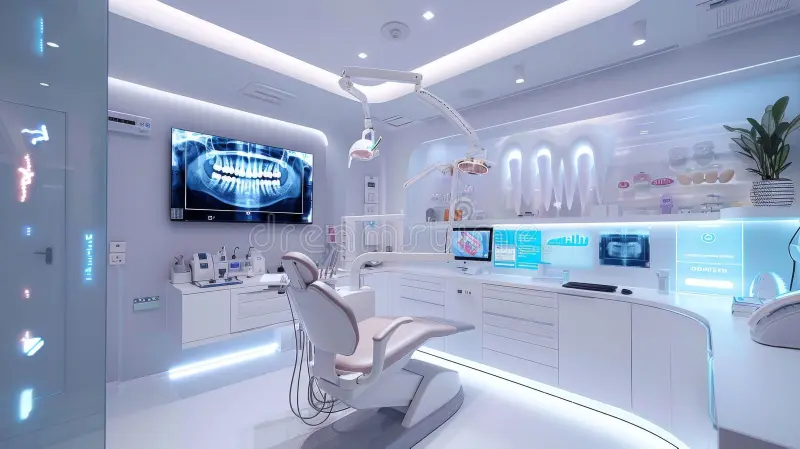
Across Tijuana, more dental clinics are incorporating digital dentistry into daily treatment. This is not just a trend or a marketing phrase. It reflects a real shift in how serious clinics approach diagnosis, planning, execution, and final outcomes. In practical terms, it means more control, better accuracy, and fewer variables left to chance.
Not long ago, many procedures still relied on traditional impressions, manual estimations, and longer restorative timelines. Today, clinics that want to operate at a higher level are investing in CT Scan, intraoral scanning, digital planning, CEREC, and surgical guides because these systems improve treatment from start to finish. In a city like Tijuana, where patients compare quality, convenience, and cost very carefully, digital workflow has become a real point of distinction.
Patients are also more informed than before. Many are no longer searching only for the lowest fee. They want clinics that can show precision, consistency, and a more modern approach. That is where digital dentistry has changed the conversation.
CT Scan and Intraoral Scan Have Improved Diagnosis and Accuracy
Any clinic performing advanced restorative or implant procedures without a CT Scan is already working with limitations. A traditional X-ray still has value, but it does not provide the detail needed for many modern treatments. A CT Scan gives the doctor a three-dimensional view of bone volume, root anatomy, nerve location, sinus position, and other critical structures.
That level of detail matters. In dental implants, placement should not be based on visual estimation alone. It requires a clear understanding of available bone, anatomical boundaries, and prosthetic goals. Better information leads to better planning, and better planning usually leads to fewer surprises.
The intraoral scan has also replaced much of the inconvenience associated with traditional impressions. Instead of using impression material, the clinic can capture a precise digital model of the teeth, gums, and bite. It is faster, cleaner, more comfortable for the patient, and more efficient for the team. It also allows the case to be reviewed immediately and shared more easily with the lab or design team.
Digital Planning, CEREC, and Surgical Guides Make Treatment More Predictable
Once the clinic has a CT Scan and an intraoral scan, the next step is digital planning. This is where the real advantage becomes clear. The case can be studied from both a surgical and restorative perspective before treatment begins.
In implant cases, the implant should not be placed only where bone is available. It should be placed where the final crown or prosthesis needs it to be, provided the biology supports it. That is what digital planning makes possible. The case is built around the final result, not just the immediate procedure.
When a clinic also uses CEREC, the process becomes even more efficient. CEREC technology allows the team to design and mill certain ceramic restorations with greater speed and control. For crowns and similar restorations, this can reduce turnaround time and, in some cases, reduce the number of visits.
Surgical guides bring that digital plan into the actual procedure. In guided implant surgery, the guide helps control position, angle, and depth. That matters because small deviations can create restorative problems later. Technology does not replace clinical judgment, but it does improve consistency.
In the U.S., Digital Dentistry Is Often Linked to Higher Fees
In the United States, clinics that fully integrate digital dentistry are often positioned at the upper end of the market. These are the practices with stronger systems, more advanced infrastructure, and higher fees. Technology requires investment, training, calibration, and a more demanding operational standard.
The same applies in implant dentistry. A clinic using CT Scan, intraoral scanning, digital planning, and guided surgery is generally delivering a more controlled and sophisticated process. As a result, those clinics usually charge more. For a single dental implant performed under this type of digital workflow, it is not unusual to see fees in the range of $5,000 to $7,000 in high-end U.S. clinics.
Tijuana Offers Modern Technology at a More Accessible Price Point
What makes Tijuana increasingly attractive is that many clinics are moving in the same technological direction while operating under a more accessible cost structure. A single dental implant performed with digital workflow, depending on the case and the clinic, may fall in the range of $1,200 to $2,000 in Tijuana.
At the same time, many clinics in Tijuana have moved away from the extremely low prices that once defined part of the market. That shift has happened for a reason. As clinics invest in better materials, stronger protocols, advanced equipment, and more predictable treatment systems, pricing naturally rises. Higher-quality dentistry with more controlled and more successful outcomes cannot be built on the cheapest model.
Even so, patients can still save up to 70% compared to many U.S. clinics while accessing a more modern workflow.
Not Every Clinic in the U.S. or Mexico Has Reached This Level
Digital modernization has not reached every clinic in the United States, and it has not reached every clinic in Mexico either. Some offices still rely on older methods, limited diagnostics, and more conventional workflows. Others have adopted only part of the process.
That is why patients should ask direct questions. Does the clinic use CT Scan for implant diagnosis? Do they perform intraoral scanning instead of traditional impressions? Is the case developed through digital planning? Are surgical guides used when appropriate? These details say a great deal about how the clinic works and how predictable treatment is likely to be.
Tijuana Is No Longer Competing on Price Alone
The old assumption was that Tijuana attracted patients mainly because it was cheaper. That is no longer the full picture. More clinics are now competing on technology, precision, and workflow efficiency, not just affordability.
That is why the rise of digital dentistry in Tijuana matters. It shows that the city is not simply offering lower fees. It is offering a more modern clinical model for patients who want stronger planning, better tools, and more predictable care.
