

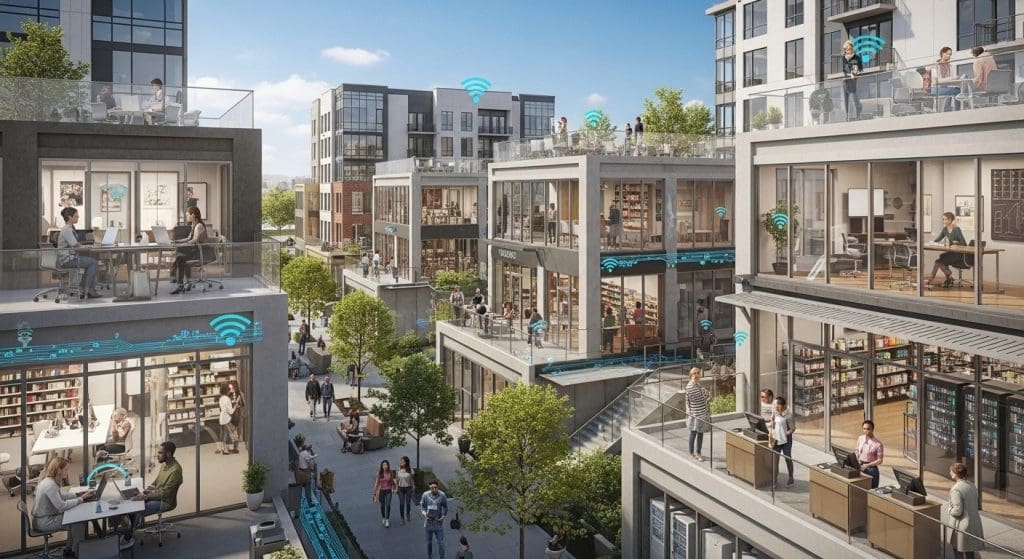
Downtown Raleigh’s Warehouse District buzzes with tech startups, restaurants, and luxury apartments occupying the same historic brick buildings. Research Triangle Park adds residential towers next to research labs. Durham’s American Tobacco Campus blends coworking spaces with event venues and retail shops. North Carolina’s mixed-use districts create dynamic communities, but they share a common challenge: traditional IT infrastructure designed for single-purpose buildings fails when residential, retail, and office spaces operate under one roof.
The Unique IT Challenges of Mixed-Use Districts
Mixed-use properties must satisfy dramatically different technology requirements simultaneously. Residents streaming movies at night need reliable bandwidth during the same hours restaurants process closing transactions. Office tenants require enterprise-grade security and high-speed connectivity for cloud applications.
Retail shops depend on point-of-sale systems and guest Wi-Fi that welcome customers without compromising network security. Peak usage times conflict: residential traffic surges when offices close, retail systems stress during lunch rushes, and all three compete for the same infrastructure resources.
Security becomes exponentially more complex when diverse users share common infrastructure. Residential networks must isolate completely from business networks. Guest Wi-Fi for retail customers cannot access tenant systems.
Office spaces need secure access controls and encrypted connections. Payment card processing requires PCI compliance with strict data isolation. A security breach in one area cannot spread laterally across the entire building.
Physical infrastructure challenges multiply in these environments. Cable distribution must serve both vertical high-rise residential towers and horizontal ground-floor retail spaces. Historic buildings converted to mixed-use present particular challenges, as century-old structures lack the capacity and pathways for modern fiber optic networks.
Tenant turnover happens constantly, requiring rapid network reconfiguration. Retail spaces change hands more frequently than office leases. The network must scale up and down gracefully, support diverse applications from smart home devices to high-frequency trading platforms, and adapt to changing technology standards.
Lessons from North Carolina’s Mixed-Use Pioneers
Research Triangle Park – Hub RTP
Research Triangle Park spent decades as a traditional research campus with dedicated single-use buildings. The 100-acre Hub RTP development changed that model by combining office and lab space with 1,200 residential units, retail shops, hotels, and green space.
This transformation created immediate IT challenges. Research facilities demand ultra-reliable, high-bandwidth connectivity with minimal latency for data-intensive applications. Lab networks require strict security protocols and compliance with industry regulations. Residential tenants expect consumer-grade simplicity and streaming-quality bandwidth.
Retail and hospitality operations need guest-friendly systems that welcome visitors. The solution required layered network architecture with strict segmentation, allowing each use to operate independently while sharing common infrastructure. Software-defined networking enabled rapid provisioning for new tenants without physical reconfigurations.
Downtown Raleigh Warehouse District
Historic red brick warehouses built for tobacco and textile storage now house technology companies, art galleries, restaurants, and loft apartments. These conversions face unique IT infrastructure challenges.
Buildings constructed in the early 1900s lack the capacity, pathways, and power distribution for modern networking equipment. Thick masonry walls that once protected inventory now block wireless signals. Preserved architectural features limit where cables can run and equipment can mount.
Technology companies occupying these spaces expect the same enterprise-grade connectivity they would find in new office towers. Restaurants need reliable point-of-sale systems and kitchen display screens. Creative solutions blend fiber optic backbones with strategically placed wireless access points, balancing historic preservation requirements with modern connectivity demands.
Durham American Tobacco Campus
Durham’s American Tobacco Campus transformed a defunct cigarette factory into a mixed-use success story combining offices, retail, restaurants, and event spaces. The adaptive reuse project preserved historic character while inserting modern infrastructure.
The campus illustrates how diverse tenant technology sophistication levels create management challenges. Some office tenants employ dedicated IT staff and manage their own complex networks. Others need turnkey solutions with minimal technical involvement. Event spaces require flexible connectivity that supports different requirements weekly.
Retail tenants range from solo entrepreneurs to national chains with corporate IT standards. A modular infrastructure approach allows tenant customization within defined parameters. A professionally managed IT in the American Tobacco District prevents conflicts between tenants with different needs and ensures baseline performance standards across all spaces.
Common Themes Across NC Mixed-Use
Patterns emerge across North Carolina’s mixed-use districts. One-size-fits-all IT approaches consistently fail when serving residential, retail, and office uses simultaneously. Security segmentation proves non-negotiable as breaches in one tenant space cannot affect others.
Flexibility matters more than permanence since tenant mix changes frequently. Professional management prevents conflicts that arise when tenants with different technical capabilities and requirements share infrastructure.
Historic building conversions require more creativity than new construction but face the same fundamental challenges. Success requires treating IT infrastructure as a core building amenity, not an afterthought.
The Modernized IT Approach for Mixed-Use Success
Properly designed network architecture forms the foundation of successful mixed-use IT infrastructure. Virtual local area networks separate residential, retail, office, and guest traffic into isolated segments that share physical equipment but operate independently.
Redundant internet connections from multiple providers prevent single points of failure. Fiber optic backbones deliver high-capacity connectivity between floors and buildings, with wireless access points providing coverage where cable installation proves impractical.
Security through microsegmentation protects each tenant while maintaining shared infrastructure efficiency. Network traffic moves through defined pathways with strict access controls preventing unauthorized lateral movement. Residential units operate in complete isolation from commercial spaces.
Retail guest networks provide internet access without visibility into internal systems. Office tenants control access to their own segments while building management maintains oversight of common infrastructure.
Centralized management with tenant autonomy balances control and flexibility. Managed service providers handle core infrastructure, monitoring performance, applying security updates, and maintaining uptime across all segments.
Tenants control their own network segments within established parameters. Flexible infrastructure adapts as tenant needs change and new technologies emerge through software-defined networking and cloud-based services.
Why Professional IT Management Matters in Mixed-Use
Building managers cannot become IT experts across residential, retail, and office technologies simultaneously. Individual tenants lack the perspective and access to manage shared infrastructure serving multiple, unrelated businesses. Professional oversight prevents conflicts that arise when tenants with different capabilities and priorities compete for resources.
Specialized knowledge of multi-tenant environments ensures fair resource allocation. Security expertise protects all tenants from threats they might not recognize individually. Round-the-clock monitoring catches issues before they escalate into outages affecting multiple businesses and residences.
Shared managed IT costs distribute across all tenants, making enterprise-grade infrastructure affordable for small businesses and residential units. Predictable monthly expenses replace unpredictable crisis spending.
Property owners avoid capital expenditures for networking equipment that depreciates quickly. The IT infrastructure becomes an amenity that attracts quality tenants willing to pay premium rents for reliable connectivity.
Tenants experience reliable connectivity from day one without waiting weeks for service providers to schedule installations. Professional support responds when issues arise, with expertise to diagnose problems quickly.
No finger-pointing occurs between property management and IT vendors. Local providers understand North Carolina market conditions, building codes, and regulatory requirements.
Conclusion
Mixed-use districts represent the future of North Carolina’s urban development, blending residential, retail, and office spaces into walkable communities. Traditional IT approaches designed for single-purpose buildings fail in these complex environments where diverse needs compete for shared resources.
Modernized infrastructure with proper segmentation, professional management, and flexible architecture enables these properties to thrive. North Carolina’s pioneering mixed-use developments provide valuable lessons for property owners and tenants nationwide. Investing in proper IT infrastructure from the start pays dividends through higher occupancy, satisfied tenants, and long-term property value.
