
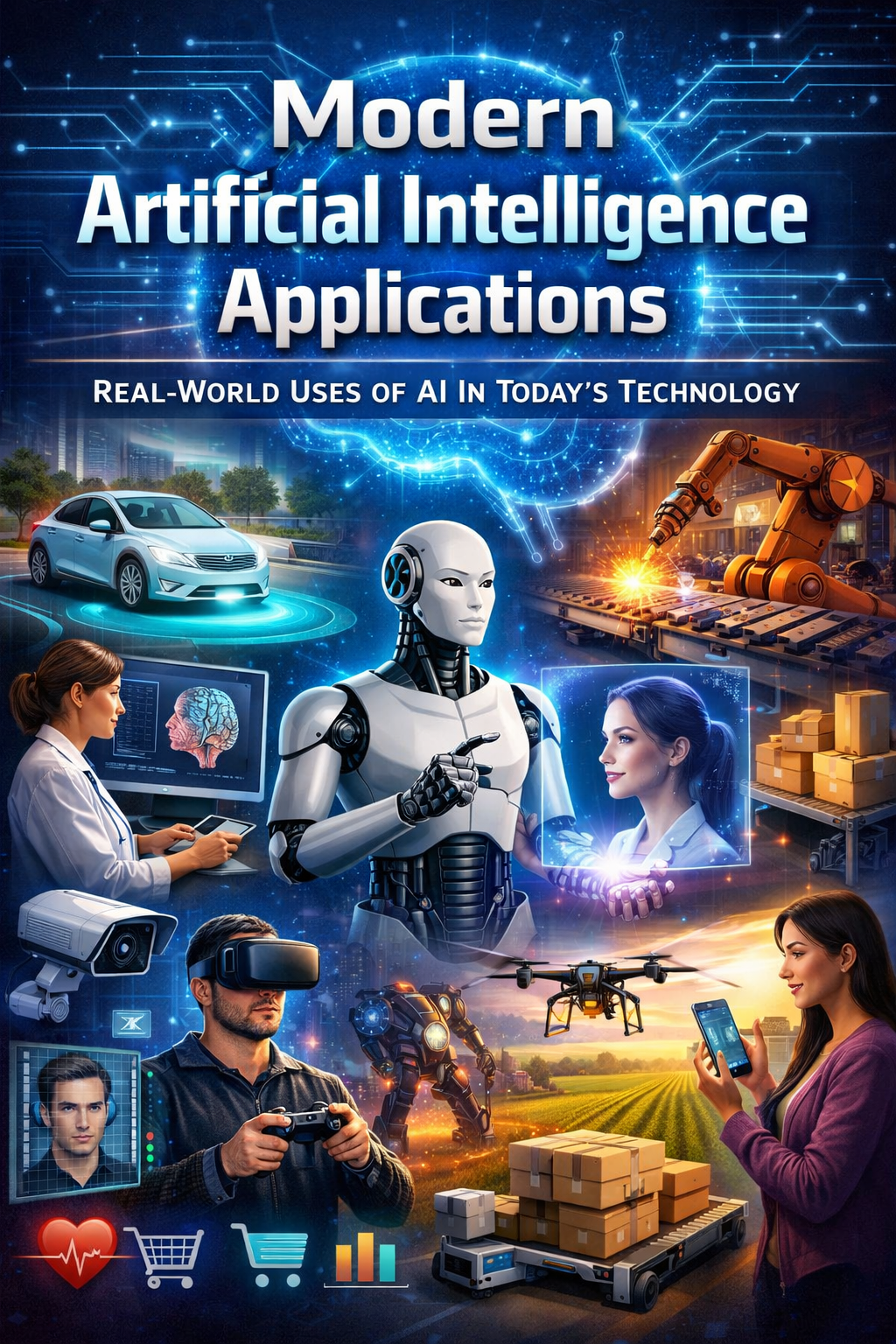
Introduction to Modern Artificial Intelligence
We are currently living in an era defined by a massive technological shift. While the concept of machines that think has existed for decades, modern artificial intelligence applications have finally moved from the pages of science fiction into the fabric of our daily lives. From the smartphone in your pocket to the complex algorithms managing global supply chains, AI is no longer a luxury—it is a foundational utility.
The journey to this point was not immediate. It began with the Dartmouth Conference in 1956, where the term “Artificial Intelligence” was first coined. Since those early days, the field has weathered several AI Winters, periods where progress stalled due to overhyped expectations and limited computing power. However, today’s landscape is vastly different. We are witnessing a surge in real world AI applications that are transforming how we work, communicate, and solve global challenges.
What Is Modern Artificial Intelligence?
To understand modern artificial intelligence applications, we must first define what the technology actually is. Modern AI refers to systems capable of performing tasks that typically require human intelligence, such as visual perception, speech recognition, and decision-making. Unlike the First AI Programs that relied on simple “if-then” logic, modern AI systems are dynamic and capable of learning from experience.
Machine Learning
Machine learning is a subset of AI that focuses on building systems that learn from data. Instead of being explicitly programmed, machine learning applications use algorithms to identify patterns. This Evolution of Machine Learning Algorithms has allowed computers to improve their performance over time as they are exposed to more information.
Deep Learning
Deep learning is a more advanced subset of machine learning inspired by the structure of the human brain. It involves multi-layered neural networks. While the concept of The Perceptron (the simplest form of a neural network) dates back to the late 1950s, it wasn’t until recently that we had the data and hardware to make deep learning applications viable for tasks like image and speech recognition.
Natural Language Processing
Natural Language Processing (NLP) allows machines to understand and generate human language. This technology powers everything from AI chatbots to real-time translation tools, making human-computer interaction more intuitive than ever before.
Computer Vision
Computer vision enables AI to “see” and interpret visual information from the world. This is the backbone of autonomous vehicles and facial recognition systems, allowing machines to categorize objects and navigate physical spaces.
Major Applications of Artificial Intelligence Today
The applications of artificial intelligence today are incredibly diverse. Industries are moving away from traditional software and toward AI-powered technologies that can adapt to changing circumstances in real-time. Whether it is a recommendation system on a streaming platform or a complex diagnostic tool in a lab, the practical uses of AI are expanding every single day.
AI in Healthcare
Perhaps no field has benefited more from modern artificial intelligence applications than medicine. AI in healthcare is saving lives by augmenting the capabilities of doctors and researchers.
- Diagnostics: Deep learning models can analyze X-rays, MRIs, and CT scans with a level of precision that often surpasses human radiologists, identifying early signs of cancer or neurological disorders.
- Drug Discovery: AI is drastically shortening the time it takes to develop new medications by simulating how different chemical compounds will interact with the human body.
- Personalized Medicine: By analyzing a patient’s genetic makeup and medical history, AI can suggest tailored treatment plans that are more effective and have fewer side effects.
AI in Finance
The financial sector has embraced artificial intelligence use cases to manage risk and improve customer service. AI in finance is now the standard for major banking institutions.
- Fraud Detection: AI systems monitor millions of transactions in real-time, identifying suspicious patterns that would be impossible for humans to spot manually.
- Algorithmic Trading: High-frequency trading platforms use machine learning to execute trades at the optimal millisecond, reacting to market fluctuations instantly.
- Credit Scoring: Modern AI systems provide a more holistic view of a person’s creditworthiness by analyzing non-traditional data points, making lending more accessible.
AI in Transportation
The transportation industry is undergoing a revolution driven by AI technology applications. The most talked-about development is the rise of autonomous vehicles. Companies like Tesla and Waymo are using a combination of computer vision and sensor fusion to create cars that can navigate complex city streets without human intervention.
Beyond self-driving cars, AI is used in logistics to optimize delivery routes, reducing fuel consumption and speeding up shipping times. In aviation, AI-powered systems assist pilots with navigation and predictive maintenance, ensuring planes are serviced before mechanical issues occur.
AI in Retail and E-Commerce
If you’ve ever used a recommendation system on Amazon or Netflix, you’ve interacted with modern artificial intelligence applications. Retailers use AI to create hyper-personalized shopping experiences.
- Inventory Management: AI predicts which products will be in high demand, allowing stores to stock up efficiently and reduce waste.
- Visual Search: Customers can now upload a photo of an item they like, and AI will find similar products across the web.
- AI Chatbots: These provide 24/7 customer support, answering queries and resolving issues without the need for a human agent.
AI in Education
In the classroom, AI is being used to create “intelligent tutoring systems.” These platforms adapt to a student’s individual learning pace, offering extra help in areas where they struggle and moving ahead when they’ve mastered a concept. Generative AI is also helping educators create lesson plans and automated grading systems, freeing up more time for one-on-one student interaction.
AI in Cybersecurity
As cyber threats become more sophisticated, traditional antivirus software is no longer enough. AI in cybersecurity acts as a digital immune system. It can detect “zero-day” attacks by identifying deviations from normal network behavior. By automating the response to breaches, AI helps organizations mitigate damage before it spreads.
AI in Manufacturing
The “Smart Factory” is a reality thanks to AI applications in industry. Robots equipped with AI can perform delicate assembly tasks that were previously impossible to automate. Furthermore, predictive maintenance algorithms analyze data from factory machinery to predict when a part is likely to fail, preventing costly downtime and improving overall manufacturing efficiency.
Benefits of Modern AI Applications
The widespread adoption of AI is driven by the tangible benefits it offers to both businesses and consumers.
Automation of Repetitive Tasks
One of the greatest strengths of AI is its ability to handle mundane, repetitive tasks. By automating data entry, scheduling, and basic customer service, humans are free to focus on creative and strategic work.
Improved Decision-Making
AI can process vast datasets much faster than a human ever could. This leads to better-informed decisions in fields like weather forecasting, stock market analysis, and urban planning.
Increased Efficiency
In almost every sector, AI-powered technologies lead to higher output with lower resource consumption. Whether it’s optimizing energy grids or reducing waste in supply chains, efficiency is a core byproduct of AI.
Enhanced Customer Experience
Personalization is the new standard. Because AI can understand individual preferences, it can provide tailored content and products, leading to higher customer satisfaction.
Challenges and Ethical Concerns
Despite the excitement surrounding modern artificial intelligence applications, there are significant challenges. Data privacy is a primary concern, as AI systems require massive amounts of personal information to function effectively. There is also the issue of algorithmic bias; if an AI is trained on biased data, it will produce biased results, which can be devastating in areas like hiring or law enforcement.
Furthermore, the displacement of jobs due to automation remains a major societal concern. While AI creates new roles, the transition period for the workforce requires careful management and retraining programs.
Future of Artificial Intelligence Applications
Looking ahead, the future of AI is likely to move toward “General AI”—systems that can perform any intellectual task a human can. We can expect even deeper integration of AI in our physical world through robotics and the Internet of Things (IoT). As generative AI continues to evolve, the line between human-created and machine-created content will continue to blur, necessitating new frameworks for intellectual property and digital ethics.
FAQs
How is modern AI different from early AI?
Early AI was based on hard-coded rules created by humans (Expert Systems in Artificial Intelligence). Modern AI is based on machine learning, where the computer learns patterns from data and adapts its own rules.
Is AI going to replace human jobs?
AI is changing the job market by automating routine tasks. While some roles may disappear, AI is also creating entirely new categories of jobs in data science, AI ethics, and machine learning engineering.
What is Generative AI?
Generative AI is a type of AI that can create new content, such as text, images, or music. It is trained on existing data and uses that knowledge to generate original outputs that follow the same patterns.
Is AI safe to use in healthcare?
When used as a supportive tool for doctors, AI is incredibly safe and effective. However, it is not a replacement for human judgment and is currently used to provide “second opinions” and data analysis to assist medical professionals.
Conclusion
The modern artificial intelligence applications we see today are only the beginning. From its humble origins at the Dartmouth Conference to the sophisticated deep learning models of the 2020s, AI has proven to be a transformative force. While we must remain vigilant about the ethical implications and challenges of this technology, the potential to improve human life is boundless. By embracing AI responsibly, we can solve some of the world’s most complex problems and usher in a new era of innovation.