

You take calcium for strong bones. You may take vitamin D for absorption. But without the right form of vitamin K2, calcium can end up where you don’t want it — like your arteries. Not all K2 is equal, and the choice between MK-7 and MK-4 shapes how well your body uses calcium. This matters for long-term bone and heart health.
read more from this article: https://zenvitaco.com/vitamin-k2-mk7-vs-mk4/
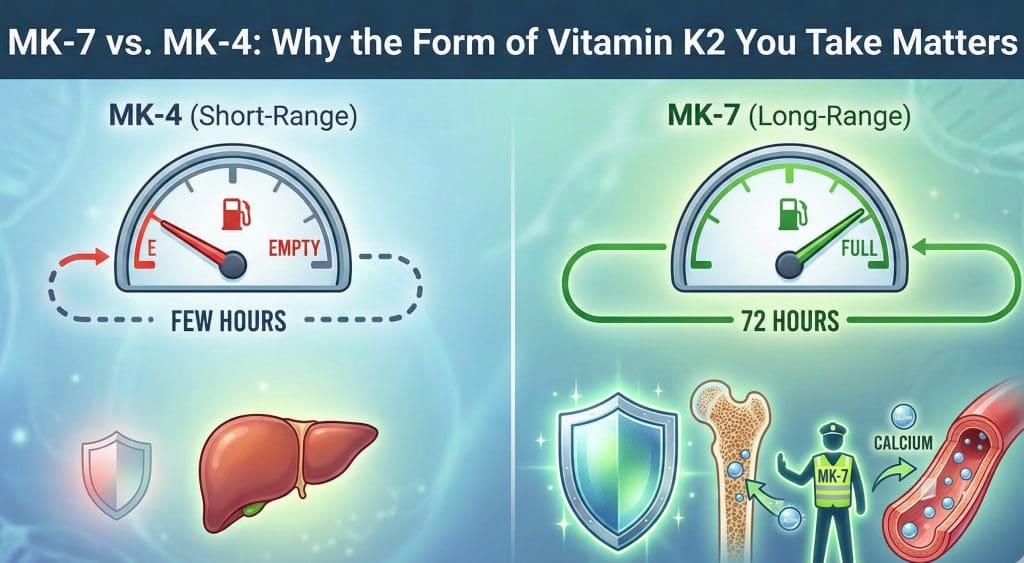
What Is Vitamin K2 — and Why Its Form Matters
Vitamin K2 is a fat‑soluble vitamin that activates proteins responsible for directing calcium. Rather than helping calcium enter bones, it ensures it stays in bones and out of arteries. Two main proteins — osteocalcin and matrix Gla protein (MGP) — need K2 to function.
Different forms of K2 vary in how long they stay active and how consistently they activate those proteins. Understanding those differences helps you choose the right supplement.
MK-7 vs MK-4: What’s the Real Difference?
| Feature | MK-7 | MK-4 |
|---|---|---|
| Common Sources | Natto, fermented foods | Animal foods (butter, liver) |
| Half‑Life in Blood | ~72+ hours | A few hours |
| Dosing Frequency | Once daily | Multiple times daily |
| Best Use | Daily wellness | Short‑term or targeted use |
Key Takeaways:
- MK-7 stays in the bloodstream longer, supporting steady protein activation.
- MK-4 works fast but dissipates quickly.
- Choosing the right form affects dosing and daily routine.
Absorption, Half‑Life, and Why MK-7 Lasts Longer in the Body
Both MK‑7 and MK‑4 are absorbed with dietary fat. But their chemical structures influence how long they remain active.
- MK-7 has a long chain that keeps it active in the bloodstream for days.
- MK-4 exits circulation in hours and needs more frequent dosing.
Because protein activation depends on K2 being present, longer activity means more consistent calcium regulation.
How Vitamin K2 Activates Osteocalcin and MGP
Vitamin K2 activates key proteins:
- Osteocalcin — guides calcium into bone tissue.
- Matrix Gla Protein (MGP) — prevents calcium buildup in arteries.
Without adequate activation, calcium doesn’t go where it should. That increases risk for weaker bones and arterial stiffness.
MK-7 vs MK-4 for Bone Health and Heart Health
Both forms support bone and heart health, but their pharmacokinetics differ:
- MK-7 supports steady protein activation, which helps long‑term maintenance of bone density and arterial flexibility.
- MK-4 may offer benefits in targeted or clinical contexts but requires consistency in dosing.
Clinical evidence often favors MK‑7 for daily supplementation due to its sustained activity.
Dosage and Supplement Practicality: Why Form Affects How You Take It
Here’s how dosing differences show up in real life:
- MK-7: Usually taken once a day (e.g., 90–200 mcg).
- MK-4: Requires higher total intake and several doses throughout the day.
Ease of use affects long‑term adherence, which matters for cumulative health benefits.
Should You Take Vitamin K2 with Vitamin D3?
Vitamin D3 increases your body’s calcium absorption. But calcium needs guidance once absorbed. That’s where K2 plays a role.
- Vitamin D3 alone: Helps absorb calcium but doesn’t direct it.
- D3 + K2 combo: Supports absorption and correct distribution.
For a well‑rounded approach, many people choose a combined supplement. A great example is Vitamin D3 K2 for Bone & Heart Support, designed to pair these nutrients for skeletal and cardiovascular support.
How to Choose the Right Vitamin K2 Supplement for Your Needs
Selecting a good supplement is more than picking a bottle off the shelf. Consider:
- Form of K2: MK‑7 for daily use, MK‑4 for specialized protocols.
- Bioavailability: Quality matters.
- Source and purity: Natural sources like fermented foods or vetted supplements.
For a product that combines D3 and K2 with bioavailable specs, check out Vitamin D3 K2 for Bone & Heart Support.

Final Verdict: MK‑7 or MK‑4 — Which One Makes Sense for You?
Here’s a simple way to think about it:
- MK‑7: Best choice for daily maintenance, once‑a‑day dosing, and steady protein activation.
- MK‑4: Useful for specialized or higher‑dose needs but demands more frequent intake.
Choose based on your goals for bone density, arterial health, and convenience. The right form helps your body use calcium effectively.
FAQ
What is the difference between MK‑7 and MK‑4?
MK‑7 stays active longer and supports consistent calcium regulation, while MK‑4 acts quickly but leaves the bloodstream sooner.
The half‑life difference affects how often you need to take each form for reliable benefits.
Which form of vitamin K2 is better?
MK‑7 is usually better for daily supplementation due to its longer duration and ease of use.
MK‑4 may be considered in specific scenarios, but it typically needs more frequent doses.
Why does vitamin K2 form matter?
The form determines absorption, half‑life, and how well it activates calcium‑regulating proteins.
This matters because you want calcium in bones, not arteries.
Is MK‑7 safe for long‑term use?
Yes, MK‑7 is considered safe at recommended daily doses and supports bone and heart health over time.
It is widely studied and often used with vitamin D3 for added benefit.
Should I take vitamin K2 with vitamin D3?
Yes, combining K2 with D3 supports calcium absorption and proper distribution in the body.
Many choose a formulated product like Vitamin D3 K2 for Bone & Heart Support to cover both.
