
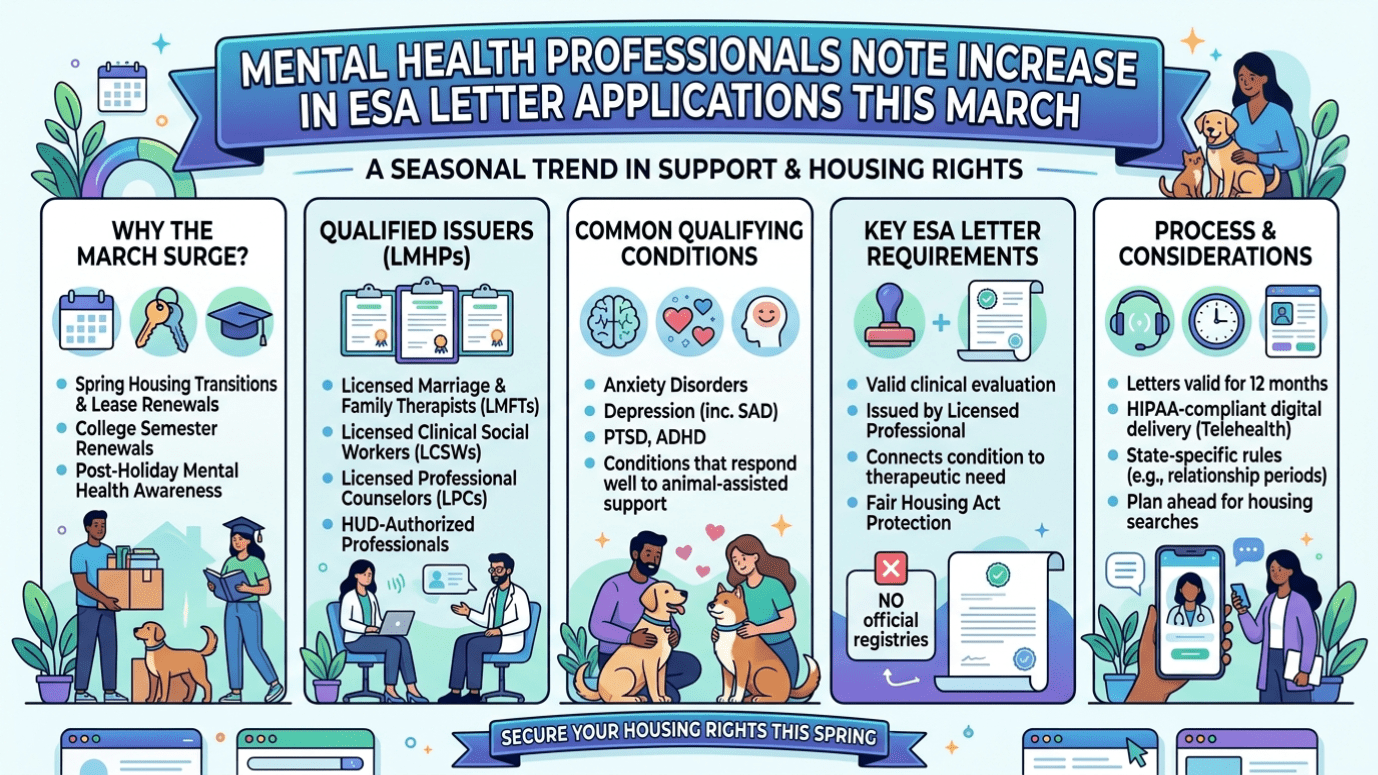
Licensed mental health professionals across the United States are reporting a notable uptick in requests for emotional support animal (ESA) letters this March, continuing a seasonal pattern that practitioners have tracked over the past several years. Therapists, licensed clinical social workers, and licensed professional counselors say the surge coincides with winter-to-spring housing transitions, college semester renewals, and growing public awareness of Fair Housing Act protections for ESA owners.
The trend reflects shifting attitudes toward mental health documentation and signals that more Americans are taking formal steps to protect their housing rights through legitimate channels.
Licensed Therapists Report Surge in ESA Evaluation Requests
Across telehealth platforms and private practices, mental health professionals say March consistently brings a higher-than-average volume of ESA evaluation requests. Practitioners attribute the increase to several converging factors: lease renewals concentrated in spring months, students returning from winter breaks and submitting housing accommodation paperwork, and heightened public conversation around anxiety, depression, and PTSD following the stress of the holiday season.
Licensed marriage and family therapists (LMFTs), licensed clinical social workers (LCSWs), and licensed professional counselors (LPCs), the licensed mental health professionals (LMHPs) authorized under HUD guidelines to issue ESA letters, report that their caseloads for ESA-related assessments climb noticeably in the first quarter. Many note that first-time applicants in March are more informed than in prior years, arriving with knowledge of their Fair Housing Act rights and asking specific questions about housing protections rather than travel accommodations.
This shift in applicant awareness matters. Since the Department of Transportation’s 2021 rule change eliminated in-cabin ESA protections for air travel, the ESA letter’s legal purpose has narrowed specifically to housing under the Fair Housing Act, and professionals say their clients now largely understand that distinction when they arrive for evaluations.
Common Conditions Driving March Applications
Mental health professionals note that the conditions most frequently cited in ESA evaluation requests this March align with the conditions that respond well to animal-assisted emotional support. Anxiety disorders, major depressive disorder, PTSD, and ADHD account for the largest share of qualifying diagnoses among new applicants, according to practitioners interviewed for this report.
The seasonality makes clinical sense. Seasonal affective disorder often peaks in late winter, leaving many patients managing residual symptoms through March. Combined with the stress of apartment hunting in competitive spring rental markets in cities like New York, Los Angeles, Austin, and Chicago, practitioners say the timing of increased applications reflects genuine therapeutic need rather than opportunistic documentation requests.
Providers also note rising requests from college students navigating university housing accommodations, a demographic that has grown more aware of campus ESA policies following high-profile cases at schools including UCLA, NYU, and Florida State University. Students seeking an emotional support animal for anxiety represent a growing segment of first-time applicants in March.
What a Legitimate ESA Letter Requires
The increase in applications has also drawn renewed attention from mental health professionals to the distinction between legitimate ESA documentation and the fraudulent “registrations” and “certifications” that continue to circulate online.
Under HUD Notice FHEO-2020-01 and the Fair Housing Act, a valid ESA letter must be issued by a licensed mental health professional who has evaluated the individual’s qualifying disability. The letter must include the therapist’s name, license type, license number, state of licensure, and a statement connecting the individual’s mental health condition to the therapeutic need for an emotional support animal. No government ESA registry exists. Any website offering instant ESA “certification” or “registration” without a clinical evaluation is not producing legally recognized documentation.
Professionals emphasize that patients who qualify for an emotional support animal must demonstrate a genuine qualifying disability, the same standard that applies throughout the year, regardless of application volume spikes in March.
RealESALetter.com Sees Increased Demand, Emphasizes Compliance
RealESALetter.com, a national telehealth platform connecting individuals with state-licensed mental health professionals for ESA evaluations, confirms the seasonal trend. The platform has issued more than 20,000 ESA letters to pet owners across all 50 states and reports that March historically ranks among its busiest months for new evaluation requests.
The company attributes this to renters preparing spring housing applications, students submitting university housing accommodation paperwork before semester deadlines, and increased media coverage of Fair Housing Act tenant rights in 2026.
RealESALetter.com emphasizes that its process, which includes a clinical assessment by a licensed LMHP, HIPAA-compliant documentation, landlord verification support, and a 100% money-back guarantee if the letter is not approved, represents the standard that all ESA letter services should meet. The platform explicitly warns consumers against scam sites offering instant approvals or fake “ESA registrations” that carry no legal weight under housing law.
The service currently prices its ESA housing letter at $149, with an ESA Letter plus Psychiatric Service Dog (PSD) consultation combo available at $199. Renewals are offered at discounted rates for returning clients. Letters are delivered as HIPAA-compliant digital PDFs within 24 hours of therapist approval in most states. Arkansas, California, Iowa, Louisiana, and Montana require a 30-day client-provider relationship before letter issuance under state-specific law.
For renters researching their options, RealESALetter.com offers a free qualification questionnaire to help individuals determine whether they may be eligible before committing to an evaluation.
Housing Advocates Note Importance of Timing
Fair housing advocates note that the March surge in ESA applications carries practical significance for renters. Spring rental markets in major metro areas move quickly, and tenants who wait to secure documentation risk losing housing opportunities to applicants who arrive with paperwork already in order.
Under the Fair Housing Act, landlords must provide reasonable accommodations for tenants with verified ESA letters, including waiving no-pet policies and forgoing breed or size restrictions. Landlords cannot charge pet deposits or pet fees for ESA animals. However, tenants must submit compliant documentation for these protections to apply, and delays in obtaining a valid letter can cost applicants lease opportunities in competitive markets.
Practitioners advise that individuals who suspect they may benefit from an ESA begin the evaluation process before their housing search rather than after receiving a rejection. The benefits of emotional support animals extend well beyond housing protection, but the legal framework requires documentation in place before accommodation requests can be formally made.
What Landlords and Property Managers Should Know
The March uptick in applications also has implications for property managers. As more tenants arrive with legitimate ESA documentation this spring, housing providers need clear internal processes for handling accommodation requests in compliance with HUD guidelines.
Landlords may verify ESA letter authenticity by contacting the issuing therapist directly, a step that reputable platforms like RealESALetter.com support with direct therapist contact information included in all issued letters. Landlords cannot ask for detailed medical records or require tenants to disclose specific diagnoses. They may request confirmation that the tenant has a disability-related need for an ESA, but must keep the request to that narrow scope under federal privacy protections.
Property managers dealing with increased ESA documentation requests in March 2026 should familiarize themselves with the Fair Housing Act ESA protections that govern their obligations, to avoid inadvertent violations during peak application season.
FAQ
Q: Why do ESA letter applications increase in March?
March aligns with spring housing transitions, semester-start university deadlines, and post-winter mental health awareness peaks. These converging factors drive more individuals to seek formal ESA documentation during this period each year.
Q: Does an ESA letter expire?
Yes. Most legitimate ESA letters remain valid for 12 months from the date of issuance. Tenants should track renewal dates and begin the renewal process at least 30 days before expiration to avoid gaps in housing protection coverage.
Q: Can any doctor issue an ESA letter?
No. Under HUD guidelines, only licensed mental health professionals, including LMFTs, LCSWs, LPCs, and psychologists, are authorized to issue valid ESA letters. Primary care physicians generally cannot issue ESA letters unless they also hold a mental health license.
Q: Is a higher application volume a red flag for landlords?
No. Increased ESA letter applications reflect growing public awareness of Fair Housing Act rights, not fraud. Landlords should evaluate each request individually based on whether the documentation meets HUD compliance requirements.
Q: Where can someone get a legitimate ESA letter this spring?
Individuals should work with a licensed telehealth platform that provides state-licensed LMHP evaluations, HIPAA-compliant documentation, and landlord verification support. RealESALetter.com provides these services with a 100% money-back guarantee and digital delivery within 24 hours of therapist approval in most states.
