
The pursuit of wireless speakers with good bass has become one of the most misunderstood challenges in consumer audio. Marketing language often reduces bass to a single dimension “more” or “louder.” But in reality, bass is governed by acoustic physics, electromechanical behavior, enclosure dynamics, and system-level efficiency. When any one of these factors is poorly executed, the result is not just weak bass but inaccurate sound reproduction.
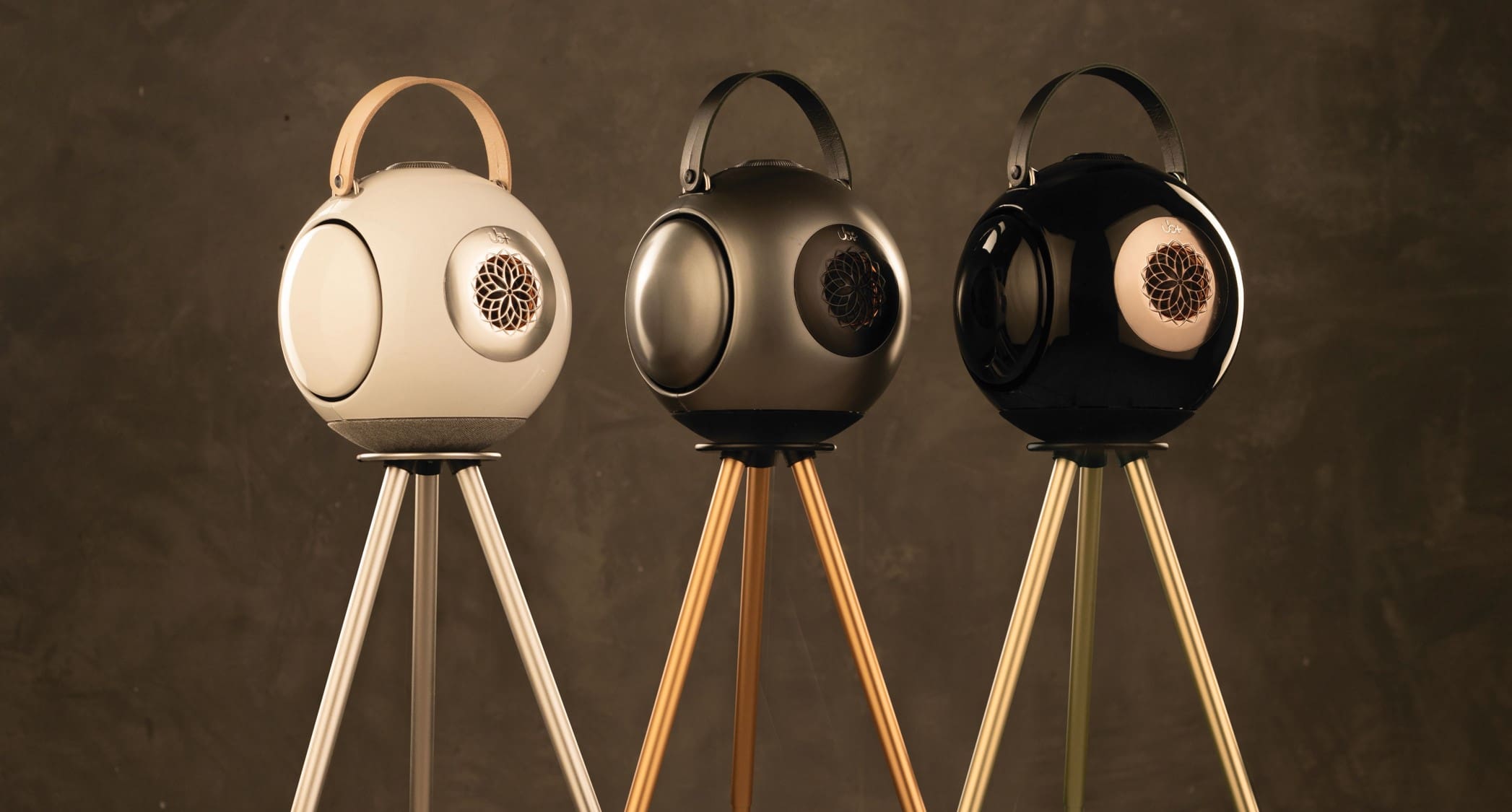
For listeners who demand depth, clarity, and consistency, understanding these principles is essential. This guide takes a technical, engineering-first perspective, breaking down how bass is produced, what limits it in wireless systems, and how advanced architectures such as the UB+ dB1 DOUBLEBASS solve these constraints through physics-driven design.
The Physics of Bass: Wavelength, Pressure, and Energy Transfer
Low-frequency sound behaves fundamentally differently from mid and high frequencies. At 40 Hz, a sound wave has a wavelength of approximately 8.5 meters. This creates a core requirement:
A speaker must displace sufficient air volume to generate perceivable pressure variations at low frequencies.
This leads to three governing equations in practical speaker design:
Air Displacement (Vd)
Vd = Sd × Xmax
Where:
- Sd = effective diaphragm surface area
- Xmax = maximum linear excursion
To produce deeper bass, either surface area or excursion must increase. In portable systems, both are constrained.
Acoustic Output vs Efficiency
Low-frequency reproduction is inherently inefficient. As frequency decreases, the energy required to maintain sound pressure level increases exponentially. This is why small speakers struggle below ~80 Hz without assistance.
Impedance and Resonance
Every enclosure-driver system has a resonant frequency (Fs). Below this frequency, output drops rapidly unless the system is tuned to reinforce it—typically through ports, radiators, or resonant chambers.
System Constraints in Wireless Speaker Design
Wireless speakers must operate within multiple constraints simultaneously:
Limited Enclosure Volume
The internal air volume (Vb) directly affects low-frequency extension. Smaller volumes increase stiffness, raising the system’s resonant frequency and reducing bass depth.
Power and Thermal Limits
Battery-powered systems must balance output with efficiency. High excursion requires more current, which increases heat and reduces battery life.
Mechanical Stability
As excursion increases, so do reaction forces. Without proper control, this leads to:
- Cabinet vibration
- Energy loss
- Audible distortion
Psychoacoustic Compensation
Many systems rely on psychoacoustic tricks boosting certain frequencies to simulate bass. While effective at low volumes, this approach fails under dynamic conditions.
Conventional Architectures: Where They Break Down
Most wireless speakers use variations of three designs:
Bass Reflex (Ported Systems)
Ports extend low-frequency response by tuning airflow. However:
- Narrow bandwidth tuning
- Port noise at high SPL
- Reduced transient accuracy
Passive Radiator Systems
Radiators replace ports with a mass-loaded diaphragm. While more compact, typical implementations suffer from:
- Limited surface area
- Asymmetrical force distribution
- Reduced efficiency
DSP-Augmented Systems
Digital processing boosts low frequencies artificially. This often introduces:
- Compression at high output
- Phase distortion
- Reduced dynamic range
Toward a Physics-Based Solution
To achieve truly effective wireless speakers with good bass, the system must optimize:
- Acoustic geometry
- Driver mechanics
- Energy transfer pathways
- Force symmetry
The UB+ dB1 DOUBLEBASS exemplifies this integrated approach.
Spherical Acoustic Geometry and Helmholtz Behavior
Elimination of Standing Waves
Rectangular enclosures create axial modes due to parallel boundaries. A sphere eliminates these modes, ensuring uniform pressure distribution.
Helmholtz Resonance Integration
The spherical chamber functions as a distributed Helmholtz resonator, where:
- Internal air mass oscillates in response to driver input
- Energy is stored and released efficiently
- Low-frequency output is reinforced naturally
Pressure Uniformity
Uniform pressure reduces localized stress points, improving:
- Frequency response linearity
- Harmonic stability
- System efficiency
Inward-Firing Driver: Pressure-Driven Architecture
Unlike conventional outward-facing drivers, the dB1 employs a central inward-firing mid-bass driver.
Functional Shift
The driver operates as a pressure excitation source, not a direct radiator.
Engineering Specifications
- 90mm neodymium magnet → high flux density
- 35mm voice coil → extended linear excursion
- 20mm piston travel → high displacement capability
- Aluminum shorting ring → reduced inductance modulation
- Wide surround → improved compliance and control
Benefits
- Controlled energy injection into the acoustic system
- Reduced direct radiation distortion
- Improved coupling with enclosure resonance
Dual Symmetrical Passive Radiators: Force Cancellation Mechanics
Symmetry Principle
Two identical radiators are placed on opposite axes. Their motion creates:
- Equal and opposite reactive forces
- Net-zero mechanical vibration
Acoustic Output
Radiators convert internal pressure into external sound waves with high efficiency.
Advantages
- Reduced cabinet resonance
- Improved transient response
- Higher usable SPL without distortion
Surface Area Multiplication and Mechanical Gain
The system’s radiators provide approximately 3.5× the surface area of the active driver.
Implications
- Increased effective Sd
- Lower required excursion for same output
- Reduced distortion
Mechanical Amplification
This acts as a passive gain stage, where:
- Small driver motion → large air displacement
- Energy efficiency increases
- Thermal load decreases
System-Level Integration
The dB1 DOUBLEBASS operates as a closed-loop acoustic system:
- Driver injects energy into enclosed air volume
- Spherical chamber distributes pressure uniformly
- Radiators convert pressure into motion
- Symmetry cancels mechanical vibration
- Increased surface area amplifies output
This integration ensures coherent phase response and consistent bass reproduction.
Comparative Engineering Analysis
| Parameter | UB+ dB1 DOUBLEBASS | JBL | Bose | Marshall |
| Enclosure Type | Spherical | Rectangular | Rectangular | Rectangular |
| Acoustic Mode Control | Uniform | Axial modes | Axial modes | Axial modes |
| Driver Orientation | Inward | Outward | Outward | Outward |
| Radiator Configuration | Dual symmetrical | Dual | Single/Port | Dual |
| Effective Surface Area | 3.5× | ~1× | ~1× | ~1× |
| Vibration Control | Self-cancelling | Partial | Partial | Partial |
| Bass Generation | Mechanical | DSP-assisted | DSP-assisted | DSP-assisted |
| Distortion at High SPL | Low | Moderate | Moderate | Moderate |
Transient Response and Group Delay
Bass quality is not only about depth it is also about timing accuracy.
Transient Response
A well-engineered system responds quickly to signal changes, producing:
- Tight, punchy bass
- Accurate attack and decay
Group Delay
Poorly tuned systems introduce delay in low frequencies, causing:
- “Lagging” bass perception
- Smearing of rhythm
Physics-driven systems minimize these effects through balanced mechanical design.
Harmonic Distortion and Linearity
Low-frequency reproduction often introduces harmonic distortion due to:
- Non-linear excursion
- Magnetic field variation
- Suspension asymmetry
The dB1 addresses this through:
- Long-stroke voice coil design
- Aluminum shorting ring
- Balanced radiator loading
Result: lower THD and improved tonal accuracy.
Real-World Acoustic Performance
In practical environments, these engineering decisions translate into:
Indoor Use
- Even bass distribution
- Reduced room interaction artifacts
Outdoor Use
- Efficient air coupling
- Maintained low-frequency presence
High Volume Playback
- Stable output
- Minimal compression
- Reduced listener fatigue
Psychoacoustics vs Physical Acoustics
Many speakers rely on psychoacoustic tricks:
- Bass boost curves
- Harmonic enhancement
While effective initially, they lack physical foundation.
True bass performance comes from:
- Air movement
- Pressure control
- Mechanical efficiency
The Future of Wireless Bass Engineering
Emerging trends include:
- Non-Euclidean enclosure geometries
- Advanced composite materials
- Multi-radiator symmetrical systems
- Reduced DSP dependency
These innovations signal a shift toward engineering authenticity over digital simulation.
Defining “Good Bass” in Technical Terms
For wireless speakers with good bass, the following criteria must be met:
- Low Fs (resonant frequency)
- High Vd (air displacement capability)
- Low THD (total harmonic distortion)
- Controlled group delay
- Uniform pressure distribution
Conclusion: Engineering as the Foundation of Bass Excellence
The search for wireless speakers with good bass is ultimately a search for engineering integrity.
True bass is not created through software it is achieved through:
- Intelligent enclosure geometry
- Precision driver design
- Efficient energy transfer
- Balanced system integration
The UB+ dB1 DOUBLEBASS demonstrates how these principles can be applied in a compact wireless format. By combining a spherical Helmholtz-inspired chamber, inward pressure-driven architecture, dual symmetrical radiators, and surface area amplification, it achieves a level of bass performance that is both technically sound and perceptually immersive.
In a market dominated by shortcuts, this approach represents a return to fundamentals where physics, not marketing, defines performance.
Explore the UB+ dB1 DOUBLEBASS