
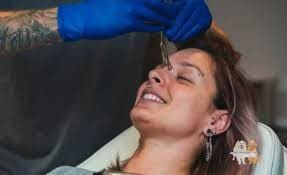
“Lobotomy piercing” is not an official or professional piercing name like eyebrow, bridge, or nostril. It’s an informal nickname used in some body modification communities.
Today, the term usually refers to two piercings placed on the temples, one on each side of the head. These are most often dermal anchors, also called microdermals, placed symmetrically near the left and right temple areas.
The name comes from the old “ice pick” lobotomy procedure, which is now known to have been harmful and unethical. Because of that history, many professional piercers avoid using the term. Instead, they describe the piercing by its exact placement, such as temple dermals.
If someone asks for a “lobotomy piercing,” a responsible piercer will ask for clarification to understand the exact location and type of jewelry the person wants.
History and Cultural Context of Lobotomy
Facial piercing has a long history across many cultures for identity, spirituality, status, aesthetics, and community belonging. What’s considered “extreme” depends heavily on time and place.
In the late 20th century, especially from the 1970s onward, modern Western body piercing grew through punk, goth, and body modification communities, then expanded into mainstream fashion. As techniques, jewelry quality, and studio hygiene improved, people began exploring placements beyond traditional ear and nose piercings.
“Extreme” facial piercings (multiple piercings, unusual placements, or surface/dermal work) often function as:
- Personal aesthetic choices (symmetry, “industrial” styling, minimalistic dermal tops)
- Subcultural identity and self-expression
- Body autonomy and intentional appearance design
This context matters because extreme placements often carry higher anatomical limits and higher complication rates, so informed decision‑making is essential.
How the Piercing Is Performed & What Actually Happens
Because “lobotomy piercing” usually refers to temple dermals, the most common method is a dermal anchor (microdermal) placement.
- Consultation and placement planning
A professional piercer will:
- Check your temple anatomy (skin thickness, movement, and likely irritation points)
- Discuss lifestyle factors (glasses, helmets, sleeping position, hairline friction)
- Mark placement while you’re sitting and making natural facial expressions to avoid awkward positioning
- Skin prep and sterile setup
Reputable studios use:
- A sterile field and sterile instruments
- Skin antiseptic prep
- New, single‑use needles where applicable
- Dermal anchor insertion (common approach)
In simple terms, the piercer creates a small pocket under the skin and inserts an anchor base that sits beneath the surface. A threaded post is left accessible so a decorative top can be attached.
Some piercers use a needle-based technique; others use a dermal punch depending on training, local regulations, and anatomy. Regardless of method, the goal is the same: a stable anchor that sits correctly and minimizes tissue stress.
- Jewelry installation and check
The piercer attaches the top, checks alignment, and explains aftercare and warning signs.
Typical Jewelry Used
For temple “lobotomy” placements, jewelry is usually:
Dermal anchors (microdermals)
- Anchor base under the skin + removable top
- Tops can be flat disks, bezel-set gems, small ends, or low-profile shapes
Surface piercing jewelry (less common in this “lobotomy” context)
If someone is using the phrase to mean a short surface piercing in the temple region, a piercer may discuss a surface bar (“staple bar”) designed to sit parallel under the skin. This is highly anatomy‑dependent and often more vulnerable to irritation.
Material standards
Safer studios typically use:
- Implant-grade titanium (commonly preferred for initial healing)
- High-quality solid gold options may be appropriate in some cases, but low-profile titanium is often the most practical for healing
Low-profile designs matter because the temple area is exposed to frequent accidental contact.
Risks, Safety Considerations, and Aftercare
Like any advanced facial piercing, a lobotomy piercing comes with specific risks that should be carefully considered before proceeding.
Because it involves sensitive areas of the face, proper technique and hygiene are essential to reduce complications.
Understanding safety precautions and following structured aftercare guidelines can significantly lower the chances of infection, rejection, or long-term scarring. Taking these factors seriously ensures a safer and more informed decision.
Key risks to understand
Temple dermals and surface work are often considered higher-risk than many standard piercings because the area can experience:
- Snagging and impact (hair brushing, glasses arms, helmets, masks, towels)
- Pressure while sleeping
- Natural facial movement that stresses the piercing
Common complications include:
- Irritation and persistent redness
- Migration (the anchor shifting position)
- Rejection (the body pushing the jewelry toward the surface)
- Infection (usually tied to poor aftercare, poor hygiene, or trauma)
- Scarring (even with good care, removal can leave a mark)
Because placement is near the eye region, any spreading swelling, severe pain, fever, or vision-related symptoms should be treated as urgent.
Clear safety rules
- Do not treat this as a casual walk-in piercing. Choose a studio experienced with dermals/surface work.
- Avoid if you cannot protect it from repeated trauma (contact sports, daily helmets, rough sleeping habits you can’t change, etc.).
- Plan for the possibility of removal. Dermals may not be permanent; many people eventually retire them.
Aftercare instructions (simple and effective)
Follow your piercer’s specific instructions, but responsible baseline care usually includes:
- Clean gently, not aggressively
- Use sterile saline (pre-packaged) to soften and remove crusting.
- Clean with clean hands only.
- Pat dry with clean, disposable material (avoid shared towels).
- Avoid “DIY disinfecting.”
- Skip alcohol, hydrogen peroxide, and harsh ointments unless a medical professional directs you. These often cause irritation and slow healing.
- Protect from pressure and snagging
- Sleep on the opposite side or use a donut-shaped pillow.
- Be careful with hairbrushes, glasses arms, hoodies, helmets, and phone use.
- Keep makeup, hair products, and sunscreen away from the site during early healing.
- Don’t twist, rotate, or “check” the jewelry
- Movement can tear healing tissue and trigger bumps or migration.
- Watch for warning signs
- Concerning signs include worsening heat, spreading redness, thick yellow/green discharge with increasing pain, fever, or the jewelry becoming increasingly visible under thinning skin.
- If you suspect infection, seek medical advice promptly, and do not remove jewelry on your own without guidance; removing it can trap infection inside.
Who Typically Chooses This Piercing & Why
People who pursue temple dermals (often called “lobotomy piercings”) commonly do so because they want:
- A symmetrical, high-impact facial look without a full set of facial piercings
- A minimal, “floating gem” effect that dermals create
- A style associated with alternative fashion and body modification communities
- A piercing that feels custom and less common than eyebrow or nostril placements
A responsible choice usually comes from people who understand they may need to retire the piercing later and are prepared for careful upkeep.
How It Differs From Eyebrow and Other Facial Piercings
The most important differences are anatomy, jewelry style, and long-term stability.
Compared with a standard eyebrow piercing
- Eyebrow piercings pass through a fold of tissue in the brow area and are typically done with a curved barbell.
- Temple dermals are an anchor under the skin with a single visible top.
- Temple dermals are often more vulnerable to impact and pressure, and they can be less predictable long-term than a well-placed eyebrow piercing.
Compared with a bridge piercing
- A bridge is a straight bar through the skin at the upper nose bridge.
- A temple dermal is not a through-and-through bar; it’s a single-point anchor.
- Both can reject, but the mechanics differ: surface tension and trauma patterns are not the same.
Compared with dermals in calmer areas
Dermals placed in areas with less movement and fewer snags can be easier to maintain. The temple region often gets more accidental contact, which raises the difficulty level.
Tips for Finding a Professional Piercer: A Responsible Checklist
For a higher-skill placement like temple dermals, choosing the right piercer matters as much as aftercare.
What to look for
- A portfolio with healed results
- Ask to see healed dermals/surface work, not just fresh photos.
- Clear hygiene practices
- Sterile tools, clean work area, and professional setup.
- The piercer should explain processes without getting defensive or vague.
- High-quality jewelry
- Implant-grade materials and appropriate threading/finishing.
- Low-profile tops for the temple to reduce snag risk.
- A realistic consultation
- A good piercer discusses rejection risk, lifestyle conflicts, and scarring.
- They should be willing to say “no” if your anatomy or lifestyle makes it unsafe.
- A plan for downsizing, checkups, and removal
- Ask what follow-ups they recommend and how they handle complications.
- Confirm they can perform or coordinate safe removal if needed.
Questions worth asking during your consult
- “How often do you place temple dermals, and what are the most common issues you see?”
- “What jewelry material and top shape do you recommend for my lifestyle?”
- “What should I do if I notice signs of migration or thinning skin?”
- “What’s your policy if this needs to be removed?”
Closing Perspective: Make It an Informed Choice
A “lobotomy piercing” (most often paired temple dermals) can create a striking look, but it’s best approached as a high-maintenance, higher-risk facial modification that requires careful planning, a skilled professional, and consistent protection during healing. The safest decision is one based on anatomy, lifestyle, and realistic expectations and not just the aesthetic.
If you tell me your intended placement (temples vs. another area) and whether you mean dermals or a surface bar, I can tailor the guidance to that specific setup and the practical risks that come with it.