
The global last-mile delivery market is entering a high-growth and transformation phase, driven by rapid e-commerce expansion, increasing consumer demand for faster fulfillment, and structural shifts in logistics operations. As the final touchpoint between businesses and end consumers, last-mile delivery now represents one of the most critical and value-sensitive segments of the supply chain, accounting for a significant share of total logistics costs while directly influencing customer satisfaction and brand loyalty.
The market is witnessing accelerated investments in artificial intelligence (AI), robotics, electric mobility, and collaborative delivery ecosystems, as logistics providers, retailers, postal services, and technology companies race to build scalable, efficient, and sustainable last-mile networks.
Market Expansion Fueled by E-Commerce and Changing Consumer Behavior
The sustained rise of e-commerce continues to be the primary growth driver for the last-mile delivery market. Globally, online retail volumes have expanded at a strong pace over the past five years, with parcel volumes reaching unprecedented levels across developed and emerging economies. Consumers now increasingly expect same-day, next-day, and time-definite delivery services, even for low-value or high-frequency purchases.
Urbanization, smartphone penetration, and digital payment adoption are further accelerating last-mile demand, particularly in Asia-Pacific, the Middle East, Africa, and parts of Eastern Europe. In these regions, logistics providers are rapidly scaling delivery networks to serve tier-II and tier-III cities, which are emerging as high-potential growth hubs due to rising consumption and limited historical logistics penetration.
In mature markets, growth is being driven less by volume alone and more by service differentiation, speed optimization, and reliability improvements, as competition intensifies among retailers and delivery platforms.
Technology, AI, and Automation Reshaping Operational Models
Technology has become the backbone of modern last-mile delivery operations. AI-driven route optimization, predictive analytics, and real-time tracking platforms are now widely adopted to improve delivery density, reduce transit times, and minimize failed delivery attempts. These technologies enable companies to process large volumes of data related to traffic patterns, customer availability, weather conditions, and order clustering.
Automation and robotics are also playing an increasingly prominent role. Autonomous delivery robots and smart sorting systems are being tested and deployed to address labor shortages and improve efficiency in high-density urban environments. Robotics-based solutions are particularly effective for short-distance deliveries, offering lower operating costs and consistent service levels.
Digital orchestration platforms are further enabling seamless integration between warehouses, delivery fleets, retailers, and consumers, improving transparency and enabling dynamic decision-making across the last-mile ecosystem.
Electrification and Sustainability as Core Growth Enablers
Sustainability has emerged as a defining theme in the last-mile delivery market. With transportation being a major contributor to urban emissions, regulators and consumers alike are pushing logistics providers to reduce their environmental footprint. As a result, electrification of last-mile fleets has accelerated significantly.
Electric two-wheelers, three-wheelers, vans, and light commercial vehicles are increasingly deployed for last-mile operations due to their lower total cost of ownership, reduced maintenance requirements, and suitability for short, stop-and-go routes. In many regions, electric vehicles are also benefiting from government incentives, preferential access to low-emission zones, and expanding charging infrastructure.
Beyond vehicle electrification, companies are adopting sustainability-focused strategies such as route consolidation, micro-fulfillment centers closer to consumers, reusable packaging, and carbon monitoring systems. Sustainability performance is increasingly influencing partner selection, investment decisions, and brand positioning within the logistics and retail sectors.
Recent Industry Developments and Strategic Insights
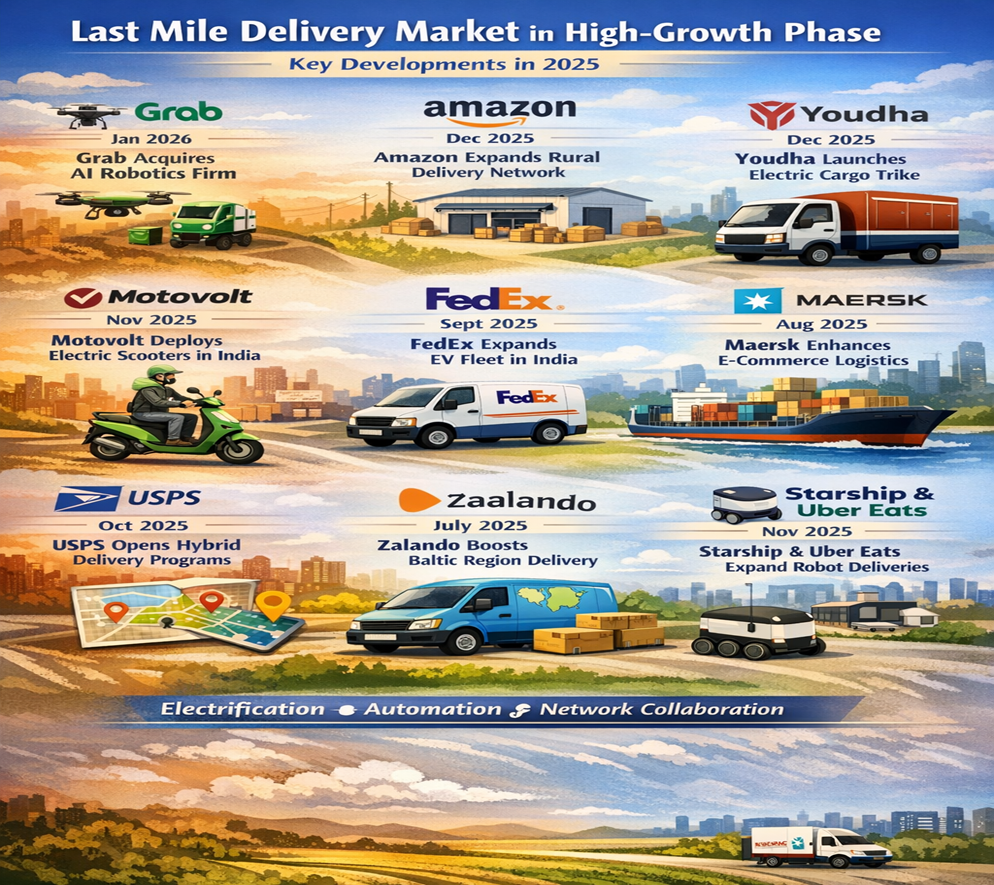
In January 2026, Grab Holdings enhanced its first- and last-mile logistics capabilities through the acquisition of an AI robotics company, signaling a strategic shift toward automation-driven delivery optimization across Southeast Asia. This move reflects growing confidence in robotics as a scalable solution for high-volume urban delivery.
In December 2025, Amazon expanded its rural last-mile delivery infrastructure in the United States by launching additional delivery stations, reinforcing its long-term strategy to improve service reach, reduce delivery times, and strengthen customer experience beyond metropolitan areas.
In November 2025, Motovolt deployed thousands of electric two-wheelers for last-mile delivery across major Indian cities, supporting the rapid electrification of urban logistics and highlighting the role of lightweight EVs in cost-effective, high-frequency delivery models.
In December 2025, Youdha introduced an electric cargo three-wheeler designed for last-mile logistics, targeting businesses requiring higher payload capacity and improved stability for dense urban delivery environments.
In October 2025, USPS initiated programs to open its last-mile delivery network to broader participation, reflecting a shift toward hybrid public–private delivery models aimed at maximizing network utilization and improving delivery efficiency.
In September 2025, FedEx expanded its electric vehicle deployments for last-mile delivery in India, aligning sustainability goals with operational efficiency and reinforcing its commitment to low-emission logistics in high-growth markets.
In August 2025, Maersk upgraded its e-commerce and last-mile delivery offerings through service integration and network enhancements, highlighting the convergence of global freight, fulfillment, and last-mile services under unified logistics platforms.
In April 2025, Aramex partnered with an AI-enabled logistics technology provider to improve last-mile productivity, focusing on real-time visibility, route intelligence, and same-day delivery enablement.
In July 2025, Zalando strengthened its last-mile delivery capabilities in the Baltic region through a regional logistics partnership, underscoring the importance of localized delivery strategies for cross-border e-commerce success.
In November 2025, Starship Technologies and Uber Eats expanded robotic last-mile delivery operations across Europe and the United States, reflecting growing acceptance of autonomous delivery solutions in food and parcel logistics.
Cost Pressures and the Push for Efficiency
Last-mile delivery remains the most expensive segment of the logistics value chain, often accounting for more than half of total delivery costs. Rising labor expenses, fuel price volatility, urban congestion, and high expectations for fast delivery continue to compress margins.
To address these challenges, companies are increasingly adopting alternative delivery models such as pickup points, parcel lockers, neighborhood hubs, and crowd-sourced delivery. Micro-fulfillment centers located closer to consumers are also gaining traction, reducing delivery distances and improving turnaround times.
Regional Dynamics and Emerging Market Opportunities
Emerging economies are becoming central to last-mile delivery growth, driven by expanding consumer bases and improving logistics infrastructure. South Asia, Southeast Asia, the Middle East, Africa, and parts of Latin America are witnessing heightened investment activity as global and regional players compete to establish strong last-mile footprints.
In developed markets, focus is shifting toward automation, sustainability, and service differentiation, while emerging markets emphasize network expansion, affordability, and reliability.
Future Outlook
The outlook for the global last-mile delivery market remains highly positive. Continued innovation in AI, robotics, electrification, and collaborative logistics models is expected to drive sustained growth over the coming decade. Companies that successfully balance speed, cost efficiency, sustainability, and customer experience will be best positioned to lead in an increasingly competitive and complex delivery landscape.
As e-commerce volumes rise and delivery expectations evolve, last-mile delivery will remain a critical enabler of global trade, digital commerce, and urban mobility.
About the Author:
HTF Market Intelligence Consulting is uniquely positioned to empower and inspire with research and consulting services to empower businesses with growth strategies, by offering services with extraordinary depth and breadth of thought leadership, research, tools, events, and experience that assist in decision-making.
