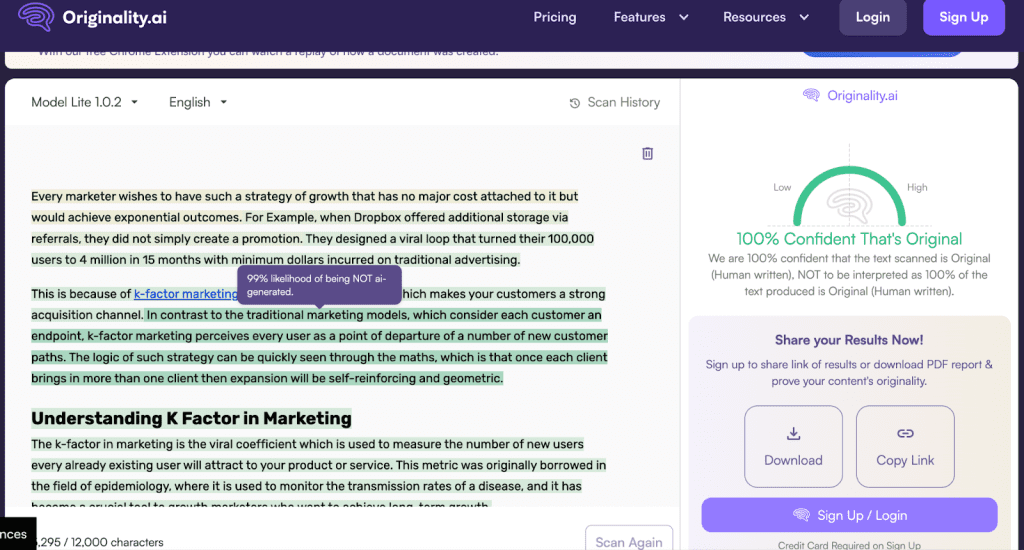
Every marketer wishes to craft such a growth strategy for which high spend is not required but it would help in achieving exponential outcomes. For example, when Dropbox offered additional storage via referrals, they did not simply create a promotion. They designed a viral loop that turned their 100,000 users to 4 million in 15 months with minimum dollars incurred on traditional advertising.
This is because of k-factor marketing, a growth strategy that makes your customers a strong acquisition channel. In contrast to the traditional marketing models, which consider each customer an endpoint, k-factor marketing perceives that every acquired user leads to a number of new potential customers. The logic of such strategy can be quickly seen through the maths, which is that once each client brings in more than one client then expansion will be self-reinforcing and geometric.
Understanding K Factor in Marketing
The k-factor in marketing is the viral coefficient which is used to measure the number of new users every already existing user will attract to your product or service. This metric was originally borrowed in the field of epidemiology, where it is used to monitor the transmission rates of a disease, and it has become a crucial tool to growth marketers who want to achieve long-term growth.
Your user base will grow exponentially when your k-factor is greater than one without the need to acquire users using paid channels. K-factor is less than one implying organic growth is not enough to support growth and constant marketing investment is needed to keep it going.
What Is K Factor and Why It Matters
The k-factor is just more than a number. It is also a strong indicator of how well the product resonates with users. High k-factor is an indicator that the customers will be willing to recommend the offering to others in an active way, because they think there is value sufficient to keep the business going.
Companies that monitor this indicator get good insights into the trends of customer behavior and their level of engagement. K-factor marketing highlights creating long term value by utilizing network effects and organic reach unlike conventional marketing metrics, which measure their success in creating instant conversions.
K Factor Calculation Made Simple
The K-factor can be calculated with a simple formula whereby you multiply the rate of your invitation and your conversion rate. The first one is to define the average number of invitations made by each user and then calculate the percentage of invitations, which lead to active users.
Considering the example of 20 percent of invitations becoming active users, such as each user invites five people, then your k-factor will be one. This metric has to be monitored on a steady basis with the help of mobile measurement platforms that would offer precise attribution data and analytics on the behavior of users.
The modern MMP tools allow companies to divide k-factor computations into user groups, acquiring platforms, and regions. Such granular analysis makes it possible to identify what categories of users are contributing the most to viral growth, and marketers can make their strategies more efficient.
Strategies to Improve Your K-Factor Marketing
Strong k-factor marketing depends on the establishment of a successful referral program. Design incentives which are mutually beneficial to existing users and new referrals, which would establish a win-win situation that would promote active participation. Differentiation rewards (rewards that are given on both sides) have been especially effective in stimulating referral behavior.
Design of the product is also very significant in accelerating organic growth. Incorporate the sharing systems into your basic user experience and make it effortless and natural to the customers to invite others. The social nature, collaborative tools and content to be shared make organic promotion more probable.
It is good to schedule your referral requests so as to maximize the conversion rates. Offer invitations in real-time following important value experiences in your product experience. This emotional apex will raise the likelihood of passionate referrals to friends and workmates.
Optimizing Growth Through Data Analysis
Effective k-factor marketing must be monitored and adjusted. Monitor your viral coefficient over various periods of time to determine trends and season. Utilize mobile measurement platform analytics to see what features or types of content are being shared most.
A/B testing various referral mechanics can be used to determine what appeals to your audience. Test different reward systems, invitation messages and channels of sharing to find which one works best in this market and customer base.
Conclusion
K-factor marketing is an effective strategy of attaining sustainable organic growth without spending too much money on advertising. Knowing what k-factor is, and learning to calculate k-factor, and applying strategic improvements, companies can make happy customers their growth sources. Put emphasis on generating real value, eliminating friction in the sharing process, and continually optimizing on the basis of data insights to create an engine of self-perpetuating growth that forms an efficient scale.