

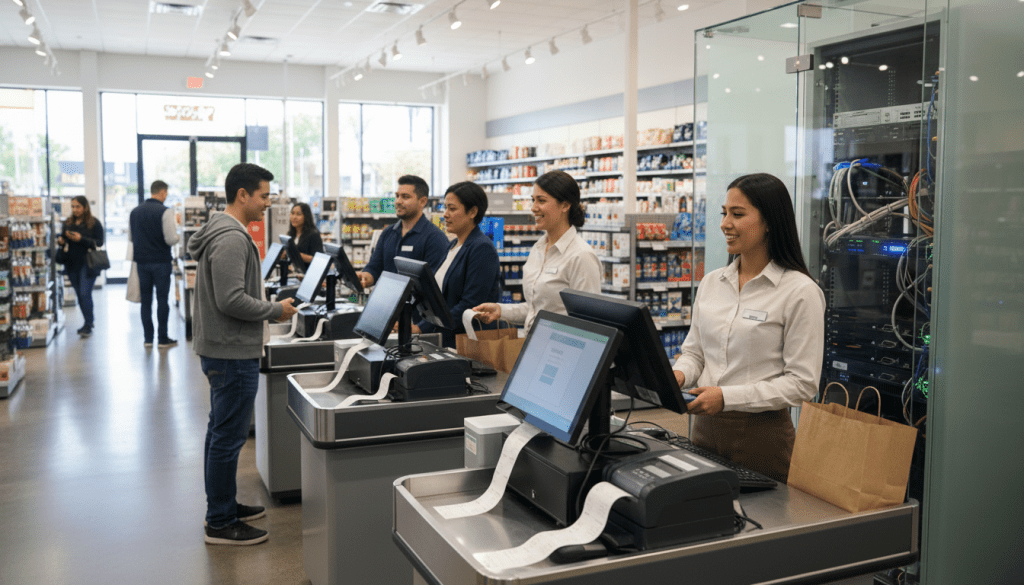
Black Friday at 9 AM. Your registers freeze. Customers wait, then leave. Every minute costs you sales you will never recover. High-traffic retail in California demands technology that never fails when you need it most.
From Downtown Burbank’s shopping districts to coastal boardwalks, retailers face the same challenge: technology must work flawlessly during peak hours, or revenue vanishes. Understanding what your IT infrastructure must deliver separates thriving retailers from those constantly fighting fires.
POS System Requirements for High-Volume California Retail
Transaction speed determines customer satisfaction during rush periods. Your POS system must process payments in seconds, not minutes. Slow terminals create lines that drive shoppers to competitors. Modern systems support contactless payments, chip cards, mobile wallets, and traditional swipes without hesitation.
Payment processing must comply with PCI DSS standards. California retailers face strict liability for customer data breaches. Your POS system needs encryption, secure networks, and regular security updates. Non-compliance brings fines and destroyed reputation when breaches occur.
Inventory synchronization across all sales channels prevents the frustration of selling items you cannot fulfill. When a customer buys online for in-store pickup, your POS must reflect that immediately. Real-time inventory accuracy keeps customers happy and reduces operational chaos.
California law requires customer-facing price displays on all POS systems. Your setup must show customers what they pay before completing transactions. Backup payment processing systems prevent total shutdown when primary systems fail. Many IT support for Burbank Empire Center businesses maintain redundant payment terminals and offline transaction capabilities for exactly this reason.
Network Infrastructure That Handles Peak Traffic
Your network carries every transaction, inventory update, and customer Wi-Fi connection. Insufficient bandwidth during Saturday afternoon rushes means frozen registers and angry customers. Retail networks need capacity for simultaneous transactions across multiple terminals, security camera feeds, digital signage updates, and customer device connections.
Redundant internet connections provide failover when your primary connection drops. A single internet line creates a single point of failure. When that line goes down, your entire operation stops. Dual connections from different providers mean automatic switchover keeps you running.
Separate Wi-Fi networks for customers and business operations protect your payment systems. Guest Wi-Fi on the same network as your POS terminals creates security vulnerabilities. Customer networks need bandwidth limits to prevent one person streaming video from slowing your entire operation.
Wired connections for POS terminals offer reliability that Wi-Fi cannot match. Wireless connections drop during interference or when too many devices compete for signal. Critical payment terminals deserve dedicated, wired network drops.
Security layers protect customer payment data and business information. Firewalls block unauthorized access. Network monitoring detects unusual activity before breaches occur. Regular security patches close vulnerabilities that hackers exploit.
IoT devices from security cameras to smart thermostats to digital menu boards all demand network capacity. Each device adds to your bandwidth requirements. Load balancing distributes traffic efficiently during peak periods, preventing bottlenecks that slow operations.
IT Support Expectations for Retail Locations
Retail operates when IT support typically does not. A register failure at 7 PM on Saturday cannot wait until Monday morning. Fast response times during business hours keep minor issues from becoming revenue losses. Your support provider needs staff available when your store is open and selling.
Remote support resolves most issues within minutes. Technicians can access your systems, diagnose problems, and implement fixes without traveling to your location. Complex hardware failures still require on-site visits, and local technicians who can arrive quickly prevent extended downtime.
Proactive monitoring catches problems before they impact operations. Automated systems watch your network, servers, and POS terminals around the clock. Alerts notify technicians when hard drives fill up, when performance degrades, or when security threats appear. Issues get fixed during slow periods instead of during checkout lines.
After-hours emergency support provides a safety net for critical failures. When your payment processing completely stops, you need someone answering the phone immediately. Emergency response should include clear escalation procedures and realistic timeframes for resolution.
Vendor coordination simplifies your life when multiple companies provide your technology. Your IT support team should manage relationships with POS vendors, payment processors, internet providers, and equipment suppliers. One call should mobilize the right resources to solve any problem.
California-Specific Retail IT Considerations
California Consumer Privacy Act compliance affects how you collect and store customer data. Retailers gathering email addresses, tracking purchases, or offering loyalty programs must protect that information and honor customer privacy requests. Your IT systems need data encryption, access controls, and processes for handling deletion requests when customers exercise their rights.
POS registration requirements vary by county but remain mandatory. Some California jurisdictions require annual registration of point-of-sale systems to verify pricing accuracy and customer price display compliance. Your IT provider should understand local regulations and maintain documentation that satisfies audits.
Sales tax integration becomes complex across California’s multiple tax jurisdictions. Your POS must calculate correct rates based on precise location, apply special district taxes, and generate reports for state and local authorities. Automated tax updates prevent errors when rates change.
E-commerce synchronization matters more in California’s competitive retail environment. Customers expect to buy online and pick up in-store, return online purchases at physical locations, and check real-time inventory before visiting. Your systems must share data seamlessly across all channels.
Seasonal traffic patterns in entertainment districts like Burbank create unique demands. Tourist shopping during studio tour seasons and entertainment industry events can double normal traffic. Your IT infrastructure must scale to handle these surges without degradation.
Building Reliable IT for Burbank Retail Success
Technology creates competitive advantage in high-traffic retail areas. Stores with fast checkouts, accurate inventory, and reliable systems capture sales that competitors lose to technical problems. Customers remember smooth experiences and avoid locations where technology fails them.
Preventing downtime during peak periods protects revenue and reputation. A POS failure on Small Business Saturday costs more than the entire year of proactive IT support. Redundant systems, regular maintenance, and monitoring prevent the catastrophic failures that empty stores and damage brand trust.
Customer experience depends on invisible, reliable technology. Shoppers notice when Wi-Fi does not work, when checkout takes too long, or when staff cannot check inventory. They do not notice when everything functions smoothly. Your IT infrastructure should fade into the background while enabling excellent service.
Scalability supports growth and seasonal demands. Adding registers for holiday shopping, expanding to multiple locations, or launching new services requires flexible technology. Cloud-based systems and modular network design let you grow without replacing entire infrastructures.
Predictable IT costs eliminate surprise emergency bills. Proactive support with fixed monthly fees costs less than reactive repairs during crises. Partnership with local IT providers who understand California retail environments and can respond quickly when on-site support becomes necessary makes the difference between minor interruptions and major losses.
Conclusion
High-traffic California retail demands IT infrastructure that performs flawlessly when stakes are highest. Your POS systems, network, and support determine whether technology drives sales or destroys them. Reliable systems process transactions instantly, protect customer data, and scale with demand. Proactive support prevents failures instead of scrambling to fix them. In competitive retail environments, technology separates thriving businesses from struggling ones.
