
Some manga are described as dark because they include a few deaths, a tragic flashback, or a threatening villain. Berserk sits in a very different category. Anyone asking “is Berserk violent?” is usually trying to measure more than blood. They want to know whether the manga is simply rough around the edges, whether it crosses into truly disturbing material, whether the violence has a narrative purpose, and whether they are likely to regret starting it. The honest answer is simple: yes, Berserk is violent, often extremely so. It contains graphic combat, mutilation, torture, war, cruelty, sexual violence, monstrous transformations, severe emotional trauma, and a constant sense that human life can be broken with brutal ease. That reputation did not appear by accident. Kentaro Miura built a world where violence is not a decorative effect used every few chapters to raise tension. It is part of the structure of the story, part of the atmosphere, part of the moral pressure placed on every character. That is why the manga leaves such a strong mark on readers. It is not only violent in what it shows. It is violent in how it feels. The pages often carry weight, dread, grief, and psychological damage as much as splashes of blood. For some readers, that makes it one of the greatest dark fantasy works ever published. For others, it makes the series too heavy to continue. Anyone approaching it for the first time should know that Berserk is aimed at a mature audience. It is not a standard action title with a darker costume. It is a severe work that asks its readers to face ugliness, fear, power, ambition, and suffering without much protection.
What kind of violence does Berserk contain?
The violence in Berserk is broad, graphic, and layered, which is why the manga feels so much harsher than many popular series. The most obvious layer is physical violence: sword fights, executions, massacres, battlefield carnage, crushed bodies, severed limbs, torture devices, and prolonged clashes against monsters that are designed to be grotesque rather than exciting in a clean heroic sense. There is also horror violence, which adds demonic imagery, body distortion, ritual slaughter, corruption of flesh, and scenes that feel closer to nightmare than adventure. A third layer comes from sexual violence, which is one of the main reasons readers need a serious warning before starting the manga. That material is not small, rare, or easy to ignore. It plays a real part in the reputation of the series. Beyond those visible forms of brutality, Berserk also carries psychological violence: betrayal, humiliation, coercion, emotional collapse, helplessness, and the lasting effects of trauma. This matters because the series does not only show bodies being damaged. It shows minds and relationships being broken under pressure. That combination gives the manga its very specific intensity. A lot of readers are first drawn to the franchise through its striking visual identity, the huge sword, the armour, the bleak medieval style, the demonic enemies, even collectibles and anime figures inspired by its iconic designs. Yet the imagery that looks powerful on a shelf comes from a story that is relentlessly severe on the page. The violence is not there to make the world look cool in a shallow way. It is there to show that this world is dangerous, corrupt, unstable, and often merciless. If someone is comfortable with ordinary battle manga, that does not automatically mean they will be comfortable with Berserk. The series stands several steps further into adult material.
Why Berserk feels harsher than most manga?
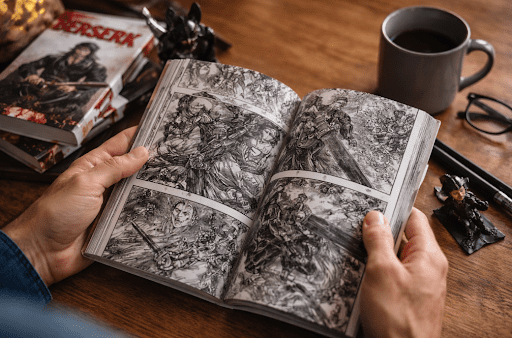
Part of the answer lies in Miura’s artwork, part of it lies in tone, and part of it lies in consequence. Many manga include combat, death, or monstrous enemies, though they still feel readable for a wide audience because the presentation keeps a certain distance from pain. Berserk does the opposite. Miura’s drawings give violence a heavy physical reality. Steel looks heavy, flesh looks vulnerable, armour looks dented and torn, monsters look obscene rather than playful, and ruined landscapes feel like graveyards that were never given a chance to rest. That artistic density makes every blow feel more final. The series also refuses to treat violence as a temporary burst of spectacle. Characters do not simply fight, recover, smile, and move on as if nothing happened. Damage remains. Trauma remains. Shame remains. Loss remains. A reader who begins by admiring the aesthetic may eventually understand why shops dedicated to dark fantasy merchandise and Berserk figures often appeal to fans who love the series’ visual power while still acknowledging that the story behind those designs is painfully bleak. Another reason the manga feels so harsh is the setting itself. This is not a bright world with occasional darkness falling over it. It is a world where cruelty is part of the soil. War, social abuse, power games, exploitation, fanaticism, predatory desire, and supernatural terror all exist at once. Human violence and inhuman violence are layered together. The result is a reading experience that can feel like walking through a battlefield covered in ashes rather than watching a dramatic action story from a safe distance. Readers do not only witness danger. They live inside its atmosphere for long stretches. That is why Berserk is not merely violent; it is oppressive in a deliberate narrative sense.
Does the violence only shock, or does it serve the story?
This is where opinions become more nuanced, because the strongest readers of Berserk often admire it for reasons that go far beyond brutality. The violence serves several clear functions in the story. It establishes the world as fundamentally unsafe. It shapes the psychology of the characters. It makes ambition feel dangerous rather than glamorous. It gives moral choices real cost. It also creates contrast, which matters a great deal in a series this dark. When a story is surrounded by cruelty, small moments of trust, loyalty, tenderness, humour, or protection become far more meaningful. A hand on a shoulder, a campfire, a gesture of loyalty, a moment of silence between companions can glow like a lantern in a ruined chapel because the surrounding darkness is so thick. That contrast is one reason readers stay attached to the series. The violence is not only there to horrify them. It is there to give emotional weight to survival, intimacy, and endurance. Still, saying that the violence has a purpose does not mean every reader will find every scene justified. Some parts of the manga are so intense that even people who love the work can criticise specific choices. The important distinction is this: Berserk does not feel empty. Even when it is excessive, it usually feels connected to themes of power, sacrifice, domination, trauma, fate, revenge, and what remains of humanity when a person is pushed beyond ordinary limits. That thematic density is what separates it from darker works that rely on gore as a shortcut.
Where the brutality adds meaning?
The best sections of Berserk use violence as a storytelling language rather than a blunt gimmick. Guts is not frightening or compelling because he is strong with a sword. He becomes compelling because the manga shows what prolonged survival does to a person forced to live inside constant threat. His anger, suspicion, endurance, and rare moments of vulnerability only make sense because the world around him has carved those reactions into his body and mind. In the same way, the ambitions of other characters become more disturbing because the series allows the reader to see their human cost in full. Kingdoms, dreams, status, beauty, devotion, charisma, religion, and destiny do not float above the mud in this story. They are tied to bodies that bleed and people who suffer. That is why violence has narrative value here. It removes any romantic mist that might otherwise soften the series. A battlefield is not noble in Berserk. It is filthy, desperate, traumatic, and full of human wreckage. A monster attack is not a thrilling interruption. It is an eruption of horror that can destroy innocence, stability, and trust. Because the manga is willing to show those consequences, moments of resilience feel earned rather than decorative. The reader is not merely told that the world is harsh. The reader experiences that harshness directly, which makes acts of courage, loyalty, and resistance more affecting.
Where some readers feel it goes too far?
Even with that narrative weight, there are parts of Berserk that many readers regard as too much. The criticism most often raised concerns sexual violence, both in its severity and in its recurrence. This is not a minor complaint from people who misunderstood the tone of the series. It is often a serious reaction from readers who admire Miura’s skill and still believe that certain scenes push suffering to a level they find hard to accept. Others feel that some forms of cruelty, especially when tied to humiliation or abuse, can become exhausting even when they understand the thematic point being made. That reaction is fair. A work can be brilliant, influential, and artistically powerful while still containing material that some readers consider excessive. Anyone asking whether Berserk is violent should hear that nuance clearly. The answer is not simply “yes, though it is worth it.” The better answer is “yes, and whether it is worth it depends on your tolerance for graphic suffering, traumatic material, and scenes that deliberately refuse comfort.” That is why good content warnings matter here. A reader can admire the craft from a distance and still choose not to engage with every page. There is no failure in that decision. It is a sensible way of recognising one’s limits.
Which scenes make its reputation so intense?
The reputation of Berserk does not come from one shocking panel or one infamous chapter. It comes from repetition, escalation, and variety. The manga moves through war zones, torture chambers, betrayals, supernatural attacks, monstrous births, ruined villages, sacrificial imagery, violent sexual threat, and moments where entire communities seem to exist one step away from annihilation. Because of that range, readers are not given one single form of fear to adjust to. The tone keeps shifting between earthly brutality and cosmic horror. One chapter may focus on human cruelty that feels historically plausible in a brutal medieval world. Another may plunge into imagery that feels infernal, symbolic, and almost mythic in its ugliness. That movement is one reason the series leaves such a long aftertaste. It is not violent in one register. It operates across several. Some readers expect the most difficult material to appear late, though the truth is that the series establishes its darkness early and keeps developing it in new shapes.
The emotional burden also matters. A graphic scene can be forgotten when it has no connection to people the reader cares about. Berserk often does the opposite. It places its violence inside relationships, loyalties, broken trust, and the collapse of fragile hopes. That is where the manga becomes more than graphic. It becomes genuinely upsetting. You are not only watching a world that is violent. You are watching what violence steals from people over time.
Who should approach Berserk carefully?
The manga is often recommended loudly online, yet it should not be treated like a universal starting point. Someone who enjoys fantasy, action, or even darker stories in general may still find Berserk far too intense. Taste is not measured by toughness. A person can recognise the artistic quality of the series and still decide that the subject matter is not right for them. That is especially true for readers who are sensitive to sexual assault, torture, child endangerment, sadism, body horror, despair-heavy storytelling, or prolonged depictions of trauma. Those are not side notes in Berserk. They are meaningful parts of its identity. The following content signals help explain the tone very quickly:
⦁ Gore
⦁ Mutilation
⦁ Torture
⦁ Sexual violence
⦁ Body horror
⦁ Trauma
⦁ Mass violence
⦁ Psychological distress
If several of those elements are likely to be deal-breakers, caution is sensible. The fact that Berserk is highly praised does not erase the weight of its content. Online enthusiasm sometimes turns the manga into a badge of seriousness, as though every reader must eventually go through it to prove they appreciate darker fiction. That is not a useful way to approach art. A better approach is to ask what you actually want from reading. If you are looking for a mature dark fantasy that treats suffering, ambition, and survival with real gravity, Berserk may be one of the most memorable manga you will ever read. If you are looking for stylish action with occasional darkness and strong catharsis, it may feel exhausting rather than rewarding. Knowing that difference before you start is far more valuable than being surprised by reputation alone.
Readers who may appreciate it most
Readers who tend to value atmosphere, consequence, and moral complexity often connect strongly with Berserk. They usually want fantasy that feels dangerous, not cushioned. They do not mind stories that leave scars on characters and refuse to tidy emotional damage away. They often enjoy dense artwork, long-form character development, and fiction that treats violence as an ugly fact rather than a shiny effect. Those readers are likely to find enormous value in the series because it gives them a world with texture, pressure, scale, and emotional depth. It also rewards patience. The manga is not important only because it is grim. It remains important because it keeps building meaning through relationships, loyalty, grief, rage, power, and the stubborn refusal to collapse completely. People who want a story that fights for every moment of tenderness will usually understand why Berserk has inspired such devotion for decades.
Readers who may want distance
Other readers may be better served by keeping their distance or by researching the most difficult content beforehand. That includes anyone who has a low tolerance for graphic imagery, anyone who finds sexual violence especially distressing, and anyone who dislikes stories where cruelty can feel relentless for long stretches. It also includes readers who simply prefer fantasy with a stronger sense of relief, humour, or emotional safety. There is nothing shallow about that preference. Berserk can be emotionally draining, and a draining work is not automatically better than one that chooses a different balance. Some readers start it because they are curious about the praise, then realise the tone is heavier than expected. That is an entirely reasonable outcome. A title can be historically important while still being the wrong fit for a particular person. The useful question is not “am I strong enough to read it?” The useful question is “do I actually want to spend time inside a story this severe?”
What stays with the reader?
So, is the manga Berserk violent? Yes, unmistakably. It is violent in imagery, in subject matter, in emotional force, and in the lasting pressure it places on both characters and readers. That violence includes gore, mutilation, horror, sexual violence, psychological trauma, and a world built on cruelty rather than comfort. At the same time, its reputation does not come from shock alone. The brutality supports themes of survival, power, ambition, sacrifice, grief, and the fragile value of human connection in a ruined landscape. That is why the series can be both admired and avoided for honest reasons. For the right reader, Berserk feels like a dark fantasy of rare intensity and depth. For the wrong reader, it can feel punishing from very early on. The clearest advice is simple: approach it as a serious adult work, know your boundaries, and trust your reaction rather than its legend.