

A. How to Increase Website Traffic Consistently (Without Chasing Short-Term Hacks)
Growing website traffic is no longer about publishing random blog posts and hoping Google notices. Today, traffic growth is a system, not a single tactic.
Many website owners struggle with the same problem: they publish content, share links, maybe even run ads—yet traffic stays flat.
This article breaks down why traffic stalls, what actually works in 2026, and how to build a sustainable traffic flow that compounds over time.
No fluff. No gimmicks. Just proven, practical solutions.
B. The Real Problem: Why Most Websites Don’t Get Traffic
Before talking about solutions, it’s important to understand what’s going wrong.
Most sites fail to grow traffic because they focus on activities, not outcomes.
C. Common Traffic Mistakes
- Publishing content without keyword intent
- Chasing viral trends instead of evergreen topics
- Relying only on social media reach
- Ignoring user experience and page speed
- No clear traffic funnel or next step
Traffic doesn’t disappear randomly. It’s blocked by structural issues.
D. Traffic Is Not Just About Volume — It’s About Flow
Many people think traffic equals numbers. In reality, traffic is about movement.
You need:
- Entry points (how users find you)
- Engagement (why they stay)
- Direction (where they go next)
Without flow, even high traffic won’t produce results.
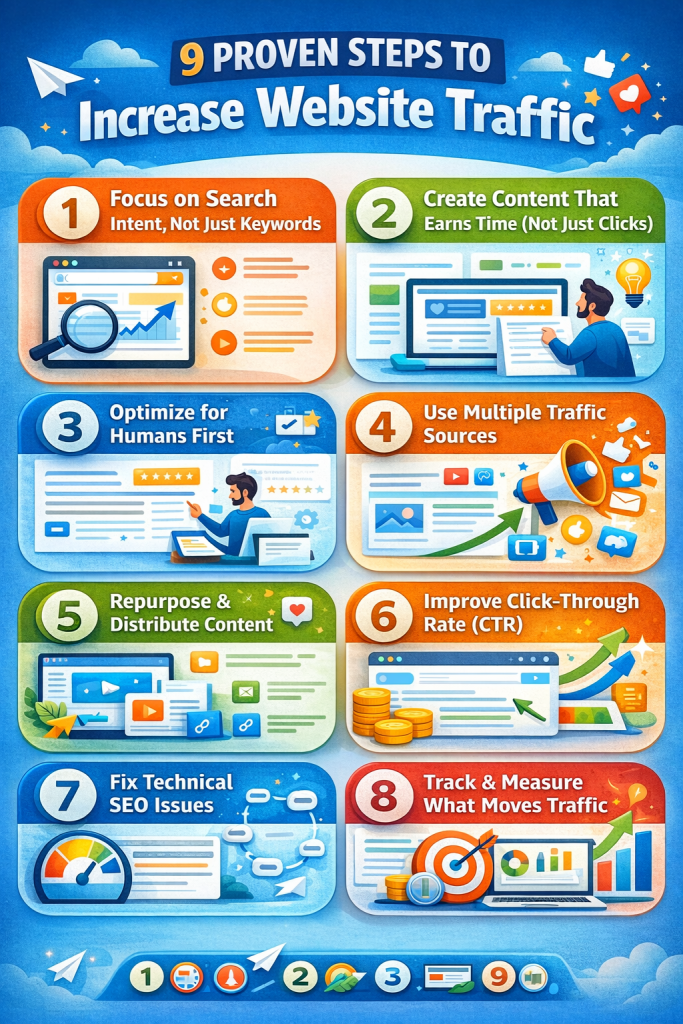
Step 1: Build Traffic Around Search Intent (Not Just Keywords)
Keyword research alone is no longer enough. What matters is searching intent alignment.
Types of Search Intent
| Intent Type | Example | Goal |
| Informational | “how to increase website traffic” | Learn |
| Navigational | “Ahrefs login” | Reach a site |
| Commercial | “best SEO tools” | Compare |
| Transactional | “buy SEO software” | Purchase |
If your content doesn’t match intent, Google won’t rank it — even if the keyword volume is high.
Solution: Write content that fully satisfies what the searcher is trying to solve, not just what they typed.
Step 2: Create Content That Earns Time, Not Just Clicks
Google tracks:
- Time on page
- Scroll depth
- Bounce behavior
Short, shallow content doesn’t survive anymore.
- What High-Performance Content Includes
- Clear structure with logical headings
- Real explanations, not summaries
- Examples, frameworks, and comparisons
- Scannable sections (bullets, tables)
When users stay longer, rankings follow naturally.
Step 3: Optimize for Humans First, Algorithms Second
Over-optimized content feels robotic. Readers leave. Rankings drop.
Human-friendly content:
- Uses conversational language
- Avoids keyword stuffing
- Explain concepts simply
- Anticipates reader questions
Search engines reward reader satisfaction, not keyword density.
Step 4: Use Multiple Traffic Sources (Don’t Depend on One)
Organic search is powerful — but fragile.
Smart sites diversify traffic.
Sustainable Traffic Channels
- Search (SEO)
- Referral traffic (guest posts, mentions)
- Social discovery
- Email lists
- Retargeted visitors
If one channel slows down, others keep traffic stable.
Step 5: Turn One Page into Multiple Traffic Assets
A single piece of content can drive traffic from many angles.
Example Repurposing Strategy
| Original Asset | Repurposed As |
| Blog post | Pinterest pins |
| Blog post | LinkedIn article |
| Blog post | Short Twitter threads |
| Blog post | Email newsletter |
| Blog post | Quora answers |
This multiplies without multiplying effort.
Step 6: Improve Click-Through Rate (CTR) Before Chasing More Rankings
Many pages rank — but don’t get clicks.
How to Increase Organic CTR
- Rewrite meta titles with benefit-driven language
- Use numbers and clarity
- Match headline with search intent
- Avoid vague wording
A small CTR improvement can double traffic without higher rankings.
Step 7: Fix Technical Barriers That Kill Traffic
Even great content fails if technical issues exist.
Traffic-Blocking Issues to Check
- Slow loading speed
- Poor mobile experience
- Broken internal links
- Thin or duplicate pages
- Confusing navigation
Technical SEO is not optional. It’s foundational.
Step 8: Build Internal Traffic Loops
Every visitor should have a next step.
- Internal Traffic Boosters
- Contextual internal links
- “Recommended reading” sections
- Content clusters around one topic
- Clear CTAs (not aggressive sales)
Internal traffic increases:
- Pages per session
- Crawl depth
- Authority distribution
Step 9: Track What Actually Moves Traffic
Vanity of metrics mislead. Focus on signals that matter.
Metrics That Indicate Growth
- Organic impressions trend
- Returning visitors
- Time on site
- Top landing pages
- Assisted conversions
Traffic growth is gradual — but predictable when measured correctly.
E. A Simple Traffic Growth Framework
Here’s a simplified model you can apply to any niche:
| Stage | Focus |
| Discovery | Search intent + visibility |
| Engagement | Content depth + UX |
| Direction | Internal links + CTAs |
| Retention | Email & remarketing |
Follow the framework consistently and traffic compounds.
F. When to Scale Traffic with Automation
Manual traffic methods work — until they aren’t scaled.
Automation helps when:
- Publishing frequency is inconsistent
- Distribution is repetitive
- Tracking becomes overwhelming
The goal is not replacing strategy — it’s removing friction.
👉 If you’re exploring smarter traffic systems, this page explains how structured automation can support growth: Increase Website Traffic.
(Useful as a reference, not a requirement.)
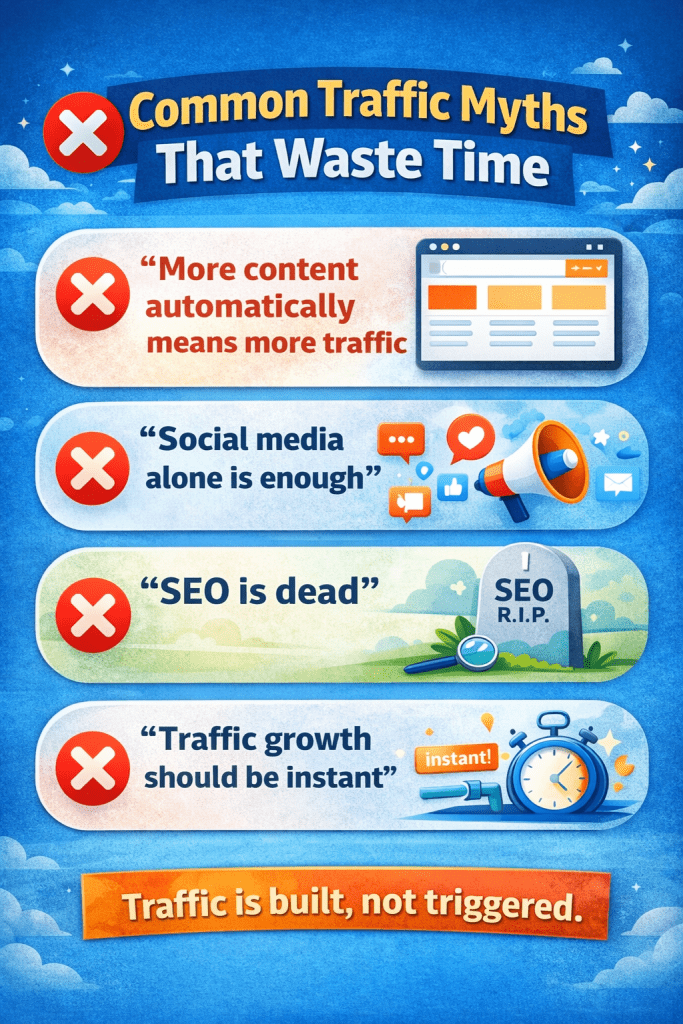
G. Common Traffic Myths That Waste Time
❌ “More content automatically means more traffic”
❌ “Social media alone is enough”
❌ “SEO is dead”
❌ “Traffic growth should be instant”
Traffic is built, not triggered.
H. Final Thoughts: Traffic Growth Is a Process, not a Trick
Websites that grow consistently don’t chase hacks.
They:
- Understand user intent
- Build content ecosystems
- Optimize flow, not just clicks
- Improve continuously
If you treat traffic as a system, not a shortcut, growth becomes predictable.
And predictability is what separates real websites from abandoned ones.
Frequently Asked Questions (FAQs)
- How long does it take to increase website traffic?
Usually 60–120 days with consistent optimization. SEO traffic compounds, not spikes.
- Is paid traffic necessary?
Not mandatory. Paid traffic accelerates testing, but organic systems sustain growth.
- How many blog posts are needed?
Quality matters more than quantity. 10 strong pages often outperform 100 weak ones.
- Can new websites get traffic?
Yes. Long-tail keywords, niche focus, and internal linking help new sites grow faster.
- Does traffic matter without conversions?
Traffic alone is not the goal. Direction and intent make traffic valuable.
