
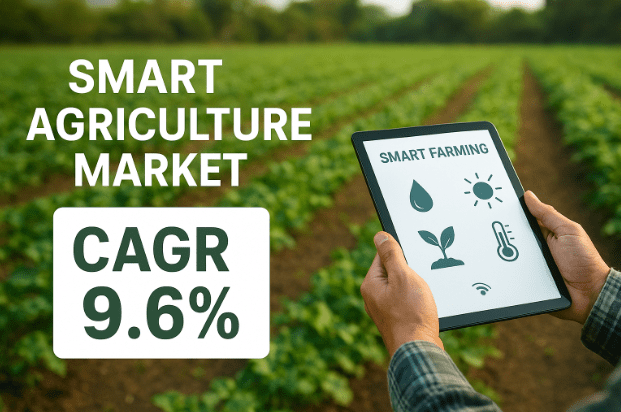
The global Smart Agriculture Market is witnessing rapid transformation as digital technology and data analytics reshape traditional farming. With increasing food demand, climate challenges, and the need for efficient resource utilization, smart agriculture has become essential. It integrates Internet of Things (IoT), artificial intelligence (AI), sensors, drones, and data analytics to improve yield, reduce waste, and ensure sustainability. From precision farming to livestock monitoring and greenhouse automation, smart agriculture is redefining how farmers operate, making farming more data-driven, productive, and eco-friendly.
Smart Agriculture Market Size and Forecast (2024–2032)
According to the SNS Insider, the Smart Agriculture Market was valued at USD 16.1 billion in 2023 and is projected to reach USD 36.73 billion by 2032, growing at a robust CAGR of 9.6% from 2024 to 2032. This steady growth reflects a global shift toward technology-driven farming practices and the adoption of precision tools that optimize productivity. Farmers, agribusinesses, and policymakers are increasingly investing in digital agriculture solutions to address food security and sustainability goals. The rising integration of AI-powered analytics, soil sensors, and real-time data monitoring systems continues to boost the market’s expansion across developed and emerging economies.
Key Drivers Boosting the Smart Agriculture Market
Several factors are fueling the growth of the Smart Agriculture Market. First, the increasing global population and shrinking arable land have heightened the need for productivity enhancement through technology. Smart sensors, GPS mapping, and autonomous machinery enable farmers to analyze soil health, weather conditions, and crop requirements in real time. Second, the rising adoption of IoT and cloud computing in agriculture is driving efficiency and precision. Farmers can now remotely monitor irrigation systems, crop conditions, and livestock health using connected devices. Additionally, supportive government initiatives promoting sustainable farming and subsidies for precision agriculture technologies further accelerate market demand.
Another crucial driver is the growing demand for automation and robotics in agriculture. With labor shortages in rural areas, automated tractors, drones, and AI-based decision tools have become vital in maintaining operational efficiency and cutting costs.
Challenges in the Smart Agriculture Market
Despite strong growth prospects, the Smart Agriculture Market faces several challenges. High implementation costs and limited access to technology in developing regions hinder large-scale adoption. Many small-scale farmers lack the capital or technical expertise required to integrate IoT and AI-driven solutions into their farming operations. Data privacy and cybersecurity risks are also emerging concerns, as smart devices and sensors collect vast amounts of sensitive agricultural information. Moreover, interoperability between different platforms and devices remains a hurdle, creating inefficiencies in data sharing and management. Overcoming these challenges will require greater collaboration between tech providers, governments, and agricultural communities.
Opportunities in the Smart Agriculture Market
The future of the Smart Agriculture Market presents immense opportunities. The expansion of 5G connectivity, AI-driven crop analytics, and drone-based monitoring systems is expected to revolutionize precision farming. Growing awareness about sustainable farming practices and the need to reduce environmental impact are pushing more farmers toward adopting smart technologies. Startups and agri-tech companies are increasingly developing affordable solutions tailored for small and medium-sized farms, bridging the digital divide. Furthermore, integrating blockchain in agriculture supply chains will enhance transparency and traceability, creating new value across the ecosystem.
The use of predictive analytics to forecast crop diseases, optimize irrigation schedules, and plan harvests is another area with significant potential. Governments and private investors worldwide are funding research and innovation to strengthen agricultural resilience and sustainability.
Regional Insights of the Smart Agriculture Market
Regionally, North America dominates the Smart Agriculture Market, driven by the early adoption of advanced farming technologies and a well-established infrastructure for IoT and automation. The U.S. and Canada are major contributors due to strong R&D investments, robust digital ecosystems, and growing use of precision farming solutions.
Europe is the second-largest market, with the EU focusing on sustainable agriculture and policies encouraging smart farming. Countries like Germany, France, and the Netherlands are leading in implementing data-driven agricultural systems, supported by digital innovation programs.
Meanwhile, the Asia-Pacific region is expected to witness the fastest growth during the forecast period. Nations such as India, China, and Japan are embracing agri-tech solutions to meet food security challenges and modernize agricultural practices. Increasing smartphone penetration, government digitization initiatives, and partnerships with global tech companies are driving the adoption of smart agriculture across the region.
Future Outlook for the Smart Agriculture Market
The Smart Agriculture Market is poised for significant evolution as emerging technologies continue to enhance farming efficiency and sustainability. With ongoing advancements in AI, robotics, and cloud computing, the agriculture industry is entering an era of data-driven decision-making. Future farms are expected to be highly automated and interconnected, minimizing resource wastage and maximizing output.
As more stakeholders adopt digital transformation, smart agriculture will play a central role in achieving global food security and environmental goals. By combining innovation, sustainability, and scalability, the market is set to revolutionize the global agricultural landscape in the coming decade.
FAQs on the Smart Agriculture Market
1. What is the CAGR of the Smart Agriculture Market during 2024–2032?
The Smart Agriculture Market is expected to grow at a compound annual growth rate (CAGR) of 9.6% between 2024 and 2032, reflecting rising adoption of IoT, AI, and automation technologies in modern farming.
2. What is the forecast period and projected market size for Smart Agriculture?
The forecast period spans 2024–2032, during which the Smart Agriculture Market is projected to expand from USD 16.1 billion in 2023 to USD 36.73 billion by 2032, driven by increased investment in digital agriculture and sustainability solutions.
3. Which regions are leading the growth of the Smart Agriculture Market?
North America leads due to early technology adoption and high investment in automation. Europe follows with sustainability-focused policies, while Asia-Pacific is the fastest-growing region thanks to government support and rapid digitalization in farming.