
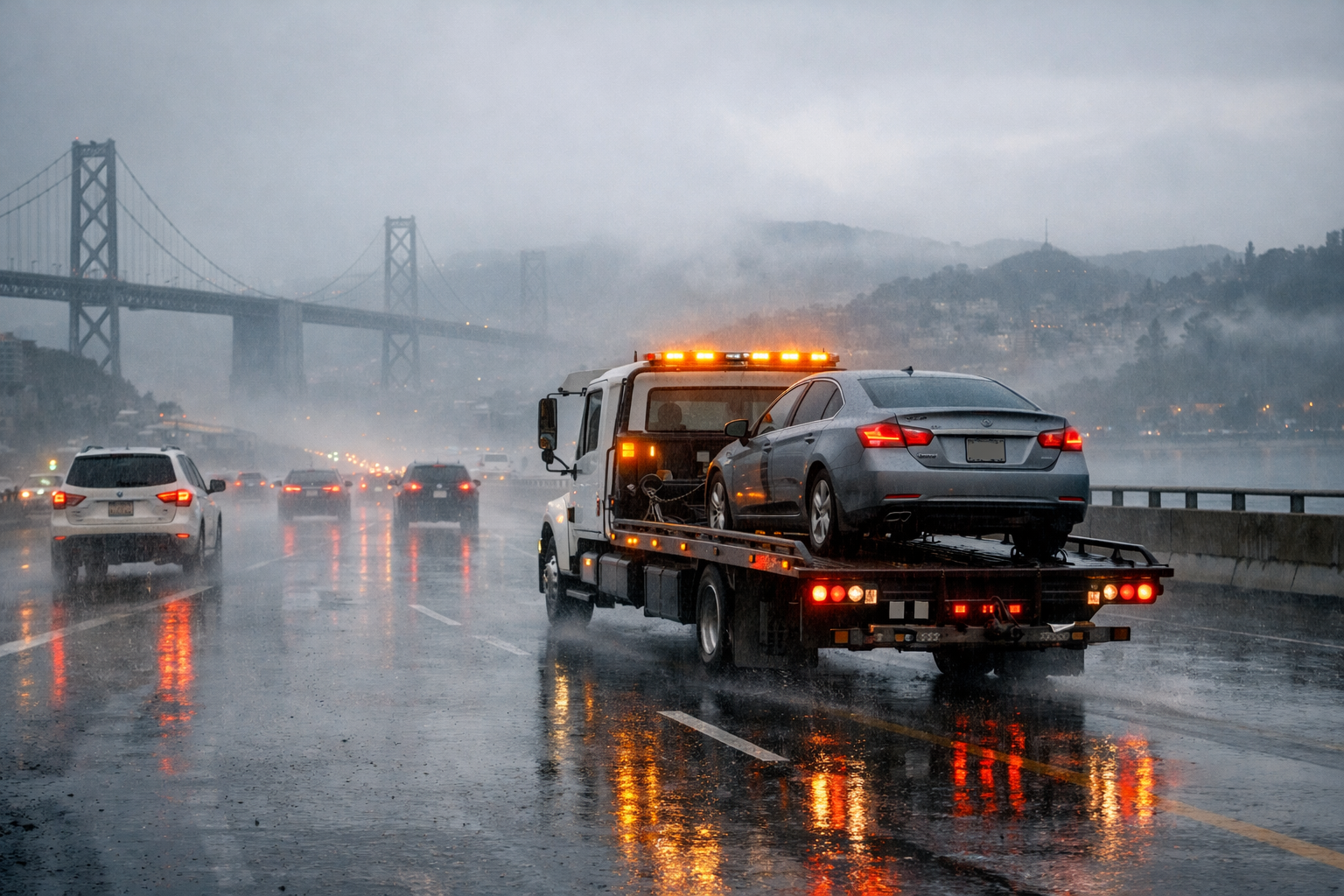
Famous for innovation, iconic bridges, and scenic drives, the Bay Area has another side of that beauty: a complex road network where the weather, traffic density, and driving meet. For towing operators and normal drivers alike, this combination inevitably results in failure to tow, breakdowns, delays, and sometimes serious accidents.
Knowing how weather and speed add to the problem of towing is not helpful to tow truck drivers only but also helps motorists make wiser decisions and shows them the reasons preparation, training, and equipment mean a great deal on Bay Area roads. This guide breaks down the real reasons towing failures happen, using an informative and practical lens.
The Bay Area’s Roads Are Not as Forgiving as They Look
On the surface, the roads in the Bay Area appear well maintained and easy to drive. But when you consider the elevations, turns, bridges, and heavy city traffic, the room for error is very small.
San Francisco street grades and turns in Marin and the Peninsula can pose quite a challenge to tow trucks, not to mention the element of unpredictable weather and speeding vehicles. This can put even the most experienced operator on the spot, struggling with situations that were difficult to plan for.
Weather Patterns That Disrupt Towing Operations
Fog That Reduces Visibility and Reaction Time
Fog is also one of the characteristic climatic conditions in the Bay Area. Coastal fog, without notice, begins to roll in, causing visibility to deteriorate quickly. For towing trucks, this poses a serious issue.
Reduced visibility means the motorist has had less time to act on situations like braking suddenly, changing lanes, or road debris. The act of towing the disabled vehicle itself already reduces the vehicle’s ability to make precise turns. Adding the effect of the weather further increases the risk of jackknife situations or failing to make a turn that could lead to towing failure.
Rain That Turns Roads Into Risk Zones
Despite the fact that the Bay Area is not characterized by rain all year round, when it rains there, the roads become even more hazardous. Dry weather gives time for oil and dirt to accumulate on the asphalt. The first rainfall turns this residue into slick roads.
In cases of tow trucks carrying an added load, the loss of traction will go on to result in longer stopping distances and difficulties during acceleration. This will further lead to tire slippage, the slippage of straps due to stress, and shifting loads.
Speed: The Silent Contributor to Towing Failures
Why Speed Matters More When Towing
Speed has a unique impact on towing vehicles compared to ordinary cars. Added weight alters the factors mentioned earlier. At high speeds, the impact amplifies.
Many towing disasters occur not due to equipment failure but due to excessive speed for the conditions. Even a well-strapped-down car could become unstable if the towing truck is proceeding too quickly for the road conditions and weather.
Freeways Encourage Risky Driving Habits
Although Bay Area freeways can be congested, once traffic opens up, speeds can increase rapidly. Tow truck drivers may be forced to respond to traffic volume, particularly during peak recovery times.
Nevertheless, coordinating speeds when trailers are involved can be hazardous. Sudden turns, limited merge points, or aggressive driving leave minimal margin for safety. Under such conditions, speed is an important variable influencing towbar loads, braking, or control over the load.
How Weather and Speed Work Together to Cause Failures
Reduced Traction at High Speeds
The presence of rain or fog already affects tire traction. When this increases in speed, it further worsens traction. This phenomenon ranks among the most prevalent factors for occurrences involving towing.
A tow truck can fishtail or experience trailer sway while taking a damp turn at high speeds. This situation is not easy to correct, and the result is not only damage but can also be the failure of the tow truck or the entire towing operation.
Delayed Driver Response Time
Weather conditions have just as much of an effect on human reaction time as they have on vehicles. Fog, rain, and wet road glare are just a few things that can impede accurate estimation of distances and speeds.
Reaction time gradually increases when speed is maintained at a higher level, making it difficult for a driver to apply smooth braking and accurate steering actions. In the context of towing a vehicle, aggressive maneuvers are likely to work a chain, hook, or winch too hard, potentially leading to a breakage.
Equipment Stress Under Harsh Conditions
Straps, Chains, and Winches Under Pressure
The heavy-duty equipment used for towing is made to tow heavy loads. However, it has its limits. Weather conditions and road speed can exceed those limits much sooner.
Rain may cause the straps to stretch somewhat, resulting in reduced tension. Conversely, very low temperatures may harden metal parts, while high-speed towing may raise the likelihood of the straps snapping, coming loose, or simply releasing.
Brake Systems Face Extra Demand
There is added weight with the tow, and then, of course, there is the weather. Rainy roads increase stopping distances, and there are the effects of downhill grade.
Brakes heat up easily at higher speeds. That means when the brakes get overheated, they will not perform well and may cause the vehicle to move unchecked on hills or sudden stops on the roadway.
Urban Streets vs Highways: Different Risks, Same Causes
City Streets and Sudden Stops
Conditions such as high-density environments, as seen in San Francisco or Oakland, often lead to failure in towing due to starting and braking frequently. Unpredictable conditions are caused by the presence of pedestrians, cyclists, or delivery vehicles.
Weather contributes to this by further worsening these conditions. roads that are slippery when braking abruptly, among other factors, increase the possibility of load shift or rear-end collisions if speed is not managed.
Highways and Sustained Speed Stress
On highways like I-80, US-101, and I-280, constant high speeds mean constant stress on towing systems. Then, crosswinds on bridges like the Bay Bridge or Golden Gate Bridge are also involved.
If wind, rain, or fog is coupled with highway speeds, towing rigs become more susceptible to both sway and diminished control.
Human Factors That Amplify Weather and Speed Risks
Pressure to Clear Roads Quickly
Tow truck drivers are often working against time. Clearing an accident quickly is helpful in reducing congestion and secondary incidents. But acting hastily can result in poor judgment.
Speeding beyond road conditions or missing the double checks of equipment may result in a normal towing becoming an unsuccessful one. Adverse weather conditions amplify this problem.
Overconfidence in Familiar Routes
Many towing operators know Bay Area roads extremely well. Familiarity can be helpful, but it can also breed overconfidence.
Assuming a road behaves the same in all conditions leads to mistakes. A curve that feels safe on a dry day can become hazardous in rain or fog, especially at higher speeds.
How Technology Helps Reduce Towing Failures
Advanced Braking and Stability Systems
Modern tow trucks increasingly rely on electronic stability control and advanced braking systems. These technologies help counteract sway and improve control during emergency maneuvers.
While helpful, technology is not a replacement for responsible speed management. Systems work best when drivers respect weather conditions and road limitations.
Real-Time Weather and Traffic Data
Access to real-time data allows towing companies to adjust routes and speeds proactively. Knowing where fog is thickest or where rain is intensifying can prevent risky situations.
Even companies outside California, such as a towing company in houston, often study Bay Area conditions as case studies for training and safety planning. This cross-regional learning improves industry standards overall.
What Drivers Can Learn from Towing Failures
Slowing Down Is a Safety Strategy
For everyday drivers, towing failures offer a clear lesson. Speed that feels normal in good conditions may be unsafe in bad weather.
By slowing down and increasing following distance, drivers reduce the risk of causing accidents that require towing in the first place.
Awareness Improves Cooperation on the Road
Understanding the challenges towing vehicles face helps drivers behave more predictably around them. Giving tow trucks extra space, avoiding sudden lane changes, and respecting reduced speeds all contribute to safer roads.
Weather and speed do not only affect towing professionals. They impact everyone sharing the road.
Training and Standards Make a Real Difference
Ongoing Education for Tow Operators
Continuous training ensures drivers understand how weather and speed interact. Simulations, safety workshops, and real-world case studies help operators recognize warning signs before failures occur.
Well-trained drivers are more likely to adjust speed early, inspect equipment carefully, and choose safer routes when conditions deteriorate.
Clear Policies and Accountability
Companies that enforce strict speed and weather policies experience fewer incidents. Clear guidelines remove ambiguity and empower drivers to prioritize safety over speed.
These standards protect not only equipment and vehicles but also lives.
The Bigger Picture
Towing failures are not isolated events. They can cause secondary accidents, traffic delays, and environmental hazards. In a region as busy as the Bay Area, the ripple effects are significant.
By understanding how weather and speed contribute to these failures, policymakers, companies, and drivers can work together to reduce risks. Safer towing practices mean safer roads for everyone.
Final Thoughts
Conditions in the Bay Area make it particularly difficult to tow due to weather, geography, and road conditions. That’s because it’s difficult to see through the fog, traction is diminished when it’s raining, and speed entails small margins of error.
By understanding and respecting these factors by those involved in driving and towing, failures would become fewer occurrences. Slowing down, preparing well, and being conscious of weather do not indicate inefficiencies. These are markers of professionalism and responsibility.
Finally, it is the road that always calls the shots. Knowing the rules of the road helps to ensure road safety.