

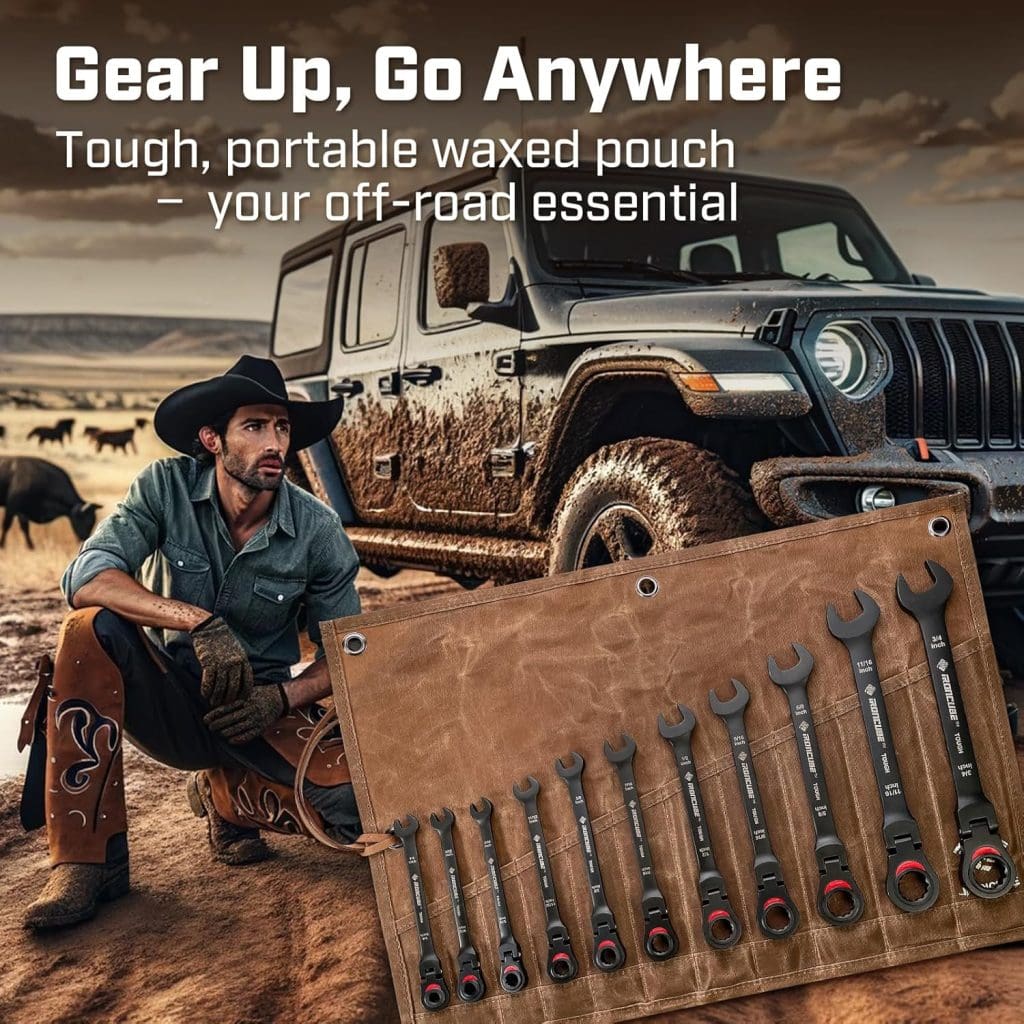
If you have ever struggled to reach a bolt buried behind an exhaust manifold, wedged under a sink, or tucked into a narrow furniture frame, you already understand why the flex head combination ratcheting wrench has become one of the most popular hand tools on the market. This single tool merges three mechanical ideas into one handle: the open-end versatility of a combination wrench, the speed of a ratcheting mechanism, and the angled reach of a pivoting head. The result is a wrench that works where ordinary spanners simply cannot.
According to Straits Research, the global hand tools market was valued at USD 24.67 billion in 2024, with wrenches dominating as the leading product category. Much of that growth is driven by professionals and DIY enthusiasts demanding tools that save time and reduce fatigue. A flex head combination ratcheting wrench does exactly that, and this guide will show you how to get the most from one.
What Exactly Is a Flex Head Combination Ratcheting Wrench?
Before diving into technique, it helps to understand what makes this tool different. A standard combination wrench has an open-end jaw on one side and a fixed box-end ring on the other. A ratcheting combination wrench adds an internal gear mechanism to that box end, so you can turn fasteners without lifting and repositioning the tool after every swing. The flex head combination ratcheting wrench goes one step further by adding a pivot joint between the ratcheting head and the handle.
That pivot, sometimes called a hinge or swivel, lets the head tilt forward or backward up to 180 degrees. Some premium models even offer a locking feature, so you can set the head at a specific angle and hold it there. Inside the ratcheting head, a toothed gear engages with spring-loaded pawls. Common tooth counts include 60-tooth, 72-tooth, and 90-tooth configurations. A 72-tooth gear, for example, needs only 5 degrees of arc to engage the next click, which is critical when you are working in spaces where you can barely move your hand. You can learn more about the internal mechanics in this detailed guide on how a ratchet wrench works.
Tools and Setup You Need Before Starting
Getting the right wrench onto the right fastener is half the battle. Before you pick up a flex head combination ratcheting wrench, take a moment to prepare. First, identify the fastener type. Metric bolts (measured in millimeters) dominate vehicles built in Europe and Asia, while SAE sizes (measured in fractions of an inch) are standard on most American-made equipment. Mixing up metric and SAE sizes is a common mistake that rounds bolt heads quickly.
If you are unsure whether a bolt is metric or SAE, keep a printable metric to SAE wrench size conversion chart on your workbench. A conversion chart eliminates guesswork and protects your fasteners. You will also want a clean rag, a small bottle of light machine oil, and safety glasses. The oil is not for the bolt; it is for the wrench. A drop of oil on the pivot joint and the ratcheting head before each project keeps the mechanism smooth and extends the life of the tool.
Step-by-Step: How to Use a Flex Head Combination Ratcheting Wrench
Step 1: Select the Correct Size
Match the wrench to the bolt or nut. The fit should be snug with zero wobble. If you feel any play between the wrench and the fastener, stop and try the next size down. A loose fit will strip the bolt corners and make the job much harder. IRONCUBE’s 8-piece metric flex head set covers the 8mm to 19mm range that handles the vast majority of automotive and household tasks.
Step 2: Set the Ratchet Direction
Most flex head combination ratcheting wrench models feature a small lever or switch on the back of the ratcheting head. Flip it one way to tighten, the other way to loosen. Some older or budget-friendly designs reverse by flipping the wrench over entirely. Whichever system your wrench uses, always confirm the direction before applying force. It only takes a split second to check, and it prevents the frustrating experience of turning a bolt the wrong way under load.
Step 3: Adjust the Flex Head Angle
Here is where the flex head combination ratcheting wrench truly shines. Tilt the head to the angle that gives your hand the clearest swing path. Working on a bolt recessed behind a pipe? Angle the head 30 degrees to the side. Reaching down into an engine bay from above? Tilt it forward 45 degrees so your knuckles clear the surrounding components. The benefits of a flexible head ratchet are most apparent when you experiment with different angles on each fastener rather than forcing one position to work everywhere.
Step 4: Engage the Fastener and Ratchet
Slide the box end of the wrench fully onto the bolt head or nut. Push the wrench so it seats completely. Then begin your ratcheting motion: pull in the tightening or loosening direction, and the pawl mechanism grips the gear teeth to apply torque. On the return stroke, the mechanism disengages and the handle swings back freely without disturbing the fastener position. This back-and-forth motion lets you work continuously, even when you only have 10 or 15 degrees of available swing. That narrow-arc capability is precisely why professionals rely on flex head sets for working in tight spaces.
Step 5: Switch to the Open End When Needed
The combination design means you always have an open-end jaw on the opposite side of the tool. Once you break a fastener free with the ratcheting box end, you can flip the wrench around and use the open end for rapid spinning on bolts that have cleared their threads. This two-in-one approach eliminates the need to carry a separate wrench and speeds up repetitive assembly or disassembly tasks considerably.
Flex Head vs. Fixed Head Ratcheting Wrenches: When Does the Difference Matter?
Not every job demands a flex head. Fixed-head ratcheting wrenches are thinner and lighter, which makes them the better choice when clearance is not an issue but profile thickness is. For example, if you are tightening a line of exposed flange bolts on a flat surface, a fixed-head wrench provides a more rigid, direct connection and slightly more torque transfer.
The flex head combination ratcheting wrench earns its place when you encounter offset, recessed, or obstructed fasteners. Automotive mechanics consistently report that flex heads save the most time when working around exhaust manifolds, alternator brackets, motor mounts, and rear suspension control arms. Plumbers find them indispensable under sinks and behind toilets. Furniture assemblers love them for reaching the interior frame bolts on bed frames and shelving units.
Quick Comparison: Flex Head vs. Fixed Head Ratcheting Wrenches
| Feature | Flex Head | Fixed Head |
| Head Movement | Pivots up to 180° | No pivot – rigid |
| Best For | Tight, obstructed spaces | Open, accessible bolts |
| Profile Thickness | Slightly thicker at pivot | Thinner overall |
| Torque Transmission | Excellent (when aligned) | Excellent (direct) |
| Versatility | High – multiple angles | Moderate – single plane |
Real-World Applications Where This Wrench Excels
The versatility of a flex head combination ratcheting wrench makes it useful across dozens of trades and hobbies. Here are some of the most common scenarios where this tool outperforms alternatives.
Automotive Repair and Maintenance. Engine compartments are notoriously cramped, especially in modern vehicles where manufacturers pack more components into smaller spaces. Replacing an alternator, swapping spark plugs on a transversely mounted engine, or accessing brake caliper bolts behind the rotor all become faster with a pivoting ratcheting head. According to IMARC Group, wrenches account for approximately 33.8% of the global hand tools market, and automotive repair is one of the biggest reasons for that dominance.
Plumbing and HVAC Work. Supply line nuts behind sinks, compression fittings in wall cavities, and condenser bracket bolts in outdoor HVAC units all sit in locations where a straight wrench cannot generate meaningful torque. The flex head lets you approach from an offset angle while the ratchet keeps the fastener moving.
Motorcycle and Small Engine Service. Motorcycles, ATVs, and lawnmower engines present their own challenges. The bolt spacing is tight, and there is often no room for a socket and ratchet handle. An IRONCUBE reversible ratcheting wrench set is a popular choice among small-engine enthusiasts for exactly this reason.
Furniture Assembly and Home DIY. Bed frames, shelving units, playground equipment, and patio furniture all use hex-head bolts in tight frame channels. A flex head combination ratcheting wrench lets you tighten dozens of bolts without constantly removing and repositioning the tool, cutting assembly time significantly.
Pro Tips for Getting Maximum Performance from Your Flex Head Wrench
Do not use the ratcheting end as a breaker bar. Ratcheting mechanisms are engineered for speed and convenience, not for maximum torque. If a bolt is seized or heavily corroded, use a standard non-ratcheting wrench or a breaker bar to crack it loose first. Then switch to your flex head combination ratcheting wrench for the rest of the removal. This protects the internal gear teeth and extends the life of the ratchet mechanism.
Let the angle do the work. Many users keep the flex head straight and never bother adjusting it. That defeats the purpose. The moment you feel your knuckles grazing a surrounding component or your wrist bending awkwardly, stop and reposition the head angle. Even a 15-degree tilt can make the difference between a smooth pull and a busted knuckle.
Use the open end for speed. After breaking a fastener free with the ratcheting box end, flip to the open end for fast spinning. This technique is especially effective on long bolts with many threads, such as the bolts on water heater mounting straps or deck railing posts.
Consider extra-long handles for stubborn fasteners. When you need more leverage but still want the flex head advantage, an extra-large heavy-duty ratcheting wrench provides a longer handle for greater mechanical advantage without sacrificing the pivoting head. For a deeper look at large wrench options, see this guide to large heavy-duty ratcheting wrenches.
Choosing the Right Flex Head Combination Ratcheting Wrench Set
The market offers dozens of wrench sets at every price point. Choosing wisely means looking beyond the sticker price and evaluating what actually matters for long-term use. Comparing wrench prices and value across brands reveals that the most expensive set is not always the best, and the cheapest set is almost never a bargain.
Material quality is the foundation. Chrome vanadium steel (Cr-V) is the industry standard for professional-grade ratcheting wrenches. It offers excellent hardness, tensile strength, and corrosion resistance. Avoid wrenches made from drop-forged carbon steel without chrome plating, as they will rust and chip over time.
Tooth count determines how little arc you need to engage the next click. A 72-tooth gear requires only 5 degrees of swing, which is more than adequate for most tasks. Some higher-end wrenches feature 90-tooth or even 144-tooth mechanisms for ultra-tight applications.
Size range should match your primary use case. An 8mm to 19mm metric set covers most automotive and household bolts. If you work primarily on American-made machinery, grab an SAE set as well. IRONCUBE offers both SAE ratcheting wrench sets and metric super-thin wrench sets with rolling pouches for organized portability.
For a curated overview of top-ranked options, check out the best large ratchet wrench comparison. You can also browse the full IRONCUBE wrench catalog to find sets tailored to specific trades.
Maintenance and Care: Keeping Your Flex Head Wrench in Top Shape
A well-maintained flex head combination ratcheting wrench can last decades. Neglect it, and the ratchet mechanism will start skipping under load within a year. Here is how to keep yours working perfectly.
Clean after every use. Wipe the entire wrench with a clean rag to remove grease, dirt, and metal shavings. Pay special attention to the pivot joint where debris accumulates fastest.
Lubricate periodically. Apply a small drop of light machine oil or penetrating lubricant to the pivot hinge and the ratcheting head. Work the mechanism back and forth a few times to distribute the oil across the internal gear teeth. Avoid heavy grease, which attracts dust and can gum up the pawl spring.
Store properly. Keep wrenches in a rolling pouch, a wall-mounted rack, or a foam-lined drawer insert. Tossing them loose in a toolbox leads to dings on the chrome finish and eventual corrosion at the damage sites. The IRONCUBE SAE set with rolling pouch is a practical example of organized storage that travels well.
Inspect the ratchet mechanism. Every few months, test each wrench by engaging the ratchet under light hand pressure. If you feel any slipping, grinding, or excessive play, the internal pawl spring may need cleaning or replacement. Catching wear early prevents mid-job failures.
Common Mistakes to Avoid with a Flex Head Combination Ratcheting Wrench
Using the wrong size. Even half a millimeter of slack between the wrench and a fastener will round the bolt corners. Always verify the size before applying torque.
Over-torquing with the ratchet end. Ratcheting wrenches are speed tools, not torque multipliers. For final tightening on critical fasteners, switch to a calibrated torque wrench.
Ignoring the direction switch. Accidentally turning the wrong way under load can damage the ratchet pawl. Confirm the direction before every use.
Forcing the pivot past its range. The flex head has mechanical stops for a reason. Forcing it beyond its designed range of motion will bend or crack the pivot pin.
Frequently Asked Questions
What is a flex head combination ratcheting wrench used for?
A flex head combination ratcheting wrench is used for tightening and loosening bolts and nuts in tight, obstructed, or hard-to-reach spaces. The pivoting head allows you to approach fasteners from multiple angles, while the ratcheting mechanism eliminates the need to lift and reposition the wrench after every turn. Common applications include automotive engine work, plumbing repairs, motorcycle maintenance, and furniture assembly.
Is a flex head ratcheting wrench better than a fixed head?
It depends on the task. A flex head combination ratcheting wrench is better for recessed or obstructed fasteners because the pivoting head reaches angles a fixed head cannot. However, fixed-head wrenches are thinner and slightly more rigid, making them preferable for open, easily accessible bolts. Most experienced mechanics own both styles and choose based on the specific job.
How many teeth should a good ratcheting wrench have?
A quality flex head combination ratcheting wrench typically features a 72-tooth gear mechanism, which requires only 5 degrees of swing arc per click. Higher tooth counts like 90-tooth or 144-tooth designs offer even finer engagement and are ideal for extremely cramped spaces. For general-purpose use, 72 teeth provides an excellent balance between precision and durability.
Can I use a flex head ratcheting wrench to break loose seized bolts?
It is not recommended. The ratcheting mechanism inside a flex head combination ratcheting wrench is designed for speed and convenience, not for maximum breaking torque. Applying excessive force to a seized bolt can strip the internal gear teeth or damage the pawl spring. Use a breaker bar or a non-ratcheting wrench to crack the bolt free first, then switch to the ratcheting wrench for removal.
What is the difference between metric and SAE flex head ratcheting wrenches?
The difference is simply the measurement system. Metric flex head combination ratcheting wrench sets are sized in millimeters (commonly 8mm through 19mm), while SAE sets use inch fractions (typically 1/4-inch through 3/4-inch). Metric fasteners are standard on vehicles and equipment manufactured in Europe and Asia, while SAE fasteners dominate American-made machinery. Having both sets ensures you are prepared for any job.
How do I maintain the pivot joint on a flex head wrench?
Clean the pivot joint after each use with a dry cloth to remove debris. Apply a drop of light machine oil to the hinge point every few weeks, or after heavy use. Work the head back and forth to distribute the oil evenly. This simple routine keeps the flex head combination ratcheting wrench pivoting smoothly and prevents corrosion from locking the joint over time.
Summary
The flex head combination ratcheting wrench is one of those tools that changes the way you work. Its combination of angled reach, continuous ratcheting, and open-end convenience makes it indispensable for automotive mechanics, plumbers, HVAC technicians, and home DIYers alike. Learning to adjust the head angle for each fastener, choosing the correct size, and maintaining the pivot and ratchet mechanism will let you get the full value out of this versatile tool for years.
If you are ready to add one to your toolkit, explore the full range of IRONCUBE professional wrench sets. Built with chrome vanadium steel and 72-tooth ratcheting mechanisms, these wrenches deliver the performance and durability that working professionals demand. For more hands-on demonstrations, visit the IRONCUBE YouTube channel. And if you have questions about sizing, bulk orders, or custom sets, the IRONCUBE contact page is the fastest way to reach the team.
The history of the wrench stretches back centuries, but modern innovations like the flex head ratcheting design have transformed what a single hand tool can accomplish. Whether you are a seasoned mechanic or a weekend warrior tackling your first project, this guide has given you everything you need to use a flex head combination ratcheting wrench with confidence.