

Most businesses are still optimizing for rankings.
Meanwhile, AI systems are summarizing answers without sending clicks. Your content might rank — but never get cited.
That’s the problem.
Search is shifting from ranking pages to retrieving sources. If your site isn’t structured for retrieval, you’re invisible inside AI-generated answers.
This is where LLMO marketing (Large Language Model Optimization) comes in.
It’s not about tweaking copy.
It’s about engineering your content for AI citation.
What Is LLMO Marketing? (Large Language Model Optimization Explained)
LLMO marketing is the practice of structuring and optimizing content so large language models can retrieve, summarize, and cite it accurately.
Instead of focusing only on rankings, LLMO focuses on retrievability, entity authority, and citation probability.
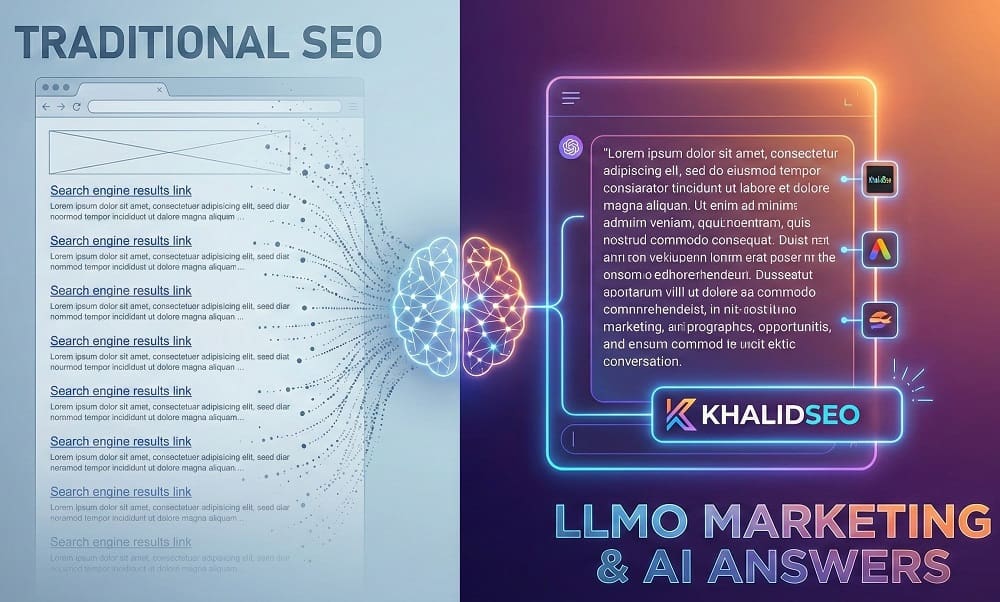
Traditional SEO optimizes for systems like Google Search.
LLMO optimizes for AI systems powered by retrieval pipelines, embeddings, and models developed by companies like OpenAI.
SEO vs LLMO: Signal Shift
| Traditional SEO | LLMO Marketing |
|---|---|
| Crawl → Index → Rank | Embed → Retrieve → Summarize → Cite |
| Keyword targeting | Entity modeling |
| Backlinks | Citation likelihood |
| Click-through rate | AI mention frequency |
| SERP position | Retrieval position |
How Large Language Models Retrieve and Cite Information
LLMs don’t “rank pages” the way search engines do.
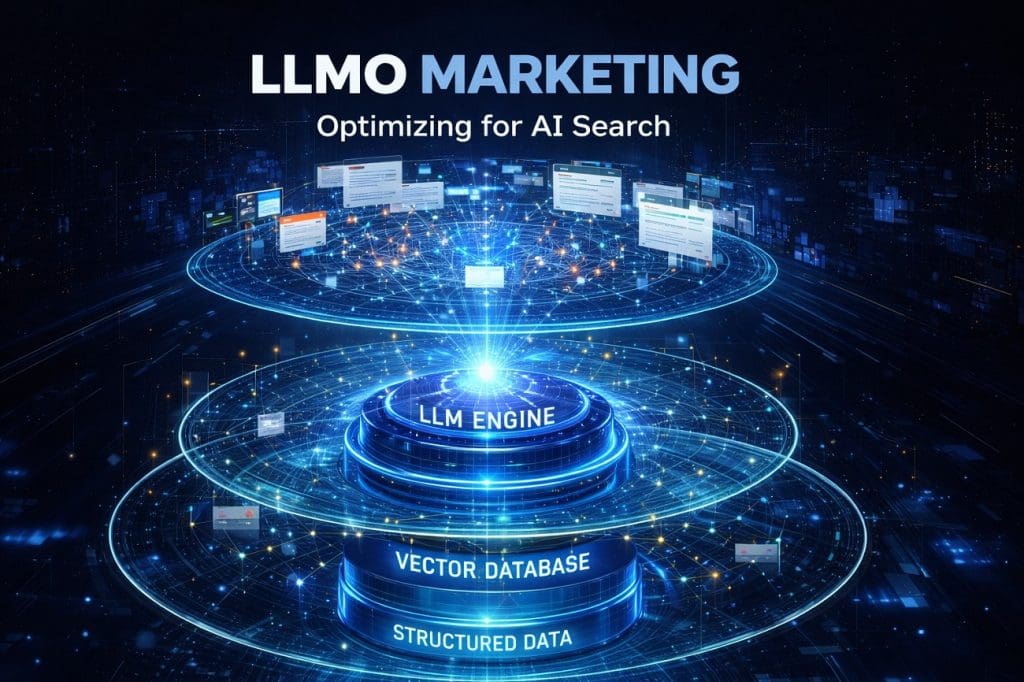
They retrieve relevant passages using vector similarity and retrieval layers, often powered by Retrieval-Augmented Generation (RAG).
Embeddings and Vector Similarity
Your content is converted into embeddings — numerical representations of meaning.
When a user asks a question:
- The query becomes an embedding.
- It’s matched against a vector database.
- The closest semantic matches are retrieved.
Relevance is about meaning proximity, not keyword density.
The Retrieval Layer
The retrieval system filters content based on:
- Authority signals
- Topical depth
- Context alignment
- Structured clarity
Only then does the model generate a response.
Citation & Grounding Logic
Models prioritize:
- Clear factual statements
- Structured formatting
- Recognized entities
- Strong domain trust
If your content is vague or bloated, it’s less likely to be cited.
LLMO vs Traditional SEO: What Actually Changes?
This is where most marketers get confused.
LLMO doesn’t replace SEO. It shifts the optimization target.
Ranking vs Retrieval
Search engines rank pages.
LLMs retrieve passages.
That means paragraph structure matters more than page authority alone.
Keywords vs Entities
LLMs rely heavily on entity recognition and contextual relationships.
Entities like:
- Knowledge Graph connections
- Brand mentions
- Structured schema
carry weight beyond simple keyword repetition.
Backlinks vs Citation Probability
Backlinks remain useful. But citation probability depends on:
- Semantic clarity
- Entity authority
- Source trust
- Contextual completeness
Clicks vs AI Mentions
AI answers may satisfy the user without a click.
Visibility becomes:
- Brand inclusion
- AI-generated citations
- Mention frequency inside summaries
The Core Signals That Influence AI Citation Probability
You can’t control the model.
But you can influence the signals it retrieves.
1. Entity Authority
Your brand should exist as a recognizable entity.
That means:
- Consistent naming
- Structured about pages
- External mentions
- Topical depth across related articles
2. Structured Data & Schema
Schema markup reinforces:
- Author identity
- Organization structure
- Article type
- Topical relationships
This strengthens Knowledge Graph associations.
3. Topical Depth & Semantic Coverage
Thin content rarely gets cited.
Cover:
- Definitions
- Comparisons
- Frameworks
- Supporting subtopics
AI favors context-rich pages.
4. Content Parsability
Short paragraphs.
Clear headings.
Bullet lists.
Defined concepts.
If a model can extract a clean answer block, citation probability increases.
Optimizing for AI Search Platforms (ChatGPT, Google AI Overviews & Perplexity)
Not all AI systems behave the same.
Understanding platform differences is strategic.
Google AI Overviews
Powered by search integration under Google, these summaries pull from indexed sources.
Optimization focus:
- Strong organic rankings
- Clear answer blocks
- High domain trust
ChatGPT
ChatGPT may rely on retrieval layers and curated datasets.
Optimization focus:
- Clear factual structure
- Entity clarity
- Authoritative positioning
Perplexity
Perplexity AI heavily emphasizes citations.
Optimization focus:
- Concise, factual statements
- Strong topical authority
- Well-structured answers
The Technical Framework for LLMO (Infrastructure-Level Optimization)
LLMO is architectural.
Here’s what that means in practice.
Schema Architecture
Implement:
- Organization schema
- Article schema
- Author schema
- FAQ schema
Ensure consistency across your site.
Internal Linking for Entity Reinforcement
Link supporting articles to pillar pages.
Create semantic clusters:
- Definitions
- Comparisons
- Deep dives
- Case studies
This reinforces topical authority.
Retrieval-Friendly Content Blocks
Design sections for extraction:
- 40–60 word definitions
- Clear bullet lists
- Comparison tables
- Step-by-step frameworks
Make it easy for AI to quote you.
Building Brand as a Knowledge Entity
Your site should function as a structured authority hub.
At khalidseo.com, LLMO isn’t treated as a content trick. It’s positioned as a system-level visibility strategy that integrates SEO, entity modeling, and AI retrieval behavior.
That positioning increases brand-level citation likelihood.
Measuring LLMO Performance (Beyond Organic Traffic)
Traditional metrics are incomplete.
You need expanded KPIs.
AI Visibility Indicators
Track:
- AI referral traffic
- Brand mentions inside AI outputs
- Citation frequency
- Assisted conversions
Attribution Challenges
AI answers may not always pass referral data.
You may need:
- Branded search growth tracking
- Direct traffic shifts
- Survey-based attribution
Long-Term Signal Monitoring
Measure:
- Entity recognition consistency
- Structured data coverage
- Topical authority growth
The Future of Search: Evolution, Not Replacement
LLMO is not anti-SEO.
It extends SEO into generative environments.
Search ecosystems are hybrid:
- Traditional SERPs
- AI Overviews
- Conversational answers
- Answer engines
The brands that win will:
- Build entity authority
- Structure content intentionally
- Engineer retrieval readiness
That requires strategic alignment, not isolated blog posts.
FAQ: LLMO Marketing
What is LLMO marketing?
LLMO marketing is the practice of optimizing content so large language models can retrieve, summarize, and cite it in AI-generated answers.
It focuses on semantic structure, entity authority, and citation probability rather than only keyword rankings and backlinks.
How is LLMO different from traditional SEO?
Traditional SEO focuses on ranking pages. LLMO focuses on being retrieved and cited inside AI-generated answers.
The shift moves from keywords to entities, from backlinks to citation likelihood, and from click-through rates to AI mentions.
How do LLMs choose which websites to cite?
LLMs retrieve semantically relevant content using embeddings, vector similarity, and authority filtering layers.
They prioritize structured, factual, and contextually dense sources that align closely with the user query.
Can you optimize for ChatGPT or AI Overviews?
Yes, indirectly. You can increase citation probability by strengthening entity authority, structured data, and semantic clarity.
You cannot directly rank inside an LLM, but you can improve retrievability and source trust.
Is LLMO the future of SEO?
LLMO is an evolution of SEO that adapts optimization strategies to AI-driven retrieval systems.
Businesses that combine traditional SEO with LLM-focused structuring will maintain visibility across both search engines and AI platforms.
