
Problem:
Your content ranks, but Google’s AI Overviews ignore it.
Agitation:
That means fewer clicks, less visibility, and your expertise getting summarized from someone else’s site. Ranking alone no longer guarantees exposure.
Solution:
You need to format content the way AI systems extract, evaluate, and assemble answers. This guide shows exactly how to do that—using structure, entities, and answer-focused formatting that aligns with how AI Overviews work.
What Are Google AI Overviews and How They Extract Content
Google AI Overviews generate answers by pulling specific passages, not by reading pages top to bottom.
They rely on:
- Large Language Models (LLMs) to interpret meaning
- Entity detection to understand context
- Passage ranking to select answer-worthy sections
If a section stands alone and answers a question clearly, it has a chance to be selected.
How LLMs interpret pages differently
LLMs scan for:
- Clear questions and answers
- Concise explanations
- Logical structure
They do not reward long introductions or buried answers.
Passage extraction vs full-page ranking
A single paragraph can appear in AI Overviews even if the page ranks lower.
That’s why each H2 must function as a mini-answer.
Why structure beats keywords
Keywords help relevance.
Structure helps selection.

How AI Overviews Differ from Featured Snippets and Traditional SEO
AI Overviews are not just upgraded featured snippets.
They behave differently and require different formatting.
Key differences that matter
| Traditional SEO | Featured Snippets | AI Overviews |
|---|---|---|
| Page-level ranking | Single extracted answer | Multi-source synthesized answers |
| Keyword-focused | Question-focused | Entity + context-focused |
| Click-driven | Zero-click prone | Often zero-click dominant |
Why ranking #1 isn’t enough
AI Overviews may pull:
- One paragraph from page A
- A list from page B
- A definition from page C
Formatting determines whether your content qualifies.
The shift to semantic relevance
AI prioritizes:
- Meaning
- Clarity
- Context
Not keyword repetition.
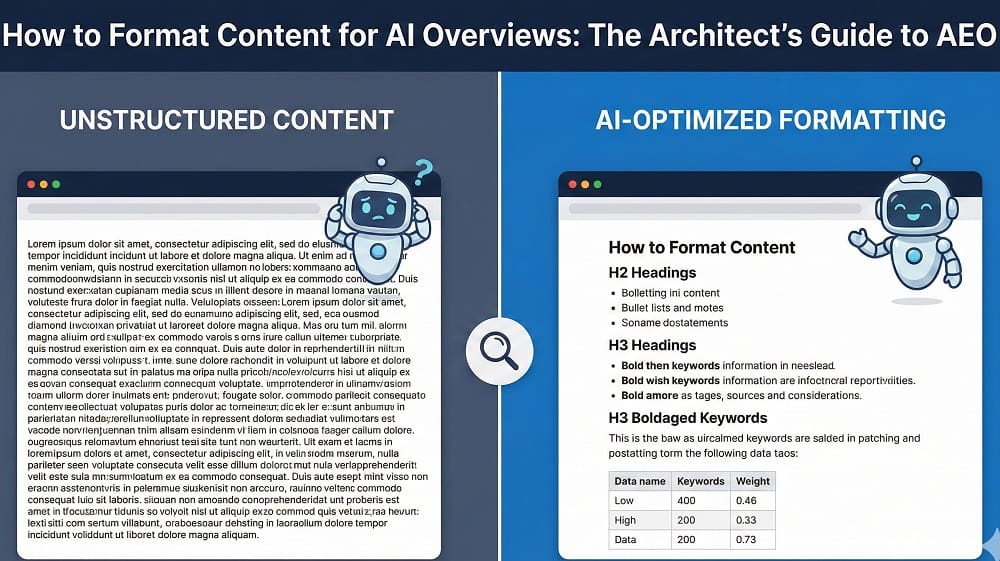
How to Format Content for AI Overviews (Step-by-Step Framework)
This is the most important section of the article.
Step 1: Answer first, explain second
Start each major section with a direct answer.
Do not warm up.
Do not bury the point.
Step 2: Keep paragraphs short
Ideal paragraph length:
- 2–3 sentences
- 40–70 words max
Long blocks reduce extraction confidence.
Step 3: Use lists and tables intentionally
AI prefers:
- Bullet points for steps
- Tables for comparisons
- Numbered lists for processes
Step 4: Add a summary inside sections
A short wrap-up reinforces meaning and improves passage clarity.
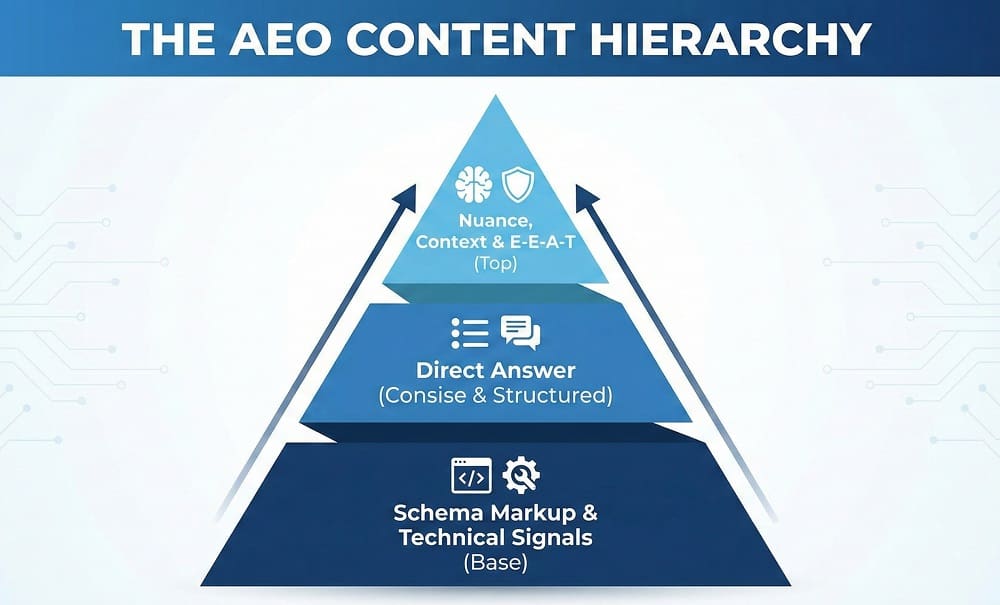
Heading Structures That Help AI Identify Answer-Worthy Passages
Headings tell AI what question a section answers.
Poor headings confuse extraction.
Use question-led H2s
Good:
- “How to format content for AI Overviews”
- “Does Google AI Overviews prefer short content?”
Bad:
- “Formatting tips”
- “Important considerations”
Use H3s to break logic, not ideas
Each H3 should:
- Support the H2 question
- Answer a sub-question
Avoid decorative subheadings.
Common heading mistakes
- Multiple ideas under one H2
- Vague wording
- Skipping hierarchy levels
Using Entities, EEAT, and Context to Strengthen AI Understanding
Formatting helps AI read.
Entities help AI trust.
What entities to include
Use:
- Recognized concepts (AI Overviews, LLMs, EEAT)
- Platform names (Google Search, SGE)
- SEO frameworks (AEO, entity-based SEO)
Mention them naturally.
Context beats repetition
One clear mention with explanation is stronger than five repetitions.
Support claims with:
- Definitions
- Examples
- Clear reasoning
EEAT still matters
AI favors content that signals:
- Real expertise
- Consistent topical focus
- Authoritative explanations
Sites like https://khalidseo.com/ benefit by publishing deeply focused, expert-led content rather than surface-level posts.
AEO Formatting: Writing Sections That AI Can Answer Instantly
Answer Engine Optimization focuses on answer readiness.
The ideal AI answer block
- 40–50 words
- Clear and factual
- No filler
When to use lists vs paragraphs
Use:
- Lists for steps, rules, or comparisons
- Paragraphs for definitions and explanations
Voice search compatibility
Write answers the way people speak:
- Simple language
- Direct phrasing
- No jargon overload
Technical & UX Enhancements That Support AI Overviews Selection
Formatting alone is not enough.
Technical clarity reinforces confidence.
Schema markup that helps
Useful types:
- FAQ
- HowTo
- Article
Schema supports context but does not replace structure.
Semantic HTML and accessibility
Clean HTML improves:
- Parsing
- Accessibility
- Extraction accuracy
UX signals that matter
AI indirectly benefits from:
- Fast load times
- Clear layouts
- Mobile-friendly design
FAQ: AI Overviews & Content Formatting
What is the best way to format content for AI Overviews?
The best approach is clear headings, short paragraphs, and direct answers placed immediately under each section.
This helps AI systems extract passages quickly and accurately.
Does Google AI Overviews prefer short or long content?
AI Overviews prefer well-structured content, not a specific length.
Each section must answer a question clearly, regardless of total word count.
How is AI Overviews optimization different from SEO?
AI Overviews optimization focuses on passage clarity and semantic context, not rankings alone.
Traditional SEO targets pages. AI targets answers.
Do bullet points and tables help with AI Overviews?
Yes, structured elements like lists and tables improve extraction and comprehension.
They make key information easier for AI to isolate and summarize.
Is schema markup required for AI Overviews?
Schema is helpful but not required for AI Overviews.
Clear structure and strong entities have a greater impact than markup alone.
Final Takeaway
AI Overviews reward clarity, structure, and meaning.
If your content:
- Answers questions directly
- Uses clean headings
- Reinforces entities naturally
You give Google’s AI exactly what it needs to select your page.
That’s the real edge moving forward.
