

Introduction
Clean and standardised address data is essential for any business that depends on accurate customer records, reliable deliveries, smooth communication, and strong reporting. In the UK, address information often arrives in many different formats because customers, staff, suppliers, and third-party systems enter data in inconsistent ways. One record may say “Flat 2, 18 High Street, London,” while another may say “18 High St, Apt 2, London.” Even when both refer to the same location, the variation creates confusion. Poor-quality address records can lead to failed deliveries, duplicate customer profiles, inaccurate billing, and weak data analysis. That is why address data cleaning and address standardisation should be a regular part of data management. For organisations working with customer databases, CRM systems, ecommerce platforms, or logistics tools, learning how to clean and standardise address data in the UK is a practical and valuable process that improves efficiency and trust.
Why UK Address Data Becomes Inconsistent
Address data usually becomes messy because it is collected from different sources over time. Some entries come from online forms, others from spreadsheets, call centre staff, legacy databases, or manual imports. Each source may follow a different structure. In the UK, variations are especially common in abbreviations, punctuation, capitalisation, and postcode formatting. For example, one user may type “Road” while another writes “Rd,” and another may leave out part of the address entirely. Human typing errors also create problems, especially where there are extra spaces, misspellings, incorrect house numbers, or incomplete postcodes. In many organisations, old records are never reviewed, so the same issue spreads across departments. When businesses do not apply a clear address format, inconsistent UK address data becomes harder to search, harder to match, and harder to trust. This is why data quality teams often prioritise address cleansing as part of broader customer data standardisation.
Start by Auditing the Existing Address Records
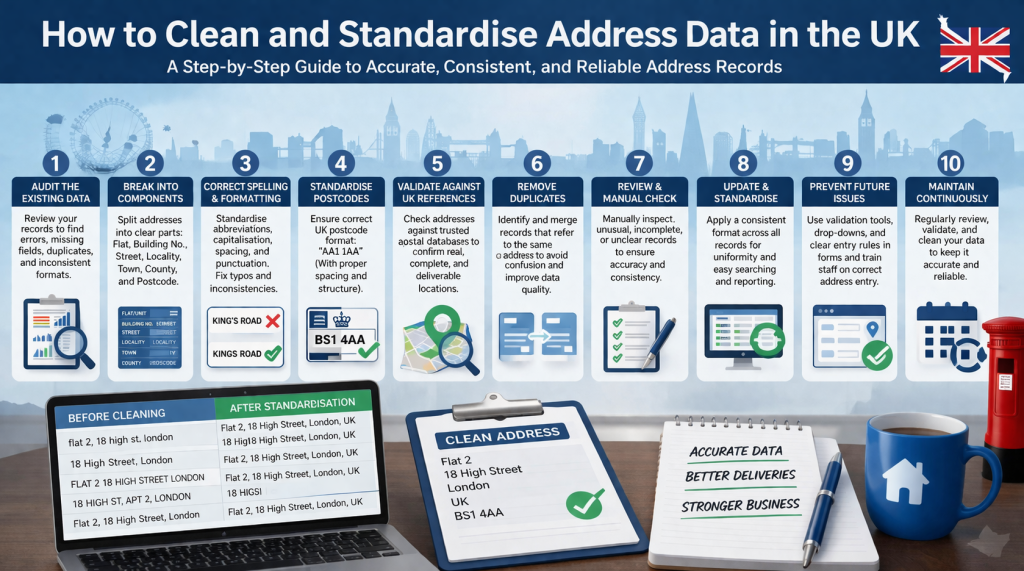
The first step in the address cleaning process is to review what you already have. Before making changes, it is important to understand the scale and type of issues inside the database. A proper audit helps identify common errors such as missing address lines, invalid postcodes, duplicate records, merged fields, spelling mistakes, and inconsistent naming. For example, some records may store the full address in one field, while others may split it into building number, street, town, county, and postcode. Some may include unnecessary details, while others may omit important information. By examining a sample or a full dataset, you can detect patterns and decide what needs correction first. This stage is important because it prevents random editing and creates a structured approach. Businesses that want to clean address data in the UK effectively should always begin with a clear assessment of current data quality, field structure, and formatting problems.
Break the Address into Standard Components
Once the audit is complete, the next step is to separate each record into consistent address elements. UK address standardisation works best when every record follows the same structure. That generally means assigning data to clearly defined fields such as flat or unit number, building name, building number, street name, locality, post town, county if needed, and postcode. When data is stored in one long text string, it becomes difficult to validate or compare. Breaking it into structured components makes the data easier to clean, search, and standardise. It also supports automation and integration with other systems. For example, if one record says “Flat 4B, 22 King’s Road, Bristol BS1 4AA” and another says “22 Kings Rd Apt 4B Bristol BS14AA,” a structured breakdown makes it easier to recognise that both likely refer to the same address. This is a key stage in UK address formatting because standard fields create the foundation for accuracy and consistency.
Correct Spelling, Formatting, and Common Variations
After structuring the data, the next task is to normalise the wording and presentation. This means applying consistent spelling, capitalisation, abbreviations, and spacing across all records. In professional datasets, “Street” and “St” should not appear randomly if your system has chosen one standard form. The same applies to “Avenue” and “Ave,” “Lane” and “Ln,” or “Apartment” and “Flat.” Standardisation also includes removing unnecessary punctuation, correcting double spaces, and making postcode formatting consistent. UK postcodes should follow the accepted spacing pattern, because postcode accuracy is critical for validation and routing. At this stage, it is also useful to correct common typographical errors and convert text into a uniform case style, such as title case or uppercase, depending on organisational preference. The aim is not to make data look neat only for appearance, but to make records comparable and machine-readable. Strong address standardisation in the UK depends on reducing every avoidable variation that weakens record quality.
Validate the Data Against Reliable UK Address References
Once the formatting is cleaned, the most effective next step is validation. Standardisation improves consistency, but validation checks whether the address is real and complete. In the UK, businesses often compare records against trusted postal reference sources to confirm that the postcode matches the post town, the street exists, and the building details are plausible. Validation can reveal incorrect combinations, outdated entries, or missing fields that basic formatting rules cannot detect. This stage is especially important when the data will be used for shipping, compliance, billing, or customer verification. A validated address dataset reduces operational risk and improves customer satisfaction. It also helps organisations identify records that need manual review. In many cases, validation software or data quality tools can automate part of this process, but human oversight is still useful for unusual or ambiguous records. For companies focused on UK data cleansing, validation is what turns a tidy-looking database into a dependable one.
Remove Duplicates and Merge Similar Records Carefully
Another major part of cleaning address data is identifying duplicate entries. Duplicate records often appear when customers place multiple orders, staff import the same contact more than once, or different systems create overlapping profiles. Two records may look different on the surface but still represent the same location. Once address elements are cleaned and standardised, duplicate detection becomes much easier. You can compare building number, street name, town, and postcode more accurately because the formatting differences have already been reduced. However, duplicate removal should be handled carefully. It is important to check whether records belong to the same household, business, or customer account before merging them. A careless merge can result in lost information or incorrect customer history. The goal is to create a single trusted version of each address record where appropriate. For businesses looking to improve UK customer data quality, removing duplicates is one of the most valuable outcomes of the standardisation process.
Create a Standard Entry Policy for Future Data
Cleaning historical records is important, but long-term success depends on preventing the same issues from returning. That is why every organisation should define a standard address entry policy for future data collection. Online forms, internal systems, and import templates should all follow the same structure and formatting rules. Required fields should be clearly defined, postcode entry should be checked at the point of capture, and address lookup or validation tools should be used where possible. Staff should also be trained to follow the same standards when entering or editing records manually. Without a future-facing policy, even a perfectly cleaned dataset will become inconsistent again. A good address data management strategy combines one-time cleansing with ongoing control. In the UK, businesses that maintain clean address records usually do so by building standardisation into daily workflows rather than treating it as a one-off correction project.
Conclusion
Learning how to clean and standardise address data in the UK is an essential step for any organisation that values accuracy, operational efficiency, and better customer experience. The process begins with a data audit, then moves through structuring, formatting, correction, validation, duplicate removal, and long-term governance. Each stage plays a different role, but together they create a database that is cleaner, more reliable, and easier to use. Accurate address data supports better deliveries, stronger analytics, lower operational costs, and more professional communication. It also reduces the confusion that comes from inconsistent records across teams and systems. In a competitive environment where data quality matters more than ever, UK address cleansing is not just a technical task. It is a business improvement strategy. When organisations commit to proper address standardisation, they create stronger foundations for growth, trust, and long-term data integrity.