

Last updated: March 19, 2026
If you are trying to figure out how to choose Ao Dai for a wedding, you are probably not just picking a dress. You are balancing family expectations, personal style, ceremony logistics, photos, comfort, and a whole lot of feelings. That is especially true for Vietnamese Americans, where the wedding may include a tea ceremony at home, a church or civil ceremony, a reception, and a second outfit somewhere in the middle because the day gets long fast.
The tricky part is that the “right” Ao Dai is not always the most ornate one, or the one with the heaviest embroidery, or the one that looked amazing on someone else online. In my opinion, the best choice is the one that makes sense for your role, your family, your timeline, and your body. You want something that honors the moment without making you feel like you borrowed someone else’s wedding.
Start With the Ceremony, Not the Dress
The first thing to decide is when you are wearing the Ao Dai and what that part of the day means to you. For many Vietnamese weddings, the tea ceremony is the moment where the Ao Dai matters most. That is often the most traditional part of the celebration, and it is the part parents and grandparents may care about most. Some couples also wear Ao Dai for formal portraits, the ceremony itself, or part of the reception. Others change into Western wedding clothes later.
This is where a lot of couples get stuck. They shop as if they are choosing one outfit for one event, but the wedding actually has layers. If your Ao Dai is mainly for the tea ceremony, you may want something more traditional, more formal, and more family-centered. If you plan to wear it through the reception too, comfort starts to matter even more. You will be sitting, standing, hugging people, kneeling, eating, taking photos, and probably overheating at least once.
So before you fall in love with a design, ask a boring but useful question: what job does this outfit need to do? Boring questions save expensive mistakes.
How to Choose Ao Dai for a Wedding Based on Tradition vs. Personal Style
There is no single correct level of tradition. That is the good news. The harder part is deciding where you want to land.
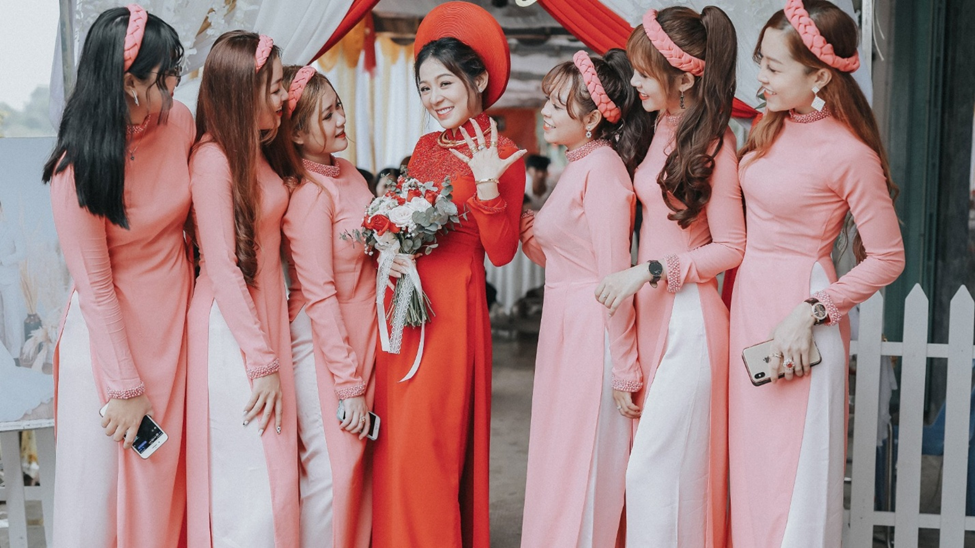
A more traditional bridal Ao Dai usually leans toward a higher neckline, longer sleeves, richer brocade or embroidered fabric, and sometimes a matching khăn đóng. A more modern version may use softer fabric, lighter embellishment, a cleaner silhouette, or details that feel closer to contemporary bridal fashion. Some brides want full traditional formality for the tea ceremony and then change later. Some want a modern Ao Dai that still feels recognizably Vietnamese. Both can work.
For Vietnamese Americans, this choice is often less about rules and more about family comfort. If your parents have strong expectations, it helps to know that early. Not because they get veto power over your whole identity, but because it is much easier to blend tradition and personal taste when you know what really matters to them. Sometimes the answer is not “traditional or modern.” Sometimes it is “traditional shape, modern fabric” or “modern fit, traditional color.”
That middle ground is where a lot of people end up, and honestly, it is often the smartest place to be.
Choose Color With Meaning and Family Dynamics in Mind
Color matters. It does not have to control you, but it matters.
Red is widely associated with luck, joy, and wedding celebration, which is why it remains such a common choice for Vietnamese bridal wear. Gold accents are also popular. Some wedding sources note that combinations like red and gold, or all-white looks, may be treated as couple colors during the wedding itself, which is one reason coordination matters. And many Vietnamese wedding guides still note that black is tied to funerals, while some white or purple floral looks can carry sadder associations in certain wedding contexts.
That does not mean every Vietnamese American wedding follows every rule the same way. Families vary. Regions vary. Generations vary. But it does mean color is worth discussing instead of guessing.
If you want the least drama, talk with your parents or elders before you order. Not for permission. For clarity. Ask whether there are colors they strongly prefer or want to avoid. Ask what the groom is wearing. Ask whether the mothers are coordinating too. This matters more than people think, because an Ao Dai does not exist in isolation. It is part of a family visual story.
If you want a safe starting point, rich reds, warm golds, jewel tones, and soft metallic details tend to feel wedding-appropriate while still giving you room to make the look your own.
Fabric Will Decide Whether You Feel Great or Trapped
On a hanger, people notice color first. On the wedding day, you will notice fabric.
A structured brocade Ao Dai can look incredible in photos and feel very ceremonial. Satin can photograph beautifully too, but depending on the weight and finish, it may also show heat, movement, or wrinkles in ways you did not expect. Lighter fabrics can feel easier for spring or summer weddings in the U.S., especially if your day includes travel between locations, home ceremonies, outdoor portraits, or a packed reception.
This is a big deal for Vietnamese Americans because the wedding might happen in California heat, a Texas ballroom, a church in the Midwest, or a winter venue on the East Coast. And the tea ceremony may happen in a crowded family home before the formal event even begins. A fabric that feels fine for ten minutes in a showroom can feel very different after three hours of moving around under lights and family attention.
If possible, look at the fabric in daylight and ask how it moves, how heavy it is, and whether it breathes. If you are ordering online, ask for swatches or close-up videos. Embroidery can be beautiful, but too much weight in the wrong place can change how the whole Ao Dai hangs on the body.
Fit Is Where the Whole Thing Wins or Loses
Ao Dai is one of those garments where fit is not a minor detail. It is the detail.
A slightly off fit in a loose dress can be forgiven. A slightly off fit in an Ao Dai is visible right away. The shoulders sit wrong. The side slits pull strangely. The pants bunch. The neckline shifts. Suddenly the elegant silhouette you wanted turns into a full-day adjustment project.
So when you think about how to choose Ao Dai for a wedding, move fit near the top of the list. Get accurate measurements. Include height and shoe height. Think about your bust, waist, hips, shoulder width, and arm comfort. And do not just stand still in the mirror. Sit down. Walk. Raise your arms. Step up. Kneel if your ceremony will involve it. Turn sideways. See what happens.
Also, leave time for alterations. Real time. Not “my wedding is next weekend and maybe my cousin can fix it.” Real time. Even a ready-made Ao Dai often needs tailoring to look right, and custom work still sometimes needs adjustment after it arrives.
Coordinate With Your Partner and Family Without Looking Overmatched
Matching does not have to mean identical.
The bride and groom can coordinate through color family, embroidery style, fabric texture, or overall formality. A groom’s look might be more understated while still echoing the bride’s tone. Family members can wear complementary shades instead of exact copies. This tends to look better in photos and gives everybody a little more freedom.
The goal is cohesion, not cloning. You want it to feel intentional when everyone is standing together, but not so rigid that it looks like a costume assignment.
This is also the point where the rest of your wedding starts connecting. If your tea ceremony attire is formal and traditional but the evening reception is more relaxed, make that clear to guests. A lot of confusion disappears when the paper suite does its job. This guide to dress code wording for wedding invitations and details cards is helpful if you need to explain different expectations for different parts of the day. And if you are ordering your stationery at the same time, How to Order Custom Wedding Invitations on PrintInvitations is a good practical next step.
Decide Whether to Buy, Rent, or Go Custom
There is no universal best option here. It depends on timeline, budget, body type, and how specific your vision is.
Custom is usually the best fit if you have a very clear idea, need special sizing, want to coordinate closely with your partner or family, or care a lot about keeping the outfit. Rental can make sense if the Ao Dai is for one event, you want a more traditional look without a full custom budget, or you do not want to store another wedding outfit forever. Ready-made can work if you find a strong base and are willing to alter it properly.
For Vietnamese Americans ordering in the U.S., the timeline matters a lot. Shipping can take longer than you expect. Alterations can take longer than you expect. Family opinions can also show up later than you expect, which is honestly a special kind of wedding problem. So order earlier than feels necessary.
Do Not Forget the Finishing Pieces
The Ao Dai is not the whole look. It is the anchor of the look.
Think about the pants color and fabric. Think about the khăn đóng if you are wearing one. Think about jewelry, shoes, bouquet, hairstyle, and what underlayers you need so the outfit stays comfortable and smooth. Do one full try-on before the wedding with everything, not just the dress by itself. That includes the exact shoes.
This sounds obvious until people skip it and discover on the wedding day that the pants are too long, the shoes catch the hem, the necklace fights the neckline, or the headpiece feels great for seven minutes and then becomes a problem. A full trial run is boring. Again. Boring usually wins.
The Best Ao Dai Choice Is the One That Feels Like You
There is a lot of emotion tied up in Vietnamese wedding clothing, especially for Vietnamese Americans. You may be honoring parents, grandparents, heritage, migration, religion, family memory, and your own taste all at the same time. That is a lot to ask from one outfit.
But the answer does not have to be complicated. If you come back to a few core questions, it gets clearer. What part of the day is this for? How traditional do you want to go? What colors make sense? Will the fabric hold up through the actual wedding day? Does the fit let you move like a human being? Do you feel like yourself in it?
That is really how to choose Ao Dai for a wedding. Not by chasing the flashiest option. Not by trying to please every single person. And not by treating tradition like a museum object. The right Ao Dai should let you look grounded, feel comfortable, and step into the day like you belong there. Because you do.
