
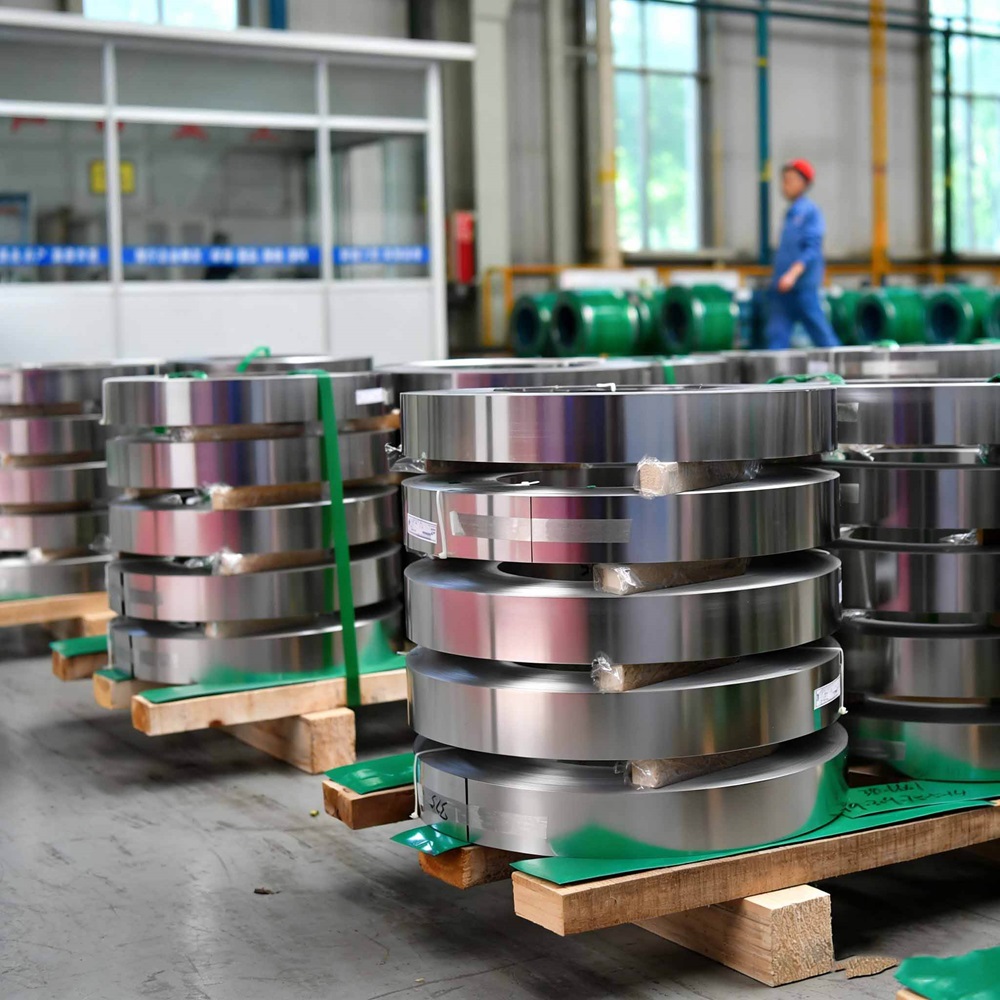
When you first hold a piece of high-precision metal, the most striking question is often: How thin can stainless steel foil actually get? The reality of modern metallurgy is staggering. We have pushed the boundaries of material science so far that stainless steel can now be produced at dimensions thinner than a human hair, all while maintaining the rugged durability the alloy is famous for.
Today, how thin can stainless steel foil get is a question answered in microns. In this guide, we’ll explore the microscopic world of ultra-thin foils, the technology required to roll them, and the high-tech industries that rely on these “metallic tissues.”
Understanding the Scale: Microns vs. Millimeters
In the world of precision stainless steel foil, we stop talking about millimeters and start talking about microns ($\mu m$).
To put the current manufacturing limits into perspective:
- Human Hair: Approximately $70\mu m$.
- Standard Kitchen Aluminum Foil: Approximately $16\mu m$.
- Ultra-Thin Stainless Steel Foil: Can reach as low as $5\mu m$ ($0.005$ mm).
Commercial-grade 316L stainless steel foil ultrathin 0.01mm is a feat of engineering, being roughly seven times thinner than a strand of hair yet possessing significantly higher tensile strength and heat resistance than almost any other flexible material.
Thickness Categories at a Glance
| Thickness (mm) | Microns (μm) | Industry Category |
| 0.20 mm | $200 \mu m$ | Thin Sheet / Shim Stock |
| 0.10 mm | $100 \mu m$ | Standard Tool Wrap |
| 0.05 mm | $50 \mu m$ | High-Flex Foil |
| 0.02 mm | $20 \mu m$ | Ultra-Thin Barrier |
| 0.01 mm | $10 \mu m$ | Precision Electronics Foil |
| 0.005 mm | $5 \mu m$ | Micro-Foil / Battery Grade |
[Image: A macro shot comparing a strand of hair to a piece of 0.01mm stainless steel foil]
What Limits the Thinness of Foil?
Producing “micro-foil” isn’t just about pressing harder; it’s a delicate dance of physics and chemistry. Several factors dictate the minimum stainless steel foil tool wrap thickness:
- Rolling Mill Precision: Achieving $5\mu m$ requires a 20-high Sendzimir mill. The smaller the work rolls, the more concentrated the pressure, allowing for thinner reductions without “spring-back.”
- Material Purity: At $10$ microns, a single microscopic inclusion or piece of dust can cause a pinhole or a tear. This is why 304 stainless steel foil and 301 stainless steel foil must be of the highest metallurgical purity.
- Intermediate Annealing: As the metal is rolled, it “work hardens.” To keep it from snapping like glass, it must be heat-treated in a bright annealing line to restore its plasticity.
- Handling Tension: The thinner the foil, the easier it is to wrinkle. Controlling the “tension” as it winds onto a coil is a mastercraft in itself.
Why Use Ultra-Thin Foil Over Aluminum?
While aluminum foil is cheaper, it cannot compete with the technical properties of stainless steel.
- Heat Resistance: Stainless foil maintains its integrity at temperatures where aluminum would melt or oxidize.
- Chemical Stability: It is the preferred choice for medical implants and surgical tools.
- Strength: It offers a much higher strength-to-weight ratio, which is critical for aerospace and EV battery shielding.
Real-World Applications for Micro-Foils
- Renewable Energy: Used as a substrate for thin-film solar cells and fuel cell plates.
- Electronics: Essential for EMI/RFI shielding in smartphones and flexible printed circuits.
- Automotive: Found in high-performance gaskets and burst discs for safety systems.
- Medical: Used in precision sensors and sterile barriers.
[Image: Ultra-thin foil being used in a flexible electronic circuit board]
Summary
The journey to $5$ microns represents the pinnacle of modern cold-rolling technology. Whether you need a rugged stainless steel foil wrap for heat treating or a microscopic electronics barrier, the grade and thickness must be perfectly matched to your environment.
For more technical data or to explore our full stainless steel foil product catalog, visit our website. If you’re struggling to decide which gauge is right for your project, check out our stainless steel foil blog or contact us for expert advice.
A Final Thought from Ewan:
As the CEO of stainlesssteelfoil.com, I’ve spent over 30 years helping engineers push the limits of what’s possible. From our facility in China, we provide the precision and consistency required for the world’s most demanding builds. Let’s talk about your next project!