

There are sporting competitions, and then there is the Premier League. Every weekend between August and May, hundreds of millions of people across six continents stop whatever they are doing to watch twenty English football clubs chase a ball around a pitch. Bars in Lagos fill up before sunrise. Families in Jakarta pass the remote control around like a sacred object. Teenagers in São Paulo paint their faces in the colors of clubs they have never seen in person. What started as a domestic restructuring of English football in 1992 has somehow become one of the most recognizable cultural exports on earth. The question worth asking, and answering properly, is how did this happen?
The story is not simply about money, though money is a big part of it. It is about timing, ambition, storytelling, and a remarkable ability to make people feel that a football match happening four thousand miles away is somehow personal to them. Understanding the rise of the Premier League means understanding modern sport itself.
From Domestic League to Global Phenomenon
When the Premier League broke away from the Football League in 1992, the ambitions were relatively modest by today’s standards. The top clubs wanted more control over television revenue and commercial deals. They got it, and then some. The timing was fortunate in ways nobody could have fully planned. Satellite television was just beginning to reshape how people consumed sport. Sky Sports signed a landmark deal that season, and suddenly English top-flight football was available in living rooms that had never been able to watch it before.
But access alone does not create passion. What the Premier League had, almost by accident at first, was drama. Relegation battles, title races decided on the final day, shock transfers, feuding managers. The 1993–94 season gave fans the Cantona era at Manchester United. By 1995–96, Alan Shearer was breaking records at Newcastle. Every season felt like a new chapter in an ongoing novel that millions of people were reading simultaneously. For fans following the valioliiga from Finland and other Nordic countries, the Premier League represented everything exciting about modern football: pace, physicality, and a narrative richness that was difficult to find elsewhere.
As the league’s identity sharpened, so did its international marketing instincts. Pre-season tours to Asia, the United States, and Australia were not just money-spinning exercises; they were deliberate brand-building trips designed to plant flags in regions where football fanbases were young and impressionable. When Manchester United played a pre-season match in Bangkok or Liverpool toured in Hong Kong, they were not just playing football. They were recruiting lifelong supporters.
The Role of Broadcasting and Media Rights
If you want to understand the engine behind the Premier League’s global reach, follow the broadcast rights. The league’s approach to selling its television rights has been methodical, competitive, and extraordinarily lucrative. By carving the market into packages, live matches, highlights, and international rights, the Premier League created a system in which broadcasters around the world bid aggressively for a share of the product. This competition drove prices up, which funded better players, which made the product more attractive, which drove prices up again. It became a self-reinforcing cycle that competitors could not easily replicate.
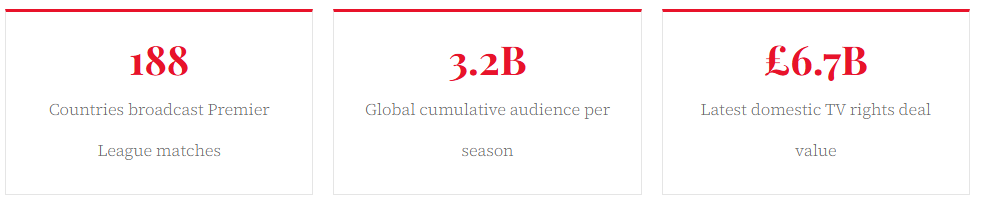
According to the Premier League’s official broadcasting information, the league currently has broadcast partners in 188 countries and territories. That figure alone tells most of the story. There is almost nowhere on earth where a motivated football fan cannot find a way to watch a Premier League match legally. In regions where traditional broadcast infrastructure is weak, the league has adapted by licensing to streaming platforms, making accessibility a core part of its expansion strategy.
The 2022–2025 domestic rights cycle in the United Kingdom fetched approximately £5 billion across Sky Sports, BT Sport, and Amazon Prime. The international rights, which cover everywhere outside England, Scotland, Wales, and Northern Ireland, added several billion more. These sums are not just impressive numbers. They represent the financial foundation that allows clubs to pay world-class wages, invest in elite training facilities, and attract the very best players from across the globe, which in turn keeps the quality of the league at a level that justifies those broadcast costs.
“The Premier League did not just sell football matches; it sold a weekly entertainment experience that could compete with everything else on a television schedule, anywhere in the world.”
Social Media and the Digital Expansion
Television rights explained the Premier League’s growth through the 1990s and 2000s, but something shifted around 2010. A new generation of fans was not waiting for Saturday afternoon. They were on Twitter watching goals in real time. They were on YouTube revisiting classic moments. They were on Instagram following their favorite players’ lives off the pitch. The Premier League and the clubs within it recognized this shift quickly and adapted with unusual speed for an institution built on tradition.
Today, Premier League clubs collectively hold billions of social media followers. Manchester United, Liverpool, Chelsea, Arsenal, and Manchester City each operate social media accounts in multiple languages, producing content specifically designed for audiences in Southeast Asia, the Middle East, South America, and Sub-Saharan Africa. This is not translation, it is localization. A Manchester City post aimed at Indonesian fans will reference local events, use culturally resonant imagery, and engage with regional fans. accounts. The level of sophistication is closer to a multinational consumer brand than a football club.
The Premier League’s own digital channels amplify this further. Its YouTube presence, featuring extended highlights, behind-the-scenes content, and archival footage, has made the league a destination for football content beyond the ninety minutes of a match. Fans who cannot afford a broadcast subscription, or who live in markets where rights have not been sold to traditional broadcasters, can still engage meaningfully with the product through free digital content.
International Fanbase and Marketing Strategies
The Premier League’s international fanbase is not an accidental byproduct of success, it is the result of deliberate, sustained marketing effort. The league has an entire department dedicated to international development, working with club commercial teams to identify high-growth markets and invest in fan engagement there before competitors do.
China, India, and the United States have been the most prominently targeted markets over the past decade. In China, partnerships with Tencent have brought Premier League content to a platform with over a billion registered users. In India, where cricket has historically dominated, the Premier League has spent years building brand awareness through dedicated Hindi-language content and grassroots fan events in major cities. In the United States, the partnership with NBC Sports (now Peacock) transformed Premier League coverage from a niche product into a mainstream weekend broadcast comparable to NFL coverage in its production values and narrative framing.
Beyond broadcast deals, clubs have opened official supporter clubs in cities from Nairobi to Mumbai to Buenos Aires. These are not passive fan associations; they are active community hubs that host watch parties, youth coaching clinics, and charity partnerships. They give the Premier League a human face in communities that might otherwise experience English football purely as a distant television product. As FIFA’s global football development reports consistently show, grassroots engagement is the most durable foundation for long-term fandom, and the Premier League has learned this lesson thoroughly.
The influx of international ownership has accelerated this globalization further. American owners at Liverpool, Arsenal, Manchester United, and Chelsea bring networks, commercial instincts, and an understanding of sports marketing in non-traditional football markets that English ownership structures rarely possessed. Similarly, Middle Eastern investment at Manchester City and Newcastle has opened doors into markets where those clubs had minimal presence a decade ago. Ownership diversity has become an unintentional but powerful internationalisation tool.
What the Numbers Actually Mean
It is easy to become numb to the figures associated with the Premier League. A £6.7 billion domestic broadcast deal. Three billion cumulative viewers per season. Clubs valued in the billions. But behind these numbers are real human choices, millions of people around the world deciding that the Premier League is worth their time, their emotional investment, and often their money. That decision is never made because of a marketing strategy alone. It is made because the football is genuinely, consistently excellent.
The quality of the Premier League product remains its most important asset. The combination of world-class players, competitive balance between clubs at the top and middle of the table, unpredictable results, and the sheer speed and physicality of English football creates something that holds attention. A fan in Lagos or Seoul does not need to understand the local significance of a Liverpool versus Manchester City rivalry to feel the tension of watching two elite teams trade blows on a Tuesday night. Sport communicates across cultural barriers in ways that very little else can.
The Road Ahead
The Premier League is not standing still. Expansion into new markets continues, with North Africa, South Asia, and Southeast Asia representing the most significant near-term growth opportunities. The potential introduction of a regulated league in the United States, modelled partly on the Premier League structure, could further cement English football’s influence over global football culture.
Technology will reshape the fan experience dramatically over the next decade. Augmented reality, personalized broadcast feeds, and interactive second-screen experiences, these are not distant concepts but products already in development by clubs and broadcasters. The fans who grew up following the Premier League through social media will expect digital experiences that reflect the era they grew up in.For now, though, the story is essentially one of organic brilliance building on calculated ambition. The Premier League became a global brand because it made great football accessible, told compelling stories around it, and never stopped looking beyond the boundaries of England for new audiences. For fans who want to stay close to the statistics, the standings, and the stories that shape each season, resources like valioliigatilastot.fi and the official Premier League website make it easier than ever to follow every dimension of the competition. The league’s greatest achievement may simply be this: it made the world care deeply about twenty clubs from a small island in the North Atlantic, and it shows no signs of letting go.