

Many traders view “averaging down” as the fastest way to blow a trading account. They aren’t wrong. Most retail participants use this technique to hide from a losing trade, hoping for a market miracle that never comes. This emotional response leads to “revenge trading” and eventual liquidation.
Professional traders, however, view price movement differently. Instead of fearing a dip, they use it to build a position at a better average price but only within a strict mathematical framework. This guide breaks down how to transform a dangerous habit into a professional risk management protocol.
Connect on Telegram Don’t miss out on critical market updates. Join my Telegram community for the latest news and trading signals delivered straight to your phone: https://t.me/mql5signals_Sarowar

Decoding the “Loser’s Average”: Why Most Retail Traders Fail
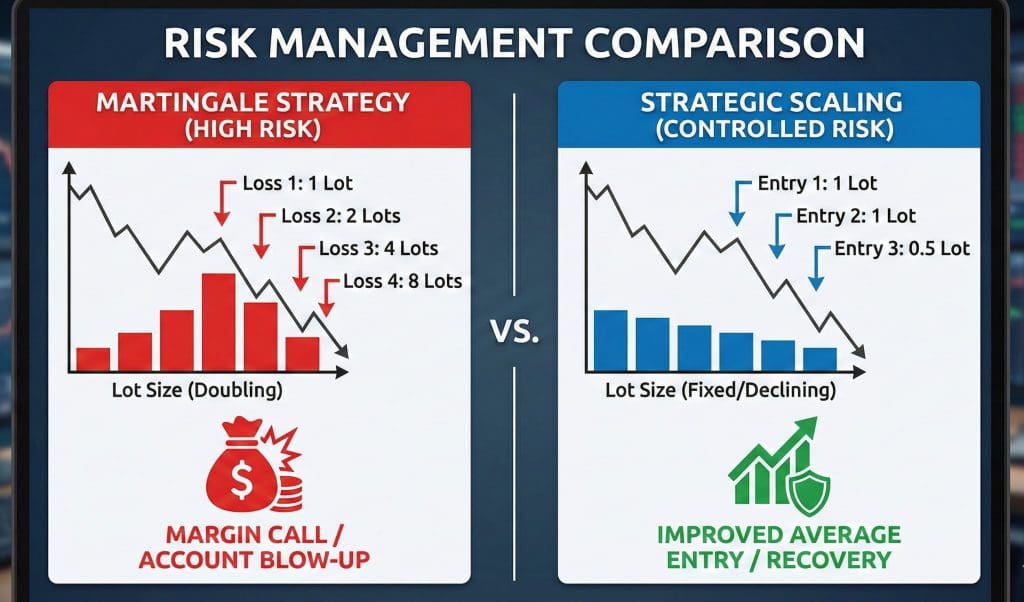
The “Loser’s Average” happens when a trader adds to a losing position because they are “sure” the market is wrong. This is the Martingale Strategy in disguise. By doubling down on a failing thesis, you expose your capital allocation to exponential risk.
Professional scaling is proactive; retail averaging is reactive. Pros decide where they will add to a trade before they open the first lot. If the price action doesn’t hit those specific value zones, they don’t add.
The Professional Framework: When Averaging Down is Mathematically Sound
Averaging down works best in markets showing high liquidity and clear support/resistance levels. It is an entry-point optimization tool. Instead of entering 1.00 lot at a single price, a pro might enter 0.25 lots at four different technical levels.
Scaling vs. Gambling
| Feature | Retail Averaging (Gambling) | Professional Scaling (Strategy) |
| Trigger | Emotional fear of loss | Technical value zones |
| Lot Sizing | Increasing (1, 2, 4 lots) | Constant or Declining (1, 0.5, 0.25) |
| Stop Loss | Non-existent or “Mental” | Hard Technical Invalidation |
| Max Risk | Unknown/Account-wide | Pre-defined (e.g., 2% of equity) |
3 Non-Negotiable Rules for Safe Position Building
To use this strategy safely on sarowarjahan.com, you must adhere to three core pillars of risk management.
Rule 1: Pre-Defined Technical Invalidation
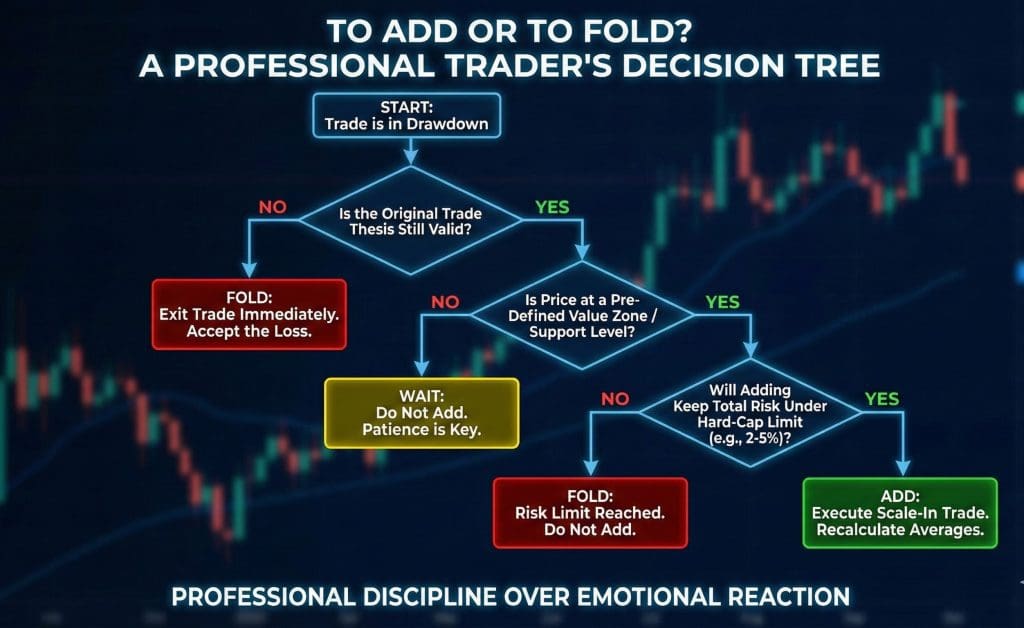
Every trade needs a “point of no return.” This is the price where your original trade thesis is objectively proven wrong. If the market crosses this line, you exit all positions immediately. No exceptions.
Rule 2: The Hard-Cap Exposure Limit
Never let a single “scaled-in” trade idea consume more than a fixed percentage of your account. Whether you have one entry or five, your total risk-to-reward ratio must remain within your 2–5% portfolio limit.
Rule 3: Declining Lot Sizes
Professional scaling often uses the “Reverse Scale” method. Your first entry is your largest. Subsequent entries are smaller. This ensures your weighted average moves toward the current price without ballooning your total exposure too quickly.
How to Calculate Your Weighted Average and Break-Even Point
Knowing your break-even point is critical for drawdown management. You aren’t just “buying more”; you are lowering the price at which the trade becomes profitable.
The Math:
- Multiply each entry size by its price.
- Add those totals together.
- Divide by the total number of units held.
For example, if you buy 1 lot at 1.1000 and another lot at 1.0900, your break-even is 1.0950. Understanding this allows you to set realistic exit targets during market retracements.
Risk Management Protocols: When to Stop and Walk Away
The greatest risk in Forex is margin exhaustion. Averaging down in a strong, runaway trend is financial suicide. If the market breaks through a multi-year support level, your strategy must shift from “averaging” to “preservation.”
Check your recovery factor regularly. If the cost of maintaining the trade exceeds the potential profit of the reversal, the trade is no longer an asset—it is a liability.
FAQ: Mastering the Scale-In
What is the difference between averaging down and a Martingale strategy?
Averaging down is a strategic scale-in based on technical value zones and fixed risk limits. Martingale is a high-risk system that doubles position sizes after losses. Professionals use fixed risk, while Martingale uses infinite risk.
Is averaging down a good strategy for professional traders?
Yes, professionals use it as a position-building tool provided they have a clear invalidation point. It allows for a better average entry price. However, it is only effective when managing total exposure.
When should you stop averaging down?
Stop adding once you reach your Maximum Exposure Limit or if the price hits a Technical Invalidation Level. If the original reason for the trade is no longer valid, you must exit rather than continue adding.
How do you calculate a break-even price when averaging down?
Divide the total cost of all entries by the total number of units or lots held. This provides the exact price where the trade moves into profit, allowing for better exit planning.
What are the risks of averaging down in Forex?
The primary risks include unlimited drawdown in a strong trend and margin exhaustion. Without a hard stop-loss, this strategy can lead to catastrophic losses. Success requires strict discipline and low leverage.
