
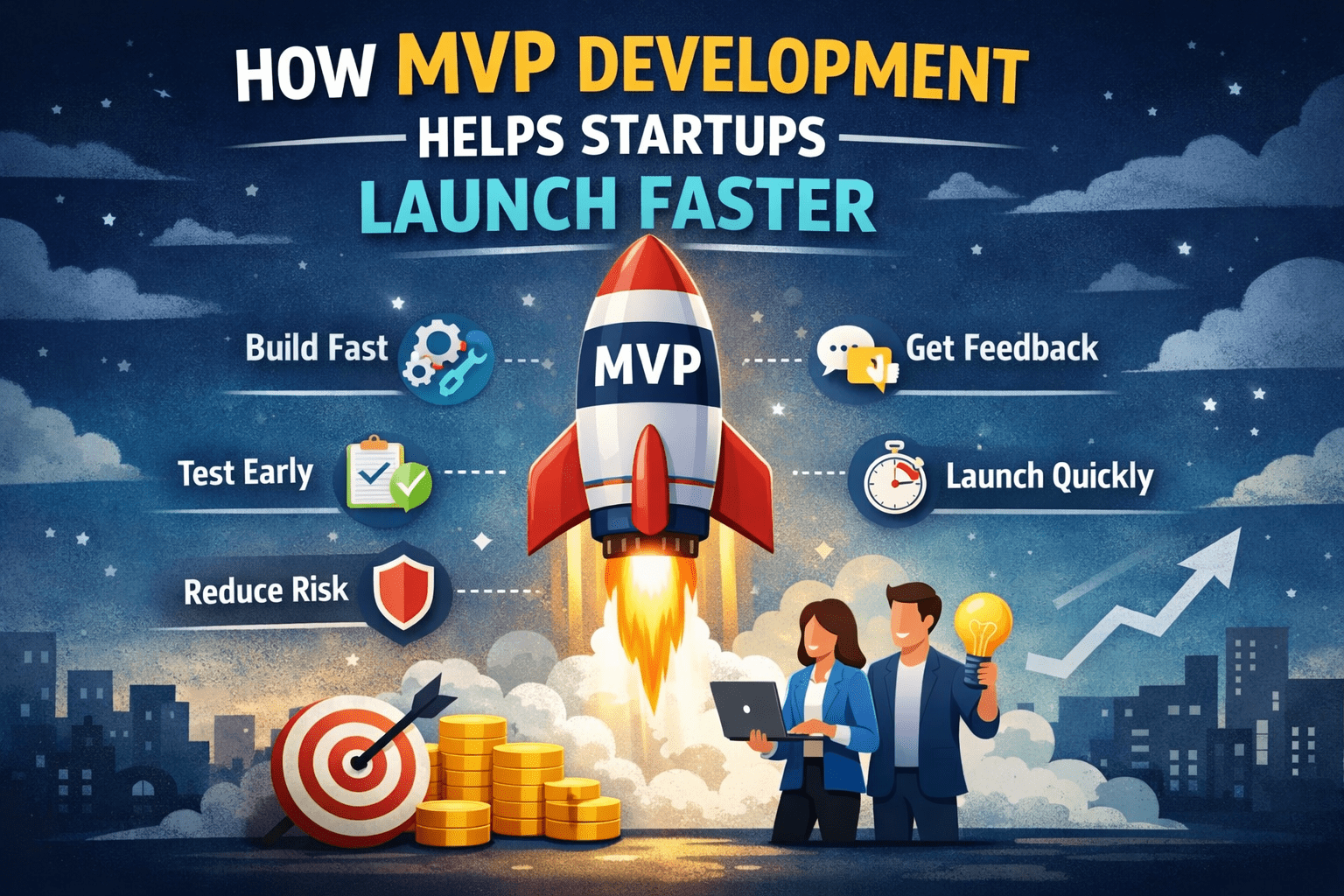
Launching a startup is exciting—but it also comes with uncertainty, limited resources, and constant pressure to move quickly. Many founders spend months (or even years) building a full product, only to realize later that it doesn’t meet market needs.
This is where MVP development changes the game.
An MVP, or Minimum Viable Product, allows startups to launch faster, test their ideas, and make smarter decisions without wasting time or money. Instead of building everything at once, startups can focus on what truly matters—getting their product into the hands of users as quickly as possible.
In this article, we’ll explore how MVP development helps startups launch faster and why it has become a go-to strategy for modern businesses.
What is MVP Development?
MVP (Minimum Viable Product) is a version of a product that includes only the core features required to solve a specific problem.
The goal is simple: build just enough to launch, test, and learn.
Instead of creating a fully-featured product, startups release an MVP to understand user behavior, gather feedback, and improve the product step by step.
Why Speed is Important for Startups
Startups operate in a highly competitive environment. Delays in product launch can lead to missed opportunities, increased costs, and even failure.
Launching faster helps startups:
- Missed market opportunities
- Increased development costs
- Higher risk of failure
- Strong competition is entering the market
Launching quickly allows startups to validate their ideas early and adapt based on real user feedback.
How MVP Development Helps Startups Launch Faster
1. Focus on Core Features Only
One of the biggest reasons startups delay their launch is trying to build too many features.
MVP development solves this by focusing only on the essential features needed to solve the main problem.
This reduces development time and helps startups go to market faster.
2. Reduces Development Time
Building a full product can take months or even years. An MVP, on the other hand, can be developed in a much shorter timeframe.
By simplifying the scope, startups can launch within weeks or a few months, depending on the complexity.
3. Early Market Validation
Instead of guessing what users want, MVP development allows startups to test their ideas in the real market.
This helps answer important questions:
- Do users actually need this product?
- Are they willing to pay for it?
- What features matter the most?
Early validation helps startups avoid building something that no one needs.
4. Saves Cost and Resources
Startups often operate with limited budgets.
MVP development ensures that resources are used wisely by focusing only on what is necessary. Instead of investing heavily up front, startups can build gradually based on feedback.
This reduces financial risk and improves ROI.
5. Early User Feedback
One of the biggest advantages of MVP development is real user feedback.
Instead of guessing what users want, startups can launch their MVP and learn directly from users. This feedback helps in improving the product and making better decisions.
6. Minimizes Risk
Building a full product without validation is risky.
MVP development allows startups to test their idea before making a large investment. If the idea doesn’t work, they can pivot or improve without significant losses.
7. Easier to Scale and Improve
An MVP is just the beginning.
Once the product is launched and validated, startups can gradually add new features based on user needs. This step-by-step approach makes scaling easier and more efficient.
8. Better Investor Confidence
Investors are more likely to support startups that have a working product and real user data.
An MVP demonstrates that your idea has potential and reduces the risk for investors. It shows that you have taken a practical approach to product development.
Real-Life Example
Imagine a startup with an idea for a food delivery app.
Instead of building a complete platform with advanced features, they launch an MVP with basic functionalities like browsing restaurants, placing orders, and tracking delivery.
After launch, they gather feedback from users and gradually improve the app by adding features like payment options, reviews, and loyalty programs.
This approach saves time, reduces risk, and ensures that the final product meets user expectations.
When Should You Build an MVP?
MVP development is ideal when:
- You have a new product idea
- You want to test market demand
- You have limited time and budget
- You want to reduce development risks
- You need user feedback before scaling
If you’re unsure about your idea, building an MVP is the smartest first step.
Choosing the Right MVP Development Partner
To build a successful MVP, it’s important to work with the right development team.
A reliable partner will understand your idea, define the core features, and develop a solution that is fast, scalable, and user-friendly.
If you’re looking to build a product quickly and efficiently, working with experts offering MVP development services can help you turn your idea into a functional product with minimal risk and faster time to market.
Common Mistakes to Avoid in MVP Development
While MVP development is effective, startups should avoid these common mistakes:
- Adding too many features in the initial version
- Ignoring user feedback
- Focusing too much on design instead of functionality
- Delaying launch for perfection
- Not defining a clear problem to solve
Keeping the MVP simple and focused is the key to success.
The Future of MVP Development
With the rise of agile development and rapid prototyping, MVP development is becoming even more important.
Startups are now focusing on faster iterations, continuous feedback, and quick improvements. This approach helps them stay competitive and adapt to changing market needs.
MVP development is no longer just an option—it’s a standard practice for building successful startups.
Conclusion
Launching a startup quickly and efficiently is critical in today’s competitive environment. MVP development helps startups reduce time, minimize risk, and validate their ideas with real users.
By focusing on core features and gathering early feedback, startups can build better products and scale with confidence.
Instead of waiting for the perfect product, launching an MVP allows you to start small, learn fast, and grow strategically.
FAQs
1. What is an MVP in startups?
An MVP (Minimum Viable Product) is a basic version of a product with essential features used to test a business idea.
2. Why is MVP important for startups?
It helps validate ideas, reduce risk, and launch products faster with minimal investment.
3. How long does it take to build an MVP?
Depending on complexity, it can take a few weeks to a few months.
4. Is MVP development cost-effective?
Yes, it reduces initial development costs by focusing only on core features.
5. Can an MVP be scaled later?
Yes, MVPs are designed to be improved and scaled based on user feedback and business growth.