
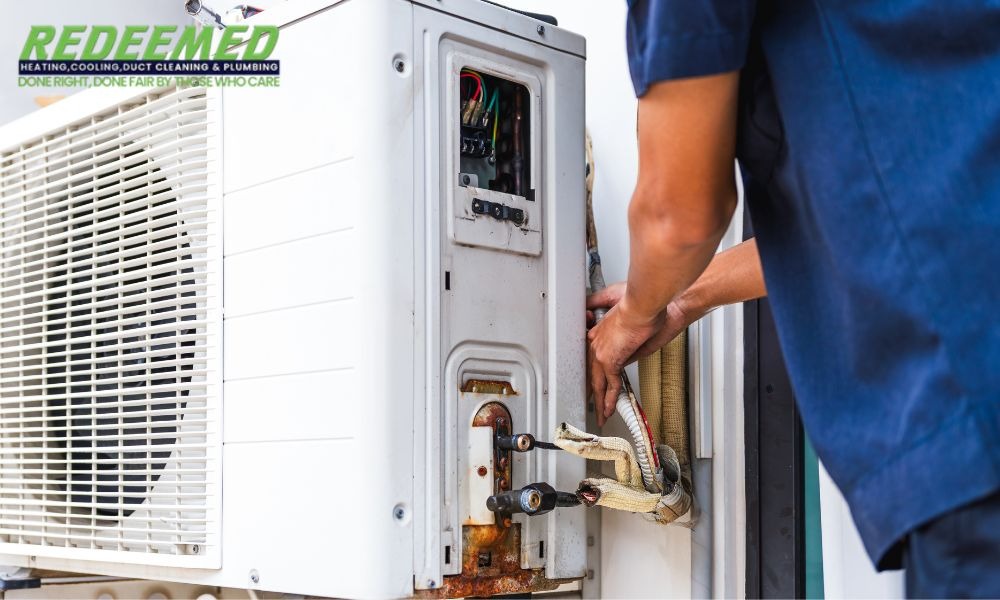
Missouri does not ease into its seasons. Springfield shifts from freezing overnight lows in January to heat index readings above 100°F in July, sometimes within the same month in spring and fall. That kind of range puts consistent mechanical stress on residential HVAC equipment that homeowners in milder climates never experience.
Understanding how heating and cooling Springfield systems respond to each season helps homeowners make smarter maintenance decisions before breakdowns happen. Redeemed HVAC serves Springfield and the surrounding Republic, MO area and sees the same seasonal failure patterns repeat every year. Most of them are preventable. This guide covers what each season does to your system and what needs attention before the next one arrives.
Winter: What Subfreezing Temperatures Do to Heating Systems
Springfield’s average January low sits at 24°F, but temperatures regularly drop below 10°F during polar vortex events, which have hit the Ozarks multiple times since 2014. At those temperatures, heat pumps operating in standard heating mode lose efficiency rapidly. The coefficient of performance (COP) for a standard heat pump drops from around 3.0 at 47°F to below 1.5 at 17°F, according to data published by the U.S. Department of Energy. Below that threshold, the backup electric resistance heat strip carries the full load, driving energy bills up sharply.
Key winter stress points on Springfield heating systems include:
- Heat exchanger cracks from repeated thermal expansion and contraction cycles
- Frozen condensate drain lines on high-efficiency furnaces rated 90 percent AFUE or above
- Refrigerant line icing on heat pumps without functioning defrost control boards
- Pressure switch failures caused by blocked or frozen PVC flue pipes
A furnace heat exchanger inspection using a combustion analyzer should be completed before the first hard freeze. A cracked heat exchanger allows combustion gases, including carbon monoxide, to enter the living space. The Consumer Product Safety Commission estimates that carbon monoxide poisoning causes approximately 400 non-fire-related deaths annually in the United States.
Spring: The Season That Exposes What Winter Left Behind
Spring in Springfield brings rapid temperature swings, with daily ranges sometimes spanning 40°F within a single 24-hour period. That means the heating system runs in the morning and the air conditioner kicks on by afternoon. This back-and-forth cycling is one of the highest-stress operational patterns a residential HVAC system faces. Capacitors, contactors, and blower motors that survived winter in weakened condition often fail during these transitional demand spikes.
Spring is also when refrigerant leaks that developed slowly over winter become noticeable. Refrigerant charge loss of as little as 10 percent reduces cooling capacity by up to 20 percent, according to research from the Florida Solar Energy Center. Signs of a refrigerant issue heading into cooling season include:
- Ice forming on the refrigerant line or evaporator coil
- Longer-than-normal cooling cycles with the home not reaching setpoint
- Higher electricity consumption compared to the same period in prior years
Spring is the correct time to schedule a full system check before peak cooling demand arrives in June. Redeemed HVAC provides pre-season inspections that include refrigerant charge verification, electrical component testing, and coil cleaning.
Summer: High Heat and Humidity Push Systems to Their Rated Limits
Springfield’s summer humidity regularly pushes the heat index above 105°F during July and August. Residential air conditioners are rated to operate at outdoor temperatures up to 115°F in most cases, but efficiency drops measurably above 95°F. The Energy Information Administration (EIA) reports that air conditioning accounts for nearly 17 percent of total residential electricity use nationally, and that figure climbs in high-humidity Midwest markets like Springfield.
Humidity control is a separate function from temperature control. An air conditioner removes moisture by passing warm air over a cold evaporator coil, causing condensation. When the system is oversized, it cools the space too quickly and shuts off before enough moisture is removed. This leaves indoor humidity above the 30 to 50 percent range recommended by the American Society of Heating, Refrigerating and Air-Conditioning Engineers (ASHRAE).
Summer cooling system failure points to monitor include:
- Condenser coil blockage from cottonwood seeds and grass clippings
- Contactor pitting from high-voltage cycling during peak demand hours
- Clogged condensate drain lines causing water backup into the air handler
- Dirty evaporator coils reducing heat transfer efficiency by up to 30 percent
Redeemed HVAC’s cooling services in Springfield include condenser coil cleaning and condensate drain flushing as standard steps in every summer tune-up.
Fall: The Maintenance Window Most Springfield Homeowners Miss
Fall is the lowest-demand season for HVAC systems in Springfield, which makes it the best time to complete maintenance that summer heat and winter cold make harder to schedule. Furnace igniter testing, heat exchanger inspection, and duct sealing are all easier to perform when neither heating nor cooling is urgently needed. The National Fire Protection Association (NFPA) recommends annual furnace inspections before each heating season, and fall provides the widest scheduling window before demand peaks in December.
Fall is also when air filter condition directly affects winter performance. A clogged filter restricts airflow across the heat exchanger, causing the high-limit switch to trip repeatedly. Over time, repeated high-limit cycling cracks the heat exchanger at the stress points created by thermal expansion. Filter replacement intervals depend on filter MERV rating and household dust load:
- MERV 8 filters: replace every 60 to 90 days in average households
- MERV 11 filters: replace every 60 days with pets or allergy concerns
- MERV 13 filters: replace every 30 to 45 days, verify system static pressure compatibility first
Ignoring fall maintenance means entering Springfield’s harshest heating months with a system that has not been verified. Emergency furnace repair calls spike in December and January, when wait times are longest and parts availability is tightest.
How Missouri’s Climate Zone Shapes Equipment Selection
Springfield sits in ASHRAE Climate Zone 4A, classified as mixed-humid. That classification means equipment must handle both meaningful heating loads in winter and significant latent cooling loads in summer. A system optimized only for dry heat or mild winters will underperform in Springfield’s actual operating conditions. The DOE’s Building America program specifies that Zone 4A homes benefit most from systems with variable-speed blowers, two-stage compressors, and integrated dehumidification controls.
Equipment decisions that align with Missouri’s climate zone include:
- Selecting heat pumps with ratings down to -13°F for low-ambient heating performance
- Choosing air conditioners with SEER2 ratings of 15 or above for summer efficiency
- Installing a whole-home dehumidifier when latent loads exceed the AC system’s removal capacity
- Pairing variable-speed air handlers with zoning systems in multi-story Springfield homes
Understanding how Missouri’s four seasons interact with mechanical systems helps homeowners make equipment choices that last 15 to 20 years rather than requiring early replacement. For year-round system guidance in Springfield, contact Redeemed HVAC at (417) 241-5687 or visit redeemedhvac.com.
