
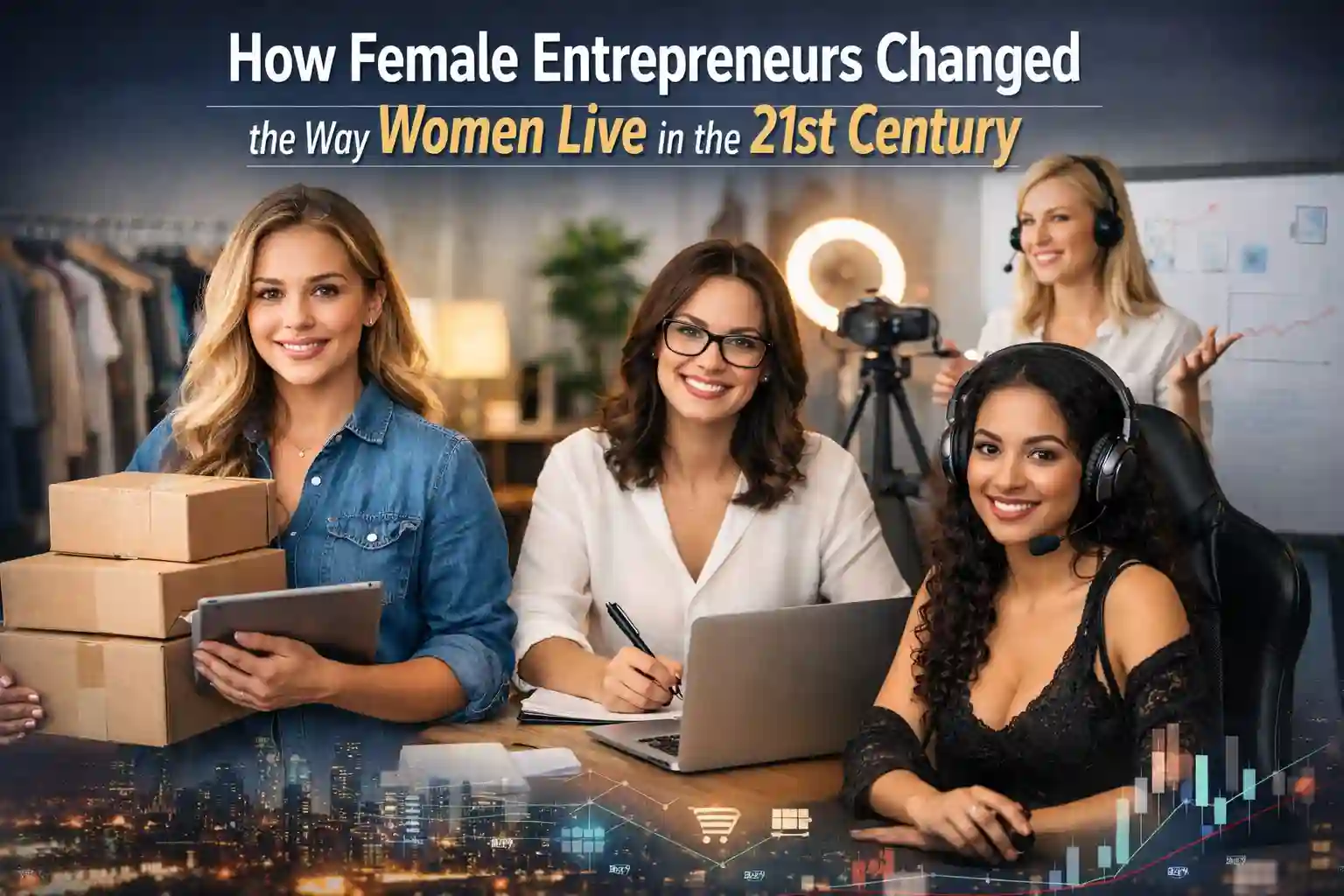
The 21st century did not quietly arrive. It kicked in the door, rewired economies, collapsed old hierarchies, and handed individuals tools that once belonged only to corporations and governments. Among the biggest beneficiaries—and architects—of this shift are women who stepped into entrepreneurship not as a trend, but as a structural correction to centuries of limited access.
Female entrepreneurs did not just create businesses. They reshaped how women work, earn, raise families, build independence, and define success. This transformation did not happen in boardrooms alone. It happened in kitchens turned into offices, laptops opened at midnight, phones used as production studios, and platforms that bypassed traditional gatekeepers entirely.
To understand how deeply women have changed modern life through entrepreneurship, we need to look at three forces: technology, autonomy, and scale. Together, they explain why women today can build income streams that were impossible even twenty years ago—and why this shift is permanent.
The Collapse of the Old Career Model
For most of modern history, women’s economic participation followed a narrow script. Education led to employment, employment followed rigid schedules, and advancement required physical presence, long hours, and conformity to systems designed by and for men. Motherhood often interrupted careers permanently. Flexibility was treated as weakness. Creativity was tolerated only if it fit corporate objectives.
The digital revolution shattered that model.
Remote work, global platforms, and online monetization broke the link between location and income. For the first time, women could build careers that adapt to life instead of sacrificing life for careers. Entrepreneurship became less about capital and connections and more about skills, consistency, and strategic positioning.
This shift explains why female entrepreneurship has surged globally. Women were not simply invited into the new economy—they recognized it as a structural advantage and moved fast.
Technology as the Great Equalizer
The most important tool female entrepreneurs gained in the 21st century is not funding or education. It is leverage.
A laptop, a smartphone, and an internet connection now allow one person to reach millions. Social platforms replaced traditional advertising. Digital payments removed banking barriers. Online marketplaces replaced physical storefronts. Automation replaced administrative staff.
For women, especially those balancing family responsibilities or living outside major economic centers, this was revolutionary.
Entrepreneurship no longer required permission.
Women could test ideas quickly, fail quietly, pivot rapidly, and scale globally without exposing themselves to institutional bias. This environment rewarded adaptability, emotional intelligence, communication skills, and consistency—areas where many women naturally excel.
The New Definition of Success
Female entrepreneurs also redefined what success looks like.
Instead of climbing corporate ladders, many women focused on building sustainable income, time freedom, and personal alignment. The goal was not always to dominate markets, but to control their own economic destiny.
This led to the rise of diverse entrepreneurial paths that prioritize flexibility, scalability, and independence over traditional prestige.
Some women built global brands. Others built quiet, profitable systems that generate steady income with minimal overhead. Both are valid—and both changed how women relate to work.
The Most Popular Entrepreneurial Paths for Women Today
While female entrepreneurship spans nearly every industry, several job categories dominate because they align with modern priorities: flexibility, scalability, low startup costs, and remote access.
The first major category is online business ownership, including e-commerce stores, digital products, and subscription services. Platforms like Shopify, Etsy, and Gumroad allowed women to sell globally without inventory-heavy models. Many started as side projects and evolved into full-scale businesses.
The second category is freelancing and consulting. Skills such as writing, design, marketing, project management, and coaching are now sold directly to clients worldwide. Women no longer need to climb corporate hierarchies to earn premium rates. Expertise, reputation, and results matter more than titles.
The third category is content-driven entrepreneurship. Social media, blogging, podcasting, and video platforms enabled women to monetize knowledge, personality, and community. Influencer marketing, brand partnerships, and personal brands created income streams that did not exist a generation ago.
These paths share a common trait: autonomy. Women choose when, how, and where they work.
The Fourth Shift: Cam Modeling Jobs as a Digital Business
Among the most misunderstood yet structurally significant developments in female entrepreneurship is the rise of cam modeling jobs as a legitimate digital income path.
Mentioning this category alongside traditional entrepreneurship often triggers outdated assumptions. That reaction itself reveals how quickly the economy has changed while cultural narratives lag behind.
In reality, cam modeling jobs operate on the same fundamental principles as other online businesses: personal branding, audience engagement, platform optimization, time management, and monetization strategy.
Women in this space are not passive participants. They are independent operators who manage schedules, content boundaries, pricing models, and audience relationships. Many treat it as a serious business, optimizing performance, diversifying platforms, and reinvesting earnings.
What makes cam modeling jobs particularly relevant to 21st-century female entrepreneurship is control. Unlike traditional employment or even influencer culture, women set encourages autonomy, boundaries, and scalability. The work is remote, requires minimal upfront investment, and can be adapted to different lifestyles.
Importantly, modern cam modeling jobs are not monolithic. Many platforms emphasize private interactions, personality-driven engagement, and conversational formats rather than explicit content. This evolution reflects broader shifts toward personalization and consent-based monetization.
Women choose this path not because they lack options, but because it offers flexibility, financial independence, and control over labor that many traditional jobs still fail to provide.
Economic Reality Over Moral Panic
One reason female entrepreneurship has transformed women’s lives is that women increasingly prioritize economic reality over social judgment.
Financial independence reduces vulnerability. It improves negotiation power in relationships. It enables mobility, education, and long-term planning. For many women, entrepreneurship is not about identity—it is about stability.
The rise of cam modeling jobs fits into this broader context. It exists because demand exists, platforms exist, and women are capable of navigating the space professionally. Ignoring it does not make it disappear. Understanding it explains why the modern economy looks the way it does.
Entrepreneurship as a Social Force
Female entrepreneurs do not just change their own lives. They influence families, communities, and cultural norms.
Children raised by entrepreneur mothers observe autonomy, resilience, and adaptability as default behaviors. Communities benefit from decentralized income sources. Societies adjust when women control capital at scale.
This is not theoretical. It is measurable in spending patterns, education outcomes, and political participation. Economic agency changes everything downstream.
Where This Is Going
The transformation of women’s lives through entrepreneurship is still accelerating. AI, automation, and platform economies will further reduce barriers while increasing competition. Women who adapt strategically will continue to thrive.
The question is no longer whether female entrepreneurs will shape the future. They already have.
The remaining question is which models will dominate next—and how women will continue to redefine work on their own terms.
From Side Hustles to Economic Infrastructure
One of the most underestimated shifts of the 21st century is how women transformed what used to be called “side hustles” into core economic infrastructure. What began as supplemental income streams evolved into primary livelihoods, employer replacements, and in many cases, scalable enterprises employing others.
This change matters because it altered risk dynamics. Traditional employment concentrated risk in institutions. Entrepreneurship distributes risk across skills, platforms, and markets. Women who once depended on a single employer now diversify income across multiple channels, reducing vulnerability to layoffs, discrimination, or economic downturns.
Female entrepreneurs didn’t just adapt to instability—they engineered around it.
The Platform Economy and Female Advantage
Digital platforms rewrote the rules of participation. Algorithms do not care about gender in the same way institutions historically did. Visibility is driven by consistency, engagement, and value delivery rather than office politics or legacy credentials.
Women quickly learned how to work with these systems rather than against them.
Platforms reward communication, empathy, storytelling, and relationship-building—skills that are central to many female-led businesses. This is why women are overrepresented among top performers in online education, coaching, community-driven brands, and personality-based digital services.
Instead of fitting into rigid corporate molds, women shaped platforms to reflect their strengths.
Flexibility as a Strategic Asset, Not a Compromise
For decades, flexibility was framed as a concession. In reality, it is one of the most powerful competitive advantages in the modern economy.
Female entrepreneurs redesigned work around life rather than forcing life to orbit work. This allowed women to remain economically active during pregnancy, child-rearing, caregiving, relocation, and health challenges—periods that traditionally derailed careers.
The result is cumulative advantage. Skills compound instead of resetting. Networks grow instead of dissolving. Income curves smooth instead of collapsing.
This alone explains why female entrepreneurship has such a profound long-term impact on wealth accumulation and independence.
Income Without Geography
Another quiet revolution is geographic liberation.
Women no longer need to live in financial centers to access opportunity. A woman in a small town, a developing country, or a restrictive local economy can now earn globally competitive income if she understands platforms, positioning, and digital demand.
This has deep implications. It redistributes wealth, reduces forced migration, and weakens the monopoly of urban centers over economic opportunity.
Female entrepreneurs are often at the forefront of this shift because location independence aligns strongly with family and lifestyle priorities.
Popular Female-Led Job Categories Revisited
Beyond the commonly discussed paths, several categories deserve closer examination because they demonstrate how entrepreneurship reframes labor itself.
Education-based businesses have exploded. Women monetize expertise through courses, memberships, private coaching, and digital products. Knowledge becomes a reusable asset rather than time-for-money labor.
Service-based digital work such as virtual assistance, community management, customer support, and moderation has professionalized rapidly. What was once informal help is now structured, contract-based income with global demand.
Personality-driven digital work continues to expand. Here, trust and connection matter more than scale. This category includes content creators, livestreamers, and interactive online roles that blend communication with monetization.
Within this broader category, cam modeling jobs represent an interesting case study in how women reclaim agency over digital labor.
Cam Modeling Jobs as Entrepreneurial Systems
When examined objectively, cam modeling jobs function less like employment and more like micro-businesses.
Women choose platforms based on payout structures and audience type. They define availability, boundaries, and pricing. They analyze performance metrics and adjust strategies. Many diversify across platforms to stabilize income and reduce dependency.
This mirrors freelancing, content creation, and consulting models.
The entrepreneurial element lies in control. Women decide how visible they are, what content they offer, and how they interact. Modern platforms increasingly support private sessions, subscription models, and niche positioning rather than mass exposure.
This evolution reflects broader trends across digital work: personalization, consent, and audience-driven value.
Removing the Middleman
One reason female entrepreneurship reshaped women’s lives is disintermediation. Women increasingly sell directly to consumers without intermediaries extracting value.
In traditional industries, women often occupied lower-paying roles while others controlled distribution and profit. Digital entrepreneurship collapses that hierarchy.
Whether selling education, services, content, or experiences, women now retain a larger share of value created. This changes power dynamics fundamentally.
Cam modeling jobs, like other platform-based work, remove traditional gatekeepers and replace them with direct monetization models. While platforms still take fees, the balance of control is radically different from legacy industries.
Psychological Impact of Economic Control
Economic independence has psychological consequences that ripple outward.
Women who control income make different choices. They negotiate relationships differently. They invest differently. They tolerate less exploitation. They plan further ahead.
Entrepreneurship does not just generate money—it rewires expectations.
This shift is visible across generations. Younger women increasingly see entrepreneurship as normal rather than exceptional. Risk tolerance rises. Career paths diversify. Dependency narratives weaken.
Cultural Lag and Misunderstanding
Despite economic reality, cultural narratives often lag behind. Female entrepreneurship is still framed through outdated lenses—especially when it deviates from traditional professions.
This creates friction, but it does not stop adoption. In fact, resistance often accelerates innovation as women build parallel systems outside mainstream validation.
Cam modeling jobs sit precisely at this intersection of cultural discomfort and economic pragmatism. Their persistence is not ideological—it is functional. They exist because they work for many women within specific constraints and goals.
The Bigger Picture
The rise of female entrepreneurship is not about individual success stories. It is about systemic change.
Women are building parallel economies optimized for autonomy, flexibility, and resilience. These systems are quieter than corporate hierarchies but more adaptive. They absorb shocks better. They evolve faster.
As technology continues to lower barriers, these models will not disappear. They will refine.
The 21st century did not just give women more jobs. It gave them options—and options change everything.
From Individual Freedom to Structural Change
When female entrepreneurship is discussed, the focus often stays on personal success stories: a woman leaving a job, starting a business, achieving flexibility. While these narratives matter, they miss the deeper transformation taking place.
The real impact of female entrepreneurs is structural.
When millions of women independently control income, time, and decision-making, societies reorganize. Labor markets adapt. Consumer behavior shifts. Education priorities change. Even political and cultural expectations evolve.
This is not accidental. It is the cumulative effect of women opting out of systems that no longer serve them and building alternatives that do.
The Redefinition of Work Itself
One of the most radical outcomes of female entrepreneurship is the redefinition of what “work” means.
Work is no longer limited to offices, uniforms, or fixed schedules. It can be asynchronous, remote, private, and deeply personalized. Output matters more than presence. Results matter more than hierarchy.
Women were particularly well-positioned to drive this change because traditional work structures conflicted most sharply with their lived realities. Entrepreneurship became less about ambition and more about survival, balance, and long-term sustainability.
As women normalized flexible work, entire industries followed.
Long-Term Wealth, Not Short-Term Income
Another underappreciated shift is how female entrepreneurs approach money.
Instead of optimizing only for short-term salary increases, many women build systems that generate recurring income, optionality, and long-term security. This includes digital products, subscription models, diversified platforms, and reinvestment strategies.
Even in categories often dismissed as temporary or informal, such as cam modeling jobs, many women treat income strategically—saving aggressively, funding education, launching secondary businesses, or transitioning into mentorship and management roles.
Entrepreneurship becomes a phase, a bridge, or a foundation—not a trap.
Autonomy Changes Social Power Dynamics
Economic autonomy does not exist in isolation. It alters power dynamics across relationships, families, and communities.
Women who are not financially dependent make different choices. They are less likely to remain in harmful environments. They negotiate partnerships from a position of strength. They invest more in health, education, and long-term planning.
These micro-level changes aggregate into macro-level shifts. Birth rates, marriage patterns, consumption trends, and migration flows all respond to women’s economic independence.
Entrepreneurship is not just a career path. It is a social force.
Normalization Across Generations
Perhaps the most enduring impact of female entrepreneurship is generational.
Children raised by entrepreneur mothers grow up with a fundamentally different understanding of work. They see income as something created, not granted. They view flexibility as normal. They internalize resilience, adaptability, and self-direction.
This effect compounds.
What was once radical becomes expected. What was once risky becomes routine. The idea that women must choose between independence and stability quietly dissolves.
The Future of Female Entrepreneurship
Looking forward, the conditions that enabled this transformation are not reversing.
Artificial intelligence will reduce entry barriers further. Automation will eliminate administrative friction. Platforms will fragment into niches, allowing women to specialize rather than compete at scale.
At the same time, competition will increase. The next phase of female entrepreneurship will reward strategy over hustle, positioning over volume, and systems over effort.
Women who succeed will not necessarily work harder. They will work smarter.
Why This Shift Is Irreversible
Cultural attitudes may fluctuate, but economic reality is stubborn.
Once women experience autonomy, control, and independence, returning to rigid systems becomes unattractive. Even when traditional employment remains part of the picture, it is increasingly negotiated on new terms.
Female entrepreneurship persists because it solves real problems. It adapts to life rather than resisting it. It aligns incentives with human realities.
That is why it keeps expanding—even in the face of misunderstanding or resistance.
A Quiet Revolution That Redefined Modern Life
The 21st century will be remembered not just for technological innovation, but for who gained access to it.
Female entrepreneurs did not wait for permission. They used available tools to redesign work, income, and identity. They created parallel economies that value autonomy, flexibility, and resilience.
From e-commerce to consulting, from education to content creation, and yes, even in misunderstood sectors like cam modeling jobs, women proved that independence is scalable.
They did not just change how women work.
They changed how women live.
