
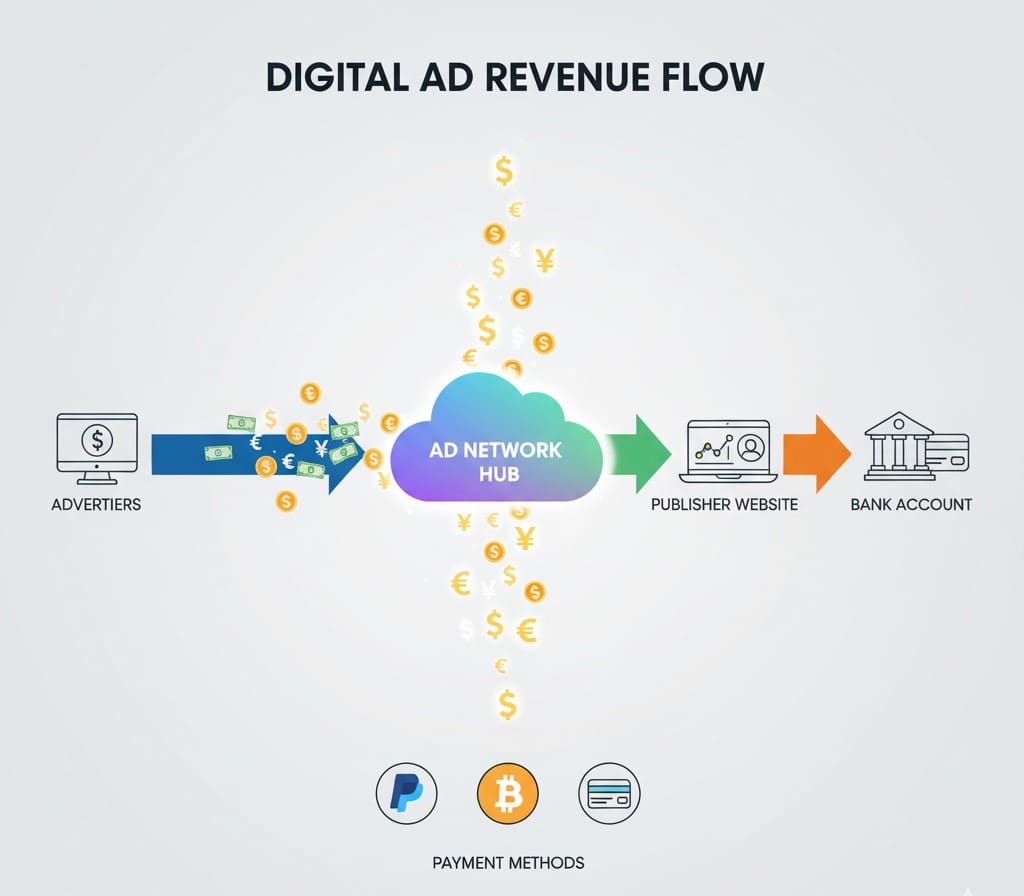
If you’re a publisher monetizing your website through ad networks, understanding how you’ll actually get paid is crucial. Whether you’re just starting out or looking to optimize your revenue strategy, knowing the ins and outs of ad network payments can help you make smarter decisions and avoid costly mistakes.
In this comprehensive guide, we’ll walk you through everything you need to know about how ad networks pay publishers—from payment models and methods to schedules and troubleshooting common issues.
Understanding Ad Network Payment Basics
Before diving into the specifics, let’s establish what we’re talking about. Ad networks act as intermediaries between advertisers who want to display ads and publishers (like you) who have website traffic to monetize. When visitors view or interact with ads on your site, you earn revenue—but how that revenue gets calculated and delivered varies significantly.
The payment process involves several stages: ad serving, impression or click tracking, data verification, revenue calculation, and finally, the actual payment transfer. Understanding each stage helps you set realistic expectations and troubleshoot issues when they arise.
Image Suggestion: Simple flowchart showing: User visits your site → Ad loads → Impression/click tracked → Revenue calculated → Payment processed → Money in your account.
Common Ad Network Payment Models
Ad networks use different pricing models to determine how much you’ll earn. Let’s break down the most common ones:
CPM (Cost Per Mille) – Payment Per 1,000 Impressions
CPM is one of the most straightforward payment models. You get paid based on the number of times ads are displayed on your site, regardless of whether visitors click on them. The “mille” is Latin for thousand, so if you have a $2 CPM rate and serve 50,000 ad impressions, you’d earn $100 (50,000 ÷ 1,000 × $2).
CPM rates vary dramatically based on your niche, audience quality, and geographic location. Finance and technology sites often command $5-$15 CPMs, while entertainment sites might see $1-$3 CPMs. Display ad networks like Google AdSense and Media.net primarily use CPM-based calculations.
CPC (Cost Per Click) – Payment Per Ad Click
With CPC payment models, you only earn money when visitors actually click on ads. The advantage? Individual clicks can be worth more than impressions. The downside? You need engaged visitors who are willing to click.
CPC rates depend heavily on advertiser demand for your audience. Clicks from visitors researching high-value purchases (like insurance or legal services) can be worth several dollars, while clicks in saturated niches might only generate a few cents. Your click-through rate (CTR) becomes crucial with this model.
Revenue Share Models
Some ad networks, particularly premium ones, use revenue share arrangements where you receive a percentage of what advertisers pay. Common splits range from 68/32 to 80/20 in the publisher’s favor. This model can be lucrative if you’re working with high-quality advertisers, as you benefit when ad prices increase.
The key advantage is alignment of interests—the network makes more money when you do. However, transparency varies, and it’s not always clear exactly what advertisers are paying.
Image Suggestion: Three-column comparison chart showing CPM, CPC, and Revenue Share models with example calculations, pros/cons, and ideal use cases.
How Publishers Actually Receive Payments
Now let’s talk about the practical side: how does money actually reach your bank account? Ad networks offer various payment methods, each with different speeds, fees, and availability.
PayPal: The Fast and Flexible Option
PayPal is popular among publishers for good reason. Payments typically arrive within 1-3 business days after being processed, and setup is straightforward. However, PayPal charges transaction fees (usually 2-3% for domestic transfers), and some countries have restricted access.
For smaller publishers just reaching their first payment threshold, PayPal’s speed and low minimum requirements make it an excellent starting choice.
Wire Transfer: For International Publishers
If you’re outside the US or receiving larger payments, wire transfers might be your go-to method. While they work globally, expect to pay $15-$50 per transfer in bank fees. Processing takes 3-7 business days, and you’ll need your bank’s SWIFT code and other international banking details.
The upside? No transaction percentage fees, making wire transfers cost-effective for larger payments (typically over $500).
Direct Deposit (ACH): The US Standard
For US-based publishers, direct deposit via ACH is often the best option. It’s free, secure, and typically processes within 2-5 business days. You’ll need to provide your bank routing number and account number, but once set up, payments arrive automatically.
Most major networks like Google AdSense offer direct deposit as the primary payment method for domestic publishers.
Alternative Payment Processors
Services like Payoneer have gained traction, especially among international publishers. Payoneer offers multi-currency support, lower fees than traditional wire transfers, and virtual bank accounts that make receiving payments from US-based ad networks easier.
Image Suggestion: Comparison table showing payment methods with columns for: Speed, Fees, Countries Available, Minimum Amount, and Best For.
Understanding Payment Schedules and Thresholds
Here’s where many new publishers get confused: just because you earned $50 in January doesn’t mean you’ll see that money in February.
Payment Terms Explained: Net-30, Net-60, and Beyond
Most ad networks operate on “net” payment terms. Net-30 means you’ll receive payment 30 days after the end of the month you earned the revenue. So earnings from January would be paid at the end of February or early March.
Google AdSense, for example, processes payments around the 21st-26th of each month for the previous month’s earnings (assuming you’ve met the threshold). Media.net uses Net-30 terms, while some networks extend to Net-60 or even Net-90.
Why the delay? Networks need time to verify traffic quality, detect invalid clicks or impressions, reconcile with advertisers, and process payments across thousands of publishers.
The Payment Threshold Challenge
Almost every ad network has a minimum payout amount—typically ranging from $10 to $100. Until your earnings reach this threshold, your balance simply accumulates. For new publishers with modest traffic, reaching that first $100 threshold can take several months.
Google AdSense and Media.net both require $100, while smaller networks like PropellerAds start as low as $5 for certain payment methods. Ezoic has a more accessible $20 threshold, making it friendlier for growing publishers.
Image Suggestion: Calendar-based timeline graphic showing: Earnings accumulated (January) → Verification period (February) → Payment processing (Early March) → Funds received (Mid March) for a Net-30 payment cycle.
The Complete Payment Processing Journey
Let’s walk through what happens behind the scenes from the moment an ad loads on your site until money hits your account.
Phase 1: Ad Serving and Tracking
When someone visits your site, your ad network’s code sends a request. Within milliseconds, an auction occurs where advertisers bid to show their ads. The winning ad displays, and the impression is recorded. If someone clicks, that’s tracked too. All of this happens in real-time.
Phase 2: Verification Period
This is where things slow down. Ad networks spend 15-30 days verifying that your traffic is legitimate. They’re checking for bot traffic, click fraud, accidental clicks, and other invalid activity. Advertisers also confirm that conversions are genuine.
During this period, you’ll see “estimated earnings” in your dashboard. These aren’t final—adjustments for invalid traffic can reduce your final payment.
Phase 3: Revenue Calculation
Once verification completes, the network calculates your final payment. This includes applying any adjustments for invalid traffic, deducting the network’s commission, and accounting for currency conversions if applicable.
Phase 4: Payment Transfer
Finally, the network initiates your payment based on your chosen method. PayPal payments process quickly, while checks can take 2-3 weeks to arrive by mail. You’ll typically receive an email notification when payment is sent.
Image Suggestion: Four-stage progress visualization showing each phase with icons (server, magnifying glass, calculator, bank) and typical timeframes for each stage.
Common Payment Issues and Solutions
Even with established publishers, payment issues occasionally arise. Here’s how to handle the most common ones:
Missing or Delayed Payments
First, confirm you’ve actually reached the payment threshold and that the payment date has passed according to the network’s terms. Check your payment information is correct—a typo in your PayPal email or bank account number will cause delays.
If everything looks correct and payment is more than 7-10 days late, contact publisher support with your account details and expected payment date. Most issues resolve within a few days.
Earnings Discrepancies
Notice your final payment is lower than your dashboard showed? This usually comes down to invalid traffic deductions. Ad networks are conservative about what they pay for, and if 5-10% of your traffic gets flagged as questionable, that comes out of your earnings.
Currency conversion and payment processing fees also reduce your final amount. A $100 payment sent via PayPal might arrive as $97 after fees.
Account Holds
Your account might get placed on hold for policy violations, suspicious traffic patterns, or incomplete tax documentation. If this happens, respond quickly to any verification requests, provide requested documents, and avoid defensive communication with support teams.
Most holds resolve within 2-3 weeks if you cooperate with the review process.
Image Suggestion: Troubleshooting flowchart: “Payment Issue?” → Check threshold → Verify payment info → Review account status → Wait appropriate time → Contact support (with decision points at each stage).
Maximizing Your Ad Revenue Payments
Understanding payment mechanics is one thing—optimizing your earnings is another. Here are practical strategies:
Focus on Traffic Quality Over Quantity
High-quality, engaged visitors from valuable demographics command higher CPM rates. A thousand visitors from the US interested in financial products might generate 5-10x more revenue than the same number of low-engagement visitors from tier-3 countries.
Invest in content that attracts your target audience rather than chasing viral traffic that doesn’t convert.
Optimize Ad Placements
Where you place ads dramatically affects earnings. Above-the-fold placements typically earn more than those buried at page bottom. Test different positions and formats to find what works for your layout and audience.
Balance revenue optimization with user experience—aggressive ad placement might boost short-term earnings but hurt long-term traffic growth.
Consider Multiple Ad Networks
Don’t put all your eggs in one basket. Using header bidding or working with multiple networks creates competition for your ad inventory, often increasing effective CPMs by 20-50%.
Just ensure you’re not violating any exclusivity clauses and that you can manage the complexity of multiple payment schedules.
Image Suggestion: Before/after website mockup showing poor ad placement (low earnings) vs. optimized placement (higher earnings) with revenue impact percentages.
Tax Considerations for Publishers
Here’s something many new publishers overlook: ad network earnings are taxable income.
If you’re a US-based publisher earning over $600 annually, you’ll receive a 1099 form and need to report this income. Many publishers qualify as self-employed, meaning you’ll also owe self-employment tax (about 15.3%) in addition to regular income tax.
International publishers face their own challenges. You’ll typically need to complete a W-8BEN form, and the US may withhold 30% of your earnings unless your country has a tax treaty reducing this rate.
Keep detailed records of your earnings from each network, save all payment confirmations, and consider consulting with a tax professional familiar with online income.
Image Suggestion: Simple tax checklist graphic with icons for: Complete W-9/W-8BEN → Track all earnings → Save payment records → Report on tax return → Consider quarterly estimated payments.
Major Ad Networks: Payment Comparison
Let’s compare payment terms for some of the most popular networks:
Google AdSense: $100 threshold, monthly payments (21st-26th of month), offers PayPal, direct deposit, wire transfer, and checks depending on country. Payments typically arrive within 7 days of processing.
Media.net: $100 threshold, Net-30 terms, PayPal and wire transfer available. Known for reliable payments to international publishers.
Ezoic: $20 threshold (lowest among premium networks), multiple payment methods including Payoneer and Tipalti. Generally processes payments faster than industry standard.
PropellerAds: As low as $5 minimum, weekly payment option available, accepts cryptocurrency. Good for publishers wanting faster payment cycles.
Understanding each network’s specific terms helps you choose the best fit for your cash flow needs and geographic location.
Image Suggestion: Side-by-side comparison cards showing 4-5 major ad networks with their key payment details: threshold, payment method, schedule, and geographic availability.
Future of Ad Network Payments
The industry continues evolving toward faster, more transparent payments. We’re seeing trends like:
- On-demand withdrawals: Some networks now let publishers access earned revenue immediately rather than waiting for monthly cycles
- Cryptocurrency options: More networks accepting Bitcoin and stablecoins for instant, low-fee international transfers
- AI-powered fraud detection: Faster verification periods as machine learning improves invalid traffic detection
- Blockchain transparency: Emerging solutions that let publishers verify earnings in real-time
These innovations address publishers’ biggest complaints: slow payment cycles and lack of transparency. As competition among ad networks intensifies, payment terms will likely continue improving.
Conclusion: Taking Control of Your Ad Revenue
Understanding how ad networks pay publishers isn’t just about knowing when money arrives—it’s about making strategic decisions that maximize your earnings and minimize headaches.
Remember these key takeaways:
- Payment models (CPM, CPC, revenue share) affect how much you earn and when
- Payment methods vary in speed, fees, and availability by country
- Most networks use Net-30 or Net-60 terms, meaning significant delays between earning and receiving money
- Payment thresholds can delay your first payment, especially for new publishers
- Traffic quality matters more than quantity for sustainable revenue
- Tax obligations exist regardless of payment method or network
Start by choosing an ad network whose payment terms align with your needs. Set up your payment information carefully, keep detailed records, and don’t hesitate to contact support when issues arise.
As your traffic grows, revisit your monetization strategy regularly. What works at 10,000 monthly visitors may not be optimal at 100,000. Stay informed about new networks and payment innovations that could improve your revenue.
The path from ad impression to payment isn’t always straightforward, but with the knowledge from this guide, you’re well-equipped to navigate it successfully.
Frequently Asked Questions
How long does it take to receive my first payment from an ad network?
Your first payment typically arrives 60-90 days after you start earning. This includes your initial earnings period (usually a full month), the network’s payment term (Net-30 or Net-60), and processing time (3-7 days). You must also reach the minimum payment threshold before any payment is issued. For example, if you start in January and the network uses Net-60 terms with a $100 threshold, and you reach $100 by end of January, you’d receive payment in early April.
What happens if I don’t reach the minimum payment threshold?
Your earnings simply roll over to the next payment period. The funds remain safely in your account and continue accumulating month after month until you reach the threshold. There’s no time limit or expiration on these earnings. Once you hit the minimum amount, the payment will be processed according to the network’s normal schedule. This rollover system protects both publishers and networks from processing numerous tiny payments.
Can I change my payment method after setting it up?
Yes, most ad networks allow you to change payment methods anytime through your account settings. However, changes typically only apply to future payments, not ones already being processed. Some networks require verification for new payment methods and may need 24-48 hours to approve changes. It’s best to update payment information at least one week before your scheduled payment date to avoid delays. You may need to re-verify your identity or provide additional documentation when switching methods.
Why is my payment less than my reported earnings?
Several factors can reduce your final payment below dashboard estimates. The most common is invalid traffic deductions—ad networks filter out clicks or impressions from bots, accidental clicks, or suspicious patterns. Payment processing fees (PayPal charges 2-3%, wire transfers have flat fees) reduce your net amount. For international publishers, currency conversion and tax withholding (up to 30% for non-US publishers without tax treaty benefits) significantly impact final payments. Check your payment report for a detailed breakdown of all adjustments and deductions.
Do I need to pay taxes on ad network earnings?
Yes, ad network earnings are taxable income in virtually all countries. US-based publishers receive 1099 forms for earnings over $600 annually and must report this as self-employment income, which includes both income tax and self-employment tax (approximately 15.3%). International publishers typically complete W-8BEN forms and may face 30% US withholding unless their country has a tax treaty. You’re also responsible for any local taxes like VAT or GST. Keep detailed records of all earnings and consult with a tax professional familiar with online income in your jurisdiction to ensure compliance and optimize deductions.
