
Introduction to Copernicus and the Solar System Revolution
The history of human knowledge is marked by moments of profound disruption, but few were as radical as the shift initiated by Nicolaus Copernicus. For over a millennium, humanity lived under the comforting but incorrect assumption that the Earth was the immovable center of all things. The copernicus solar system model shattered this ego-centric illusion, replacing it with a universe where our world was merely one of many orbiting a central star.
This transition was not merely a change in mathematical calculations; it was a fundamental reimagining of our place in the cosmos. Copernicus dared to challenge the established religious and scientific dogmas of the 16th century, sparking what we now call the Copernican revolution in astronomy. By placing the Sun at the center, he provided the framework for everything from the laws of planetary motion to the eventual exploration of deep space.
The Geocentric View Before Copernicus (Pre-1543)
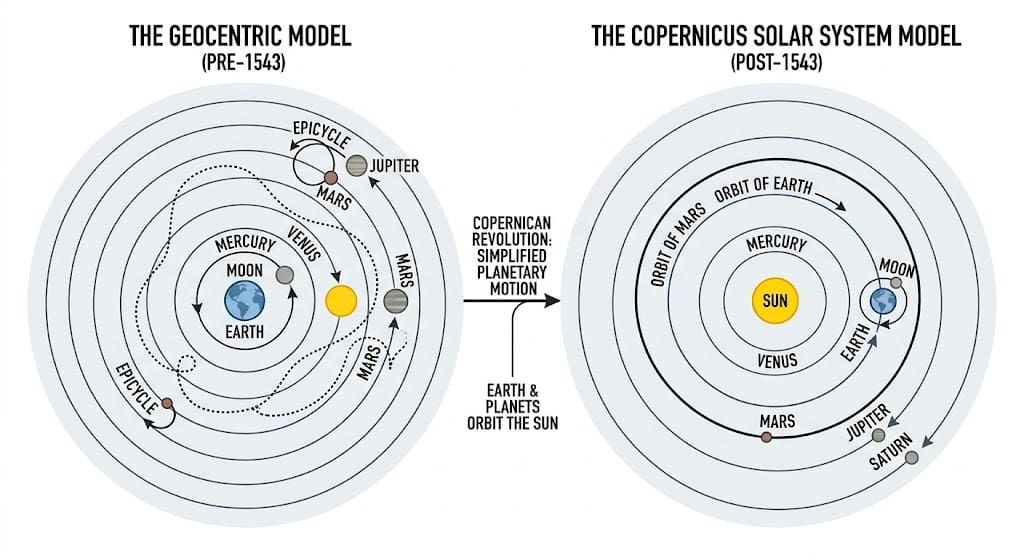
To understand the impact of the copernicus solar system model, we must first look at the world he inherited. For nearly 1,500 years, the Western world adhered to the Ptolemaic system, a geocentric model developed by Claudius Ptolemy in the 2nd century.
In this system, the Earth sat perfectly still at the center of the universe. Surrounding it were concentric crystalline spheres that carried the Moon, the Sun, and the known planets. To account for the “retrograde motion” (where planets appear to move backward in the sky), astronomers used “epicycles”—complex circles within circles. While mathematically ingenious, it was increasingly cumbersome.
The geocentric model was deeply intertwined with Aristotelian physics and Catholic theology, which suggested that the heavens were perfect and the Earth was the realm of change and decay. Any challenge to this view was not just a scientific disagreement; it was seen as a challenge to the divine order of the universe.
Copernicus and the Birth of the Heliocentric Theory (1543)
Nicolaus Copernicus, a Polish cleric and polymath, spent decades quietly observing the heavens and refining his mathematics. He realized that the complexities of the Ptolemaic system could be simplified if one dared to swap the positions of the Earth and the Sun. This was the birth of the copernicus solar system model, a sun centered solar system that prioritized mathematical harmony over traditional dogma.
In his seminal work, he outlined that the Earth rotates on its axis once a day and revolves around the Sun once a year. This was a radical departure from the status quo. To share his findings, he authored one of the most significant books of copernicus (de revolutionibus), titled De revolutionibus orbium coelestium (On the Revolutions of the Heavenly Spheres).
Aware of the potential backlash from the Church, Copernicus was hesitant to publish. The book was finally printed in 1543, allegedly reaching him on his deathbed. His work provided the first modern technical argument for a heliocentric vs geocentric model, changing the course of history forever.
Understanding Planetary Motion in the Copernican Model
The brilliance of the copernicus solar system model lay in its ability to explain natural phenomena more elegantly than its predecessor. One of the greatest mysteries of early modern astronomy was why planets like Mars seemed to slow down and move backward periodically.
Copernicus explained that this “retrograde motion” was merely an optical illusion. Because Earth orbits the Sun at a different speed than other planets, we occasionally “overtake” them in our orbit, making it look like they are moving backward.
“In the center of all rests the Sun. For who would place this lamp of a very beautiful temple in another or better place than this wherefrom it can illuminate everything at the same time?” — Nicolaus Copernicus
While his model still used circular orbits (rather than the elliptical ones discovered later by Kepler), his focus on planetary motion around the sun allowed for a much more accurate calculation of the relative distances of the planets. It was a masterpiece of Renaissance astronomy discoveries that replaced chaos with a structured, logical system.
Evidence Supporting the Sun-Centered Universe
The copernicus solar system model was not immediately accepted by everyone. It required a leap of faith and further empirical evidence. During the 16th and 17th centuries, the history of heliocentric theory was bolstered by the invention of the telescope.
Galileo Galilei’s observations of the phases of Venus provided the “smoking gun” for the Copernican system astronomy. If Venus orbited the Earth, it would never show a full range of phases like the Moon. However, Galileo saw Venus go through full phases, proving it must orbit the Sun.
Furthermore, the discovery of moons orbiting Jupiter proved that not everything in the universe revolved around the Earth. These findings transformed the copernicus’ heliocentric model from a mathematical hypothesis into an observable reality. These early modern astronomy breakthroughs slowly dismantled the wall of geocentrism.
[Image comparing geocentric and heliocentric planetary phases]
Influence on Renaissance Astronomers (1550–1650)
The copernicus solar system model acted as a catalyst for a golden age of discovery. Renaissance astronomers were no longer content with ancient texts; they wanted to measure the heavens for themselves.
- Tycho Brahe: While he didn’t fully accept heliocentrism, his incredibly accurate data on planetary positions became the foundation for later proof.
- Johannes Kepler: Using Brahe’s data and the Copernican framework, Kepler realized that planets move in ellipses, not perfect circles. This corrected the minor inaccuracies in the original copernicus solar system model.
- Galileo Galilei: As mentioned, his telescopic evidence made the heliocentric theory impossible to ignore, despite his subsequent house arrest by the Inquisition.
These thinkers took the baton from Copernicus, ensuring that the Copernican revolution in astronomy would gain unstoppable momentum.
Copernicus and the Scientific Revolution
The impact of the copernicus solar system model extended far beyond the stars. It is often cited as the starting point of the Scientific Revolution. By proving that the senses (which see the Sun “move” across the sky) could be deceiving, Copernicus encouraged a new era of skepticism and empirical investigation.
The scientific revolution astronomy movement shifted the source of truth from religious scripture to observation and mathematical proof. This “Copernican Turn” influenced other fields, including physics, medicine, and philosophy. It taught humanity that to find the truth, one must be willing to question even the most deeply held “obvious” beliefs.
The copernicus astronomy discoveries laid the groundwork for Isaac Newton’s law of universal gravitation. Newton eventually explained why the planets orbited the Sun, providing the physical mechanism for the model Copernicus had described mathematically over a century earlier.
Impact on Modern Astronomy and Space Science
Today, the copernicus solar system model is the bedrock of all space exploration. Our ability to send probes to Mars, land on the Moon, and launch the James Webb Space Telescope depends on the fundamental understanding that we live in a heliocentric system.
Modern astrophysics has expanded on Copernicus’s ideas, revealing that not only is the Earth not the center of the solar system, but our Sun is just one of billions of stars in the Milky Way, which is just one of billions of galaxies.
Every time we calculate a launch window for a satellite or map the trajectory of a comet, we are utilizing the legacy of the copernicus solar system model. He didn’t just give us a map of the planets; he gave us a new way to see the truth. His courage to publish books of copernicus (de revolutionibus) ensured that science would forever be a pursuit of objective reality rather than comfortable myths.
Frequently Asked Questions (FAQs)
1. Why was the copernicus solar system model so controversial?
It was controversial because it contradicted both the prevailing scientific views of Ptolemy and the religious interpretations of the Bible, which suggested the Earth was stationary. It was seen as a threat to the social and spiritual order of the time.
2. What is the difference between the heliocentric and geocentric models?
The geocentric model places the Earth at the center of the universe with all celestial bodies revolving around it. The heliocentric model, popularized by the copernicus solar system model, places the Sun at the center, with Earth and other planets orbiting it.
3. Did Copernicus prove his theory during his lifetime?
No, Copernicus presented it as a mathematical model that was simpler and more logical. Definitive physical proof didn’t arrive until the 17th century with Galileo’s telescopic observations and Newton’s laws of gravity.
4. What was the name of the main book written by Copernicus?
The primary work was titled De revolutionibus orbium coelestium (On the Revolutions of the Heavenly Spheres), often cited as one of the most important books of copernicus (de revolutionibus) in history.
5. How did Copernicus explain the seasons?
He explained that the Earth’s tilt on its axis as it orbits the Sun causes the changing angles of sunlight, which creates the seasons. This was a much more natural explanation than those offered by geocentric models.
Conclusion
Nicolaus Copernicus was a radical visionary who looked at the sky and saw a truth that others were too afraid to acknowledge. The copernicus solar system model was the spark that ignited the modern world, ending the stagnation of the Middle Ages and ushering in an era of enlightenment.
By moving the Earth from the center of the universe, he paradoxically elevated the human mind, proving that we have the capacity to understand the vast, complex mechanics of the cosmos. As we look toward the future of space travel and the search for exoplanets, we remain indebted to the man who first told us that we are all travelers on a moving world, orbiting a magnificent sun.