

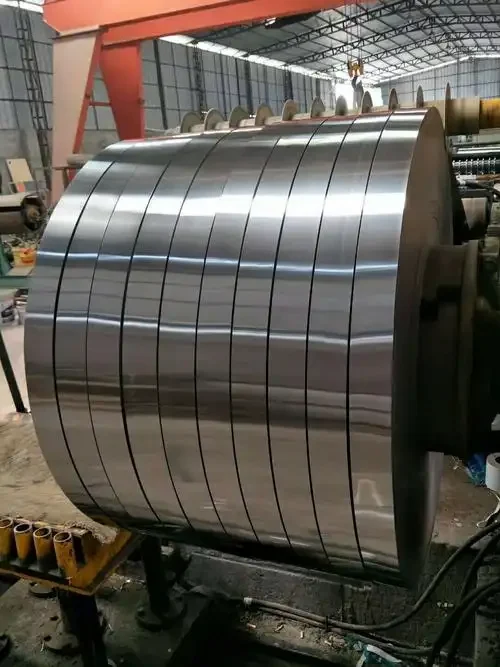
The transformation of a rugged, oxidized hot-rolled slab into a mirror-bright, paper-thin Cold Rolled Stainless Steel Coil is one of the most complex journeys in metallurgy. This process doesn’t just change the shape of the metal; it re-engineers its internal crystalline structure to achieve extreme strength and surface perfection.
Whether you are sourcing material for aerospace components or decorative kitchenware, understanding the manufacturing process of cold-rolled stainless steel is essential for selecting the right finish and grade.
Step 1: The Raw Material – Hot-Rolled Black-Skin Coil
The journey begins with a “Black-Skin” coil. These are typically 3–6 mm thick and have been processed at temperatures reaching 1250°C. At these heats, the metal reacts with oxygen to form a thick, dark crust of magnetite and chromium oxide. This scale is incredibly hard—nearly as tough as corundum—and must be removed before any precision work can begin.
Step 2: Bell Annealing (BAF) – Healing Internal Stresses
Before the steel can be thinned, it must be “softened.” The Bell Annealing process involves placing the entire coil under a massive, pressurized hood filled with a hydrogen-nitrogen mix.
By heating the coil to 1050–1100°C, we redissolve carbides into the austenitic matrix. This “heals” the uneven stresses left over from hot rolling, restoring the ductility needed for the high-pressure rolling steps ahead.
Step 3: Descaling & Pickling (HAPL)
To protect the expensive rollers in the cold mill, the black scale must be entirely stripped away. This is a two-stage process:
- Mechanical Descaling: Shot blasting or steel brushes crack the scale.
- Chemical Pickling: A bath of nitric and hydrofluoric acids dissolves the remaining oxides.
The result is a “White-Skin” coil, also known as a No. 1 Finish, characterized by a clean, silvery-matte appearance.
Step 4: The Heart of the Process – Cold Rolling (CRM)
This is where the magic happens. Unlike hot rolling, this occurs at room temperature. The steel is forced through a series of high-precision mills:
- 12-High Mills: Used for “roughing,” taking the 6 mm strip down to about 2 mm.
- 20-High (Sendzimir) Mills: These use very small work rolls to apply massive localized pressure. This allows us to reach gauges as thin as 0.02 mm stainless steel foil.
The Work Hardening Effect: As the steel is compressed, its grains flatten and dislocations multiply. The metal becomes significantly harder and stronger—a phenomenon known as work hardening. To keep the metal from becoming brittle and snapping, it must undergo intermediate annealing cycles.
Step 5: The “Fork in the Road” – Choosing Your Finish
After the final rolling pass, the manufacturer chooses between two distinct paths that define the product’s market value:
Path A: CAPL (The 2B Finish)
The strip is annealed and then pickled again. This creates the 2B Finish—the industry standard. it is silver-gray, slightly reflective, and perfect for most industrial applications.
Path B: Bright Annealing (The BA Finish)
The strip is annealed in a 100% pure hydrogen environment. Because no oxygen touches the metal, no scale forms, and no pickling is needed. This results in the BA Finish—a mirror-like, highly reflective surface often seen in high-end appliances and precision stainless steel foil products.
Step 6: Skin Pass & Leveling (SPM)
Even after annealing, the coil might have “orange peel” textures or slight waviness. The Skin Pass Mill applies a tiny amount of pressure (0.5–2% reduction) to:
- Eliminate the yield plateau (preventing stretch marks during stamping).
- Correct flatness issues.
- Imprint the final desired surface texture.
Step 7: Final Slitting and Finishing
Finally, the wide master coil is divided into its commercial forms:
- CTL (Cut-to-Length): Flat sheets for laser cutting or bending.
- STL (Slitting): Narrow stainless steel strips used for pipe welding or spring manufacturing.
- TLL (Tension Leveling): Ultra-flat coils for high-precision continuous stamping.
Summary
The production of Cold Rolled Stainless Steel is a delicate balance of brute force and chemical precision. From the initial “black-skin” descaling to the final mirror-bright annealing, every step is designed to enhance the metal’s performance.
For more technical insights on selecting the right stainless steel heat treat foil thickness or understanding alloy differences, visit our stainless steel foil blog.
A Note from Ewan: I’m the CEO of stainlesssteelfoil.com. With over 30 years of experience in the Chinese manufacturing sector, I’ve seen firsthand how these processes have evolved to meet global standards. If you have questions about custom slitting or high-grade finishes, feel free to contact us!